


Remember the day we went to battle
At 94 years old, signalman Pham Phu Thuyen, from residential area 4, Thanh Binh ward, Dien Bien Phu city, remains remarkably sharp-minded. Memories of his early days in the army and his participation in military campaigns are still deeply etched in his mind, expressed through his poems. During a meeting to honor Dien Bien Phu veterans in Thanh Binh ward (Dien Bien Phu city), we had the opportunity to listen to the simple, heartfelt verses of signalman Pham Phu Thuyen.
In 1950, young Pham Phu Thuyen left his hometown of Thai Binh to join the army. In the moment of parting with his relatives, family, and especially his elderly mother back home, he composed the poem: "Farewell, Old Mother." The verses are simple yet full of poignant emotion: "1950 - Farewell, old mother / Leaving behind a lonely house / My mother stands and sits / Unable to speak, tears fall in two streams /… My mother whispers / When the war is over, I will return to you, mother…" The feelings of a son leaving his homeland for the first time cannot help but evoke longing for family, relatives, friends, and his hometown.
Stepping onto the battlefield at the young age of 20, Mr. Thuyen felt an even deeper longing for his homeland. From the banana groves, rows of betel nut trees, small rivers, streams, moss-covered village communal houses, and classmates, he concluded his journey with two lines of poetry affirming his patriotism and determination to fight wholeheartedly for his country and people, making every place his homeland: "But then everything is far away / A hundred regions of the country are all my homeland."
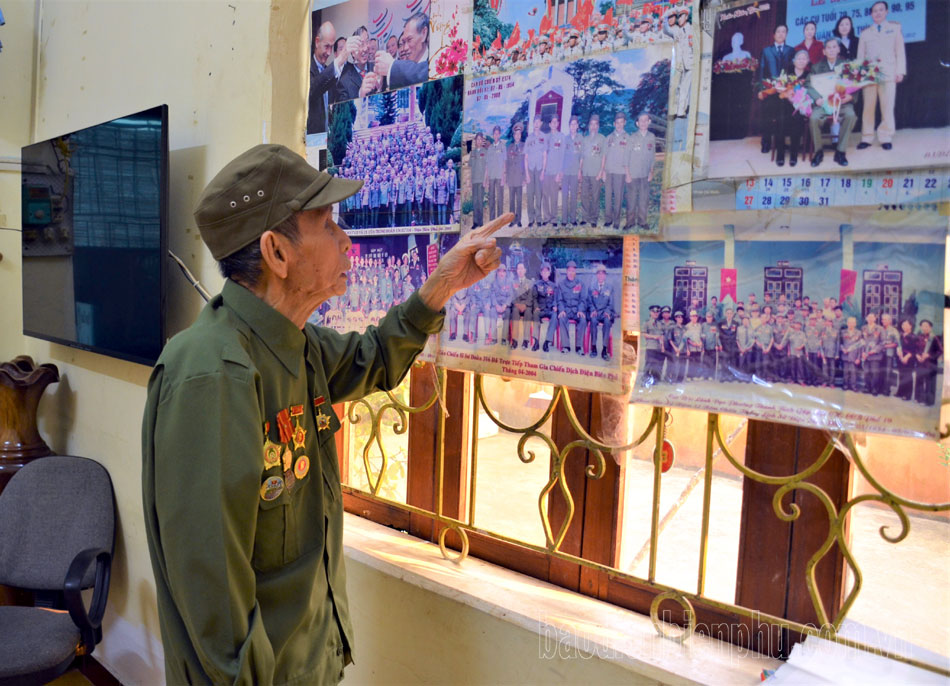
Former Dien Bien Phu Thuyen shared: “Although I’m not a professional poet, I’ve written many poems. Besides the poem ‘Farewell to My Old Mother,’ I’ve written many other poems and recorded them in my diary. Even during the fighting, I still wrote verses for my comrades. However, the diary has deteriorated due to the elements and is no longer preserved; I only remember a few poems in my head!”
Battle Diary
During the Dien Bien Phu Campaign, Mr. Thuyen was assigned to Company 151, Regiment 174, Division 316. At that time, Regiment 174 was tasked with destroying the A1 hill stronghold. Unlike his comrades, Mr. Thuyen did not directly carry a weapon, but in the Dien Bien Phu Campaign, signal soldiers like him played an extremely important role in organizing and ensuring communication for a large-scale combined arms offensive, defeating the enemy's fortified stronghold defenses.

At that time, the communications forces were present in the infantry divisions (304, 308, 312, 316) and the 351st Artillery Division, each division having its own Communications Department. Particularly during the fierce fighting in the A1 Hill area, communications soldiers like Mr. Thuyen bravely and creatively maintained their positions, holding their ground at the openings and battlefields; ensuring communication for the command and working alongside the infantry to eliminate the enemy.
Mr. Thuyen recalled: “In my communications duties, I was closely associated with the radio equipment alongside our troops during the offensive campaign. At that time, there were no telephones like there are now. Besides radio communication, the communications soldiers had to carry radios with wired communication cables attached, following their company commanders to ensure uninterrupted communication. When the cable was broken, the soldiers on urgent duty had to trace the line to the location of the break to reconnect it. The communication lines were repeatedly damaged and broken by artillery fire, so the soldiers had to be brave, resourceful, creative, and quick to find ways to restore the lines and ensure uninterrupted communication.”

At this point, Mr. Thuyen's voice softened as he confided, "Although I didn't directly fight on the front lines, five of my comrades fell in the campaign to bring about victory in this historic battle." One day after the Dien Bien Phu victory (May 8, 1954), Dien Bien Phu soldier Pham Phu Thuyen composed the poem "Diary of a Night Battle" to remember his comrades: "Tonight, the unit attacks the outpost / Our guns and enemy guns roar loudly / The guns fall silent at dawn / Checking the troop count, who didn't return / Victory in battle, but heartbroken / Some went, some didn't return…" Despite the losses and sacrifices, the Dien Bien Phu soldiers fought selflessly to bring independence and freedom to the nation today. The pain in the verses of communications soldier Pham Phu Thuyen serves as a reminder to future generations of the sacrifices and losses of their ancestors to achieve the glorious victory that "shook the world and resonated across the five continents."
As the whole nation commemorates the 70th anniversary of the Dien Bien Phu Victory, every Vietnamese person is grateful for and deeply remembers the contributions and sacrifices of their ancestors. The example of the Dien Bien Phu soldiers in particular, and Vietnamese national heroes in general, has become a source of pride, inspiring future generations with a spirit of patriotism; this includes the courageous, resourceful, proactive, and creative communications soldiers like Dien Bien Phu soldier Pham Phu Thuyen, who contributed to the glorious victory on the Dien Bien Phu battlefield.
Source
![[Photo] My Son at night: A thousand-year-old heritage site amidst the Milky Way](https://vphoto.vietnam.vn/thumb/1200x675/vietnam/resource/IMAGE/2026/04/15/1776261039184_ndo_br_chon6-jpg.webp)
![[Photo] Mrs. Ngo Phuong Ly meets and exchanges views with Mrs. Peng Li Yuan](https://vphoto.vietnam.vn/thumb/1200x675/vietnam/resource/IMAGE/2026/04/16/1776277858080_phu-nhan-1-jpg.webp)
![[Photo] National Assembly Chairman Tran Thanh Man attends the opening session of IPU-152](https://vphoto.vietnam.vn/thumb/1200x675/vietnam/resource/IMAGE/2026/04/16/1776277863731_ctqh5-jpg.webp)
![[Photo] The General Secretary, President and his wife meet with Vietnamese-Chinese friendship leaders.](https://vphoto.vietnam.vn/thumb/1200x675/vietnam/resource/IMAGE/2026/04/15/1776264829725_vna-potal-tong-bi-thu-chu-tich-nuoc-to-lam-gap-mat-nhan-sy-huu-nghi-viet-nam-trung-quoc-8703641-3130-jpg.webp)








































































Comment (0)