

Gold surged past the $2,400/ounce mark.
At the start of trading on July 11th (night of July 11th in Vietnam time), the spot gold price on the New York exchange surged by approximately $30 to $2,410 per ounce after the US announced that the consumer price index for June was lower than expected.
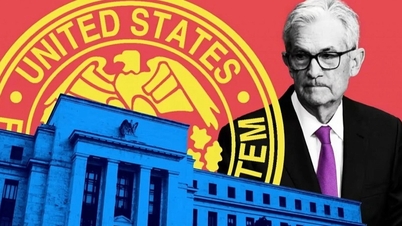
This information, along with the new policy stance shared by Federal Reserve Chairman Jerome Powell before the US House of Representatives in the previous session, immediately led investors to bet on a nearly 90% chance that the US central bank will cut interest rates in September.
According to the U.S. Bureau of Labor Statistics, the consumer price index (CPI) fell 0.1% in June after remaining flat in May. This is positive news for the U.S. economy and exceeds economists' expectations of a 0.1% increase.
Over the past 12 months, US inflation stood at 3%, lower than the expected 3.1% and lower than the 3.3% recorded in May. Core CPI (excluding energy and food prices) rose only 0.1%, compared to expectations of a 0.2% increase.
Earlier, gold had a fairly strong upward session in Asian markets after Chairman Powell unexpectedly announced that the Fed would lower interest rates without needing inflation to reach its 2% target.
This represents a significant shift in the Fed's policy stance.
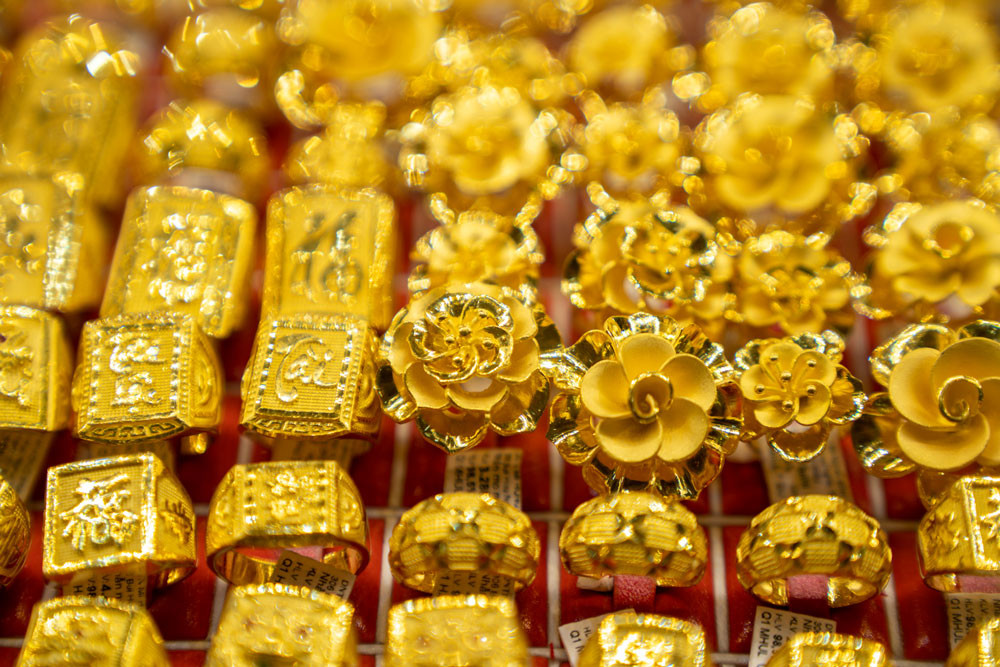
Previously, Powell consistently maintained his stance on bringing inflation down to the 2% target and believed it was achievable.
However, the situation has changed considerably. The US economy has recently begun to show more negative signs – something that many Fed officials and market analysts are concerned about. Employment figures for May were revised downward, while the unemployment rate rose in June.
During a hearing before the House Financial Services Committee on July 10th, Fed Chairman Powell stated that the Fed would not wait until inflation falls to its 2% target before cutting interest rates. He argued that waiting that long would cause inflation to fall below 2% – an undesirable outcome.
That being said, the issue that worries Powell and many Fed officials the most is the lagged impact of policy on the US economy. Keeping interest rates too high, as they are currently (5.25-5.5% per year), could lead to a recession in the US economy. The damage would then be enormous.
This is also an issue that economists have discussed extensively in recent times. However, the Fed has faced considerable difficulty in determining the appropriate time to change or reverse monetary policy.
Powell's statement this time is clearer than ever. The Fed may accept inflation higher than its decades-old target of 2%.
If the US accepts the new reality, will the price of gold rise to $3,000?
The reason for the change in the Fed's inflation target is that the US economy, as well as the global economy, has changed significantly after the Covid-19 pandemic and recent geopolitical conflicts in Ukraine, the Red Sea, the Middle East, and other regions.
Many countries around the world are grappling with rising consumer prices, while their economies are slowing down.
The world today is tending towards fragmentation. Global supply chains are also breaking down and becoming fractured. Countries tend to impose taxes on many goods to protect domestic production, rather than promoting free trade.
Recently, central banks in many countries have decided to lower interest rates and inject more money into the market to support economic growth amidst persistently high inflation, including the European Central Bank (ECB), the Central Bank of Canada, Sweden, and Switzerland...
ECB officials also raised their average inflation forecast for 2024 from 2.3% to 2.5%. For 2025, inflation was raised from 2% to 2.2%. In 2026, inflation is projected at 2.9%.
In the US, barring any major changes, the likelihood of the Fed cutting interest rates at its September 18 meeting is very high. The Fed may also cut interest rates twice this year. The US dollar is expected to weaken, thereby pushing gold prices up.
By 8:25 PM on July 11th (Vietnam time), the DXY index – which measures the fluctuations of the US dollar against six major currencies – had fallen 0.8% from the previous session to 104.2 points. The price of gold rose to $2,410 per ounce (equivalent to VND 74.7 million per tael).
In the long term, the Fed is projected to cut interest rates many more times, possibly up to 10 times. The US dollar will also face future pressure from efforts by China, Russia, and other BRICS countries to diminish its role.
A weaker US dollar will push gold prices higher. Gold is also supported by increased demand for the metal from central banks in many countries as they build up their reserves.
The Fed's interest rate cut is just one factor impacting gold. Between now and the end of the year, the world will see many important events, including the US presidential election in November. Whether Trump, Biden, or whoever else takes office is expected to influence the financial and commodity markets. More money may be injected into the economy.
Many forecasts predict gold will reach $2,500 per ounce by the end of this year. Goldman Sachs believes gold will reach $3,000 per ounce (equivalent to 93 million VND per tael) next year as the Fed enters a monetary easing cycle.
| Domestically, the price of SJC gold bars has remained stable at nearly 77 million VND/ounce (selling price) for approximately 31 consecutive sessions. The price of gold rings has risen to 76.25 million VND/ounce (selling price), only about 750,000 VND/ounce lower than the price of SJC gold bars. Compared to the beginning of the year, the price of gold rings has increased by about 13-14 million VND/ounce. |

Source: https://vietnamnet.vn/my-doi-lap-truong-gia-vang-tang-dung-dung-dich-nao-cho-2024-2300979.html


![[Image] Central Party Office summarizes work in 2025](/_next/image?url=https%3A%2F%2Fvphoto.vietnam.vn%2Fthumb%2F1200x675%2Fvietnam%2Fresource%2FIMAGE%2F2025%2F12%2F18%2F1766065572073_vptw-hoi-nghi-tong-ket-89-1204-jpg.webp&w=3840&q=75)
































































































Comment (0)