


08:39, 11/06/2023
Editor's Note: Although Dak Lak does not share a border with Laos, it has a close and deep relationship and has signed many cooperation agreements with localities in the southern region of Laos, including the provinces of Sekong, Champasak, Attapư, and Salavan.
In particular, the Lao community in Buon Don district not only contributes to the local development but also creates a unique cultural imprint in the diverse cultural landscape of the province. To introduce the history, culture, and people of Southern Laos, Dak Lak Weekend Newspaper is launching a long-running series titled "Southern Laos Chronicle," inviting readers to follow along.
Lesson 1: Afternoon Sun in Pakse
On a 29-seat bus departing from Da Nang City and crossing the Nam Giang border gate (Quang Nam province), in less than a day, I arrived in Pakse – the city and capital of Champasak province in Laos. Pakse is a transliteration from the Lao language (meaning "river mouth"), pronounced "Pak Xe" in Vietnamese.
My first impression was that Pakse resembled other cities in the Central Highlands. Although not part of the Boloven Plateau, Pakse is situated right at the confluence of the Mekong and Xedon rivers, so it's surrounded by rivers, mountains, grasslands, and forests that look like the bamboo and dipterocarp forests in Gia Lai and Dak Lak. My younger brother, who owns a brick kiln near Pakse, said: "You're right, Pakse's scenery is somewhat similar to the Central Highlands, but because it's lower, the temperature is usually higher, and it's hotter in the summer."
I arrived in Pakse late in the afternoon. The sun was no longer scorching, leaving only a lingering warmth on the sidewalks and rooftops. Looking around, I saw fairly wide streets with few tall buildings, and the traffic and pedestrians weren't overly bustling. Looking at the scenery of Pakse, I couldn't help but compare it to Buon Ma Thuot. There are similarities in history, but the pace of development is different. Originating from the policy of urban development in Indochina during the colonial conquest, in the early 20th century, around 1905-1906, Buon Ma Thuot and Pakse were planned by the French simultaneously. Now, while Buon Ma Thuot is a major city in the Central Highlands, Pakse is the fourth largest city in Laos. Despite its high ranking, due to its large land area, sparse population, and less developed socio-economic conditions, Pakse feels smaller in scale compared to Buon Ma Thuot. Pakse currently has a population of approximately 100,000, the majority of whom are of Vietnamese and Chinese descent.
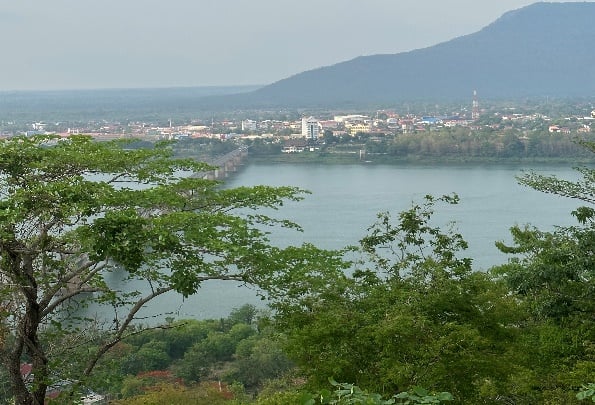 |
| View of Pakse from Wat Phusalao temple. |
Since I only stayed in Pakse for a few days, my cousin Thang took me to see many places. I must say Pakse has a beautiful location and convenient transportation. It's situated right at the confluence of the Xedon and Mekong rivers, only a few dozen to a hundred kilometers from the borders with Vietnam, Thailand, and Cambodia, and has a national road network connecting it to the capital Vientiane and the provinces of Central and Lower Laos. The climate here has two distinct seasons: rainy and dry. While the dry season brings hot winds and sunshine, the rainy season provides abundant rainfall, allowing vegetation to thrive. The people of Pakse (Lao, Vietnamese, and Chinese) are kind and gentle. On the streets, in restaurants and shops, and at tourist spots, you'll easily find friendly smiles and greetings: "Sa ba di!" (Hello!), "Khop chay lai lai!" (Thank you very much!)
Observing the people's personalities, attitudes, and urban lifestyle, I noticed that the people of Pakse are quite typical of Laotians in general: peaceful, content with their current standard of living, meaning they are not competitive or striving for material gain. My sister's friend, a Laotian of Vietnamese descent who speaks only a little Vietnamese, whose Vietnamese name is Thong and whose birth name in Lao is Bounthong Phounsavat, told me: "Laotians have always been like this. Everywhere, in every village and neighborhood, there are temples. Buddhism is present almost everywhere here. In their lives, everyone shaves their head and goes to the temple a few times, sometimes for a few days, sometimes for two or three months. People practice Buddhism for many reasons: to show filial piety to their parents, to cultivate their character, to express gratitude to life…" Indeed, throughout Pakse, every street is lined with temples in vibrant colors of yellow, white, red, and blue… characteristic of Laotian temple architecture. Within the grounds of temples or at temple gates, and along city walls, there are round stupas that taper towards the top like pyramids. In the early morning, groups of monks silently and slowly walk along the sidewalks like shadows. And along the sidewalks, many people sit neatly, with trays of food and offerings in front of them for the monks.
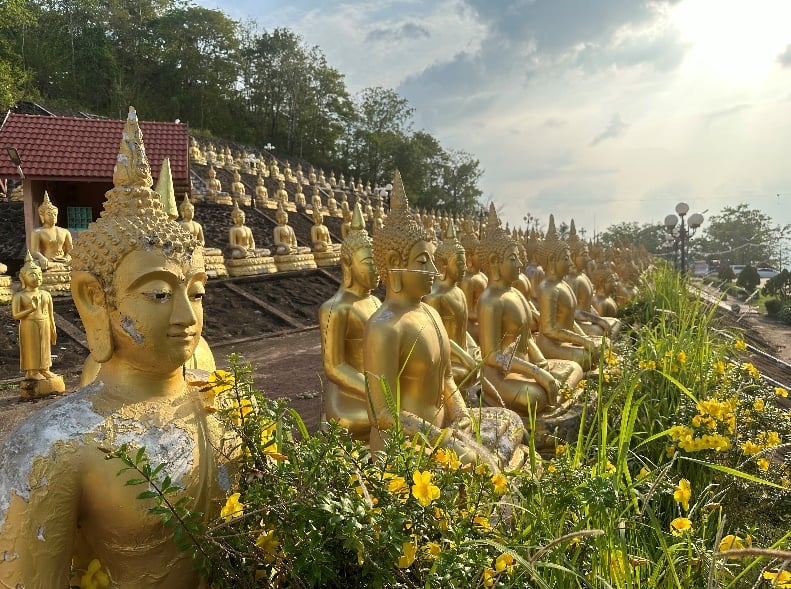 |
| The Buddha garden at Wat Phusalao temple. |
Speaking of Lao temples, I've indeed visited many famous temples in the capital Vientiane and Luang Prabang (Northern Laos), and I found the temples in Pakse to be equally remarkable and magnificent. Within the city center alone, there are many large, pristine, and beautiful temples such as Wat Phabat and Wat Loang… Among the 18 major temples in Pakse, Wat Phusalao stands out, known to the Vietnamese as the Golden Buddha Temple. The temple features a massive Buddha statue atop a hill, facing the Mekong River that meanders through the central urban area of Pakse. That afternoon, I felt as if I had taken in the entirety of a peaceful Laos, with its beautiful life and unspoiled nature.
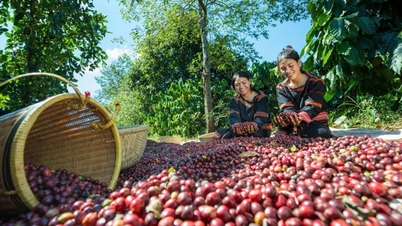
When I mentioned comparing Pakse to the major cities in the Central Highlands, Buonthong said, "Laos will continue to develop. The Central Highlands has had coffee, rubber, and fruit trees for over a hundred years, and the land is fertile, so it develops faster. Champasak province in particular, and the southern region of Laos in general, have always grown coffee and rubber, and now they are developing specialized fruit-growing areas such as durian, mangosteen, and rambutan... In the future, when the whole region develops, Pakse will also develop and become prosperous."
After just a couple of days in Pakse, I fell in love with Lao cuisine. Similar to the Central Highlands, there are dishes like grilled chicken, grilled stream fish, and dried foods like salted fish, chili, and laap... And I also fell in love with the traditional music and the graceful steps of the Lao girls in their Phon dance during a joyful evening.
On that final afternoon before leaving Pakse, by the Mekong River, the mirror-like surface softening the intense heat of the day, I pondered the connection between the sun and Pakse. Indeed, "afternoon" in Vietnamese also refers to the setting sun. But here, the afternoon sun isn't the scorching heat of the late afternoon, but rather the cool, refreshing sunlight by the Mekong. Looking down at the mirror-like river, a line of poetry suddenly came to mind, the opening line of a poem: "As the afternoon sun sets, my heart is filled with the warmth of Pakse…"
Read Part 2: The Mysterious Wat Phou
Pham Xuan Hung
Source link





































Comment (0)