

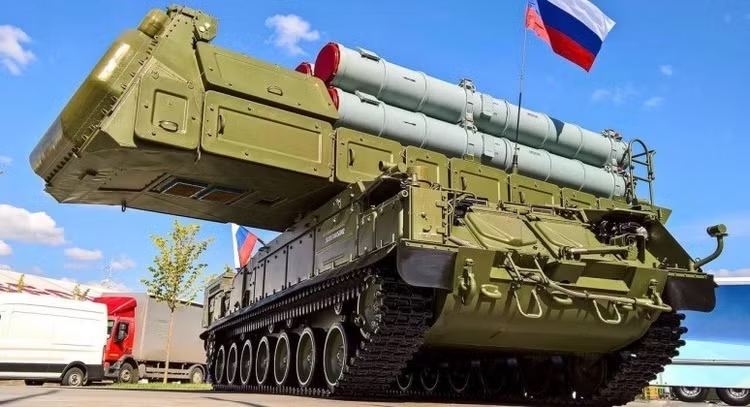
Recent reports indicate that Russian forces are effectively using the Buk-M3 air defense system to intercept attacks from the US-supplied HIMARS multiple rocket launchers to Ukraine, thereby significantly reducing the effectiveness of this weapon, which was once considered a "trump card."
According to Military Watch, the Buk-M3 system – the most modern version in the Buk series – has been widely deployed to counter high-precision attacks, particularly GMLRS guided rockets from the HIMARS system.
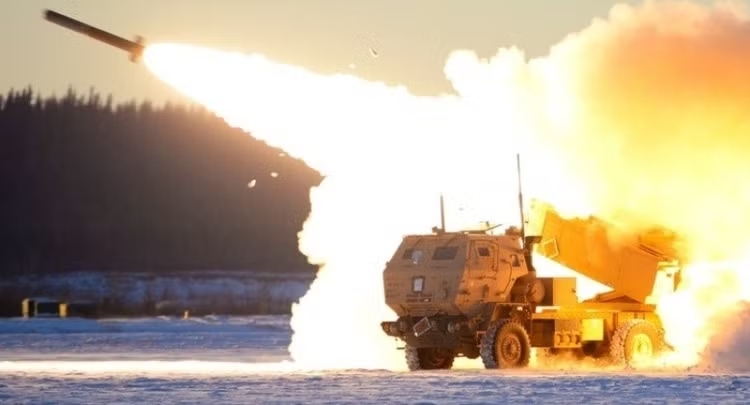
HIMARS (M142) is a highly mobile multiple rocket launcher system developed by the United States, capable of striking targets at distances up to 300 km depending on the type of ammunition, with very high accuracy thanks to GPS guidance. During the Ukraine conflict, HIMARS inflicted significant damage on Russian ammunition depots, command centers, and logistics lines.
However, the Russian side quickly adjusted its tactics and reinforced its air defenses. The Buk-M3 is designed to destroy a wide variety of airborne targets, including cruise missiles, aircraft, UAVs, and tactical rockets. This system has a range of approximately 70 km and can track and engage multiple targets simultaneously with a high probability of destruction.
A notable feature is that the Buk-M3 utilizes a modern radar and a combined guidance mechanism, enhancing its anti-jamming capabilities and its ability to counter high-speed or low-flying targets – characteristics of HIMARS rockets. This allows the system to detect and intercept the rocket early, before it reaches its target.
Russian military sources claim that the Buk-M3 has successfully intercepted HIMARS rockets on numerous occasions in the battlefield. While these claims are difficult to independently verify, the reality is that the effectiveness of HIMARS has decreased recently compared to the early stages of the conflict – a fact also acknowledged by some Western experts.
According to analyses published on VOV and TTXVN, Russia has built a multi-layered air defense network, combining systems such as the S-300, S-400, and Buk to create a "shield" against high-precision weapons. In this network, the Buk-M3 plays a crucial role in the medium-range air defense layer, protecting tactical targets and frontline forces.
In addition, Russia also deployed electronic warfare measures to jam the GPS signals of HIMARS rockets, reducing their accuracy. When combined with interception by Buk-M3, the overall effectiveness of HIMARS was significantly limited.
Nevertheless, experts believe that HIMARS remains a dangerous weapon, especially when used flexibly and in conjunction with reconnaissance systems. The confrontation between HIMARS and Buk-M3 clearly reflects the trend of "high-tech offensive and defensive" in modern warfare, where each side continuously upgrades to neutralize the other's advantages.
The Buk-M3 demonstrates Russia's effective adaptation to Western precision weapons. The combination of multi-layered air defense and electronic warfare significantly reduces the effectiveness of HIMARS. However, this "technological battle of wits" is far from over, as both sides continuously improve their tactics and equipment. This reflects a trend in modern warfare: no single weapon maintains absolute dominance for an extended period.
Source: https://khoahocdoisong.vn/nga-su-dung-he-thong-buk-m3-de-doi-pho-hieu-qua-voi-ten-lua-himars-post2149099221.html





![[Photo] General Secretary and President To Lam presides over the meeting to approve the draft report on the results of the second inspection by the Politburo of the Standing Committee of the Hanoi City Party Committee.](https://vphoto.vietnam.vn/thumb/1200x675/vietnam/resource/IMAGE/2026/05/26/1779789811432_a2-bnd-4430-9620-jpg.webp)


























































































Comment (0)