

Poet Van Trong Hung, former Director of the Department of Culture and Information of Binh Dinh province and playwright of traditional Vietnamese opera, confided: "When I was little, I used to follow my mother to watch traditional opera night after night, and I became addicted without even realizing it. Now, every time I hear the sound of the ceremonial drums somewhere, I want to run to see the opera immediately." Therefore, in Binh Dinh, there's a saying: "Hearing the war drums / I go even without being told / Hearing the urging of the ceremonial drums / I run headlong."
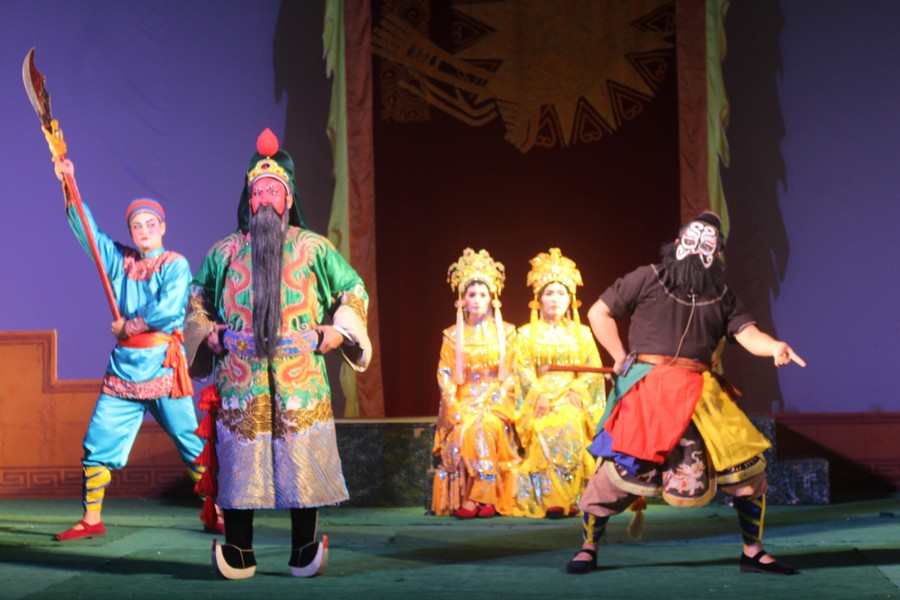
I recall that in an article in the Binh Dinh newspaper some time ago, Professor Hoang Chuong praised the late Chairman of the People's Committee of Nghia Binh province (formerly), To Dinh Co. While he was alive, Mr. Co was a lover of traditional Vietnamese opera and personally led the drumming in several performances in his hometown. His drumming was very skillful, soulful, and captivating to the audience.
During the time that To Dinh Co was in office, the Binh Dinh traditional opera troupes (both professional and amateur) received special attention and developed very strongly. Many talented artists of the opera stage also emerged. He took the Binh Dinh opera troupe to Hanoi to perform for National Assembly delegates. He also directly led the performances, receiving praise from the Party and National Assembly leaders at the time. In 2014, the traditional Binh Dinh opera was recognized as a National Intangible Cultural Heritage.
According to researchers, although it is unclear exactly when Vietnamese classical opera (tuong) was introduced to Vietnam, the first person to lay the foundation for this art form in Vietnam was Dao Duy Tu (1572-1634), during the reign of Lord Nguyen Phuc Nguyen. Later, during the Nguyen dynasty, especially under Emperor Tu Duc, the art of tuong reached its peak with the famous playwright Dao Tan (1845-1907), from Tuy Phuoc (Binh Dinh), who is considered the founder of Vietnamese tuong. Dao Tan's famous plays, such as "Van Buu Trinh Tuong," "Co Thanh," "Tram Huong Cac," and "Dien Vo Dinh," are highly praised.
During the two wars of resistance against French colonialism and American imperialism, the Party Committee of Zone V advocated for the revival of traditional Vietnamese opera (tuong), thus allowing the establishment of the Zone V Inter-Region V Tuong Troupe in 1952. In 1954, this troupe relocated to the North, establishing itself in Hanoi. After liberation (April 30, 1975), Quang Ngai and Binh Dinh provinces merged to form Nghia Binh province, and the opera artists consolidated into the Nghia Binh Tuong Troupe, which was later upgraded to the Nghia Binh Tuong Theatre; in 1988, it was renamed the Dao Tan Tuong Theatre.
Five years ago, the Dao Tan Traditional Opera Theatre merged with the Binh Dinh Bai Choi Folk Opera Troupe to form the Binh Dinh Provincial Traditional Arts Theatre. Famous artists from the Dao Tan Traditional Opera Theatre, once beloved by the public, included People's Artist Hoa Binh, People's Artist Hoang Ngoc Dinh, and People's Artist Vo Thi Tuyet Mai...
In previous years, the Dao Tan Traditional Opera Theatre made significant contributions to the development of traditional opera in all three regions of the country, both theoretically and practically. At the same time, many playwrights with unique styles have enriched the treasury of traditional opera scripts in Vietnam, from ancient times to the present. Commenting on the traditional opera scripts of playwright Van Trong Hung from Quy Nhon (Binh Dinh), with five representative scripts in the collection "Searching for the True Lord" (Theatre Publishing House, 2004), art critic Nguyen Van Thanh, Deputy Director of the Institute of Theatre, said: “Watching and reading Van Trong Hung’s plays, I feel as if I am standing before a multi-layered relief sculpture, with areas of prominence, depth, darkness, and light. If one only views it through the lens of perspective or with a simplistic, one-sided approach to art reception, one cannot penetrate the depths of the artistic world that the playwright has painstakingly and passionately created.”
Today, although the number of fans of Vietnamese traditional opera (tuong) is no longer large, especially among young people, the artistic heritage of Vietnamese traditional opera in general and Binh Dinh in particular has left an indelible mark on the public's heart.
Source: https://baogialai.com.vn/nghe-thuat-tuong-dau-an-binh-dinh-mot-thoi-post329290.html
![[Image] Close-up view of the interchange connecting the two expressways and Long Thanh Airport.](https://vphoto.vietnam.vn/thumb/1200x675/vietnam/resource/IMAGE/2026/05/25/1779703378210_ndo_br_z7863716673926-224453a31600126cce10622af6290afd-4549-jpg.webp)
![[Image] Hanoi's urban life under the challenge of a "scorching hot" environment](https://vphoto.vietnam.vn/thumb/1200x675/vietnam/resource/IMAGE/2026/05/25/1779706979265_nang-nong-t5-2026-minh-duy-7-4636-jpg.webp)












































































Comment (0)