

The Vietnam Salt Festival - Bac Lieu 2025 unfolds a vast expanse of white salt: images of salt overflowing on social media platforms, giant "salt mountains" in Hung Vuong Square - where many festival activities begin, and salt on billboards strung throughout the streets stretching towards the sea.
Salt grains, submerged beneath the seawater through the ups and downs of countless generations to become a national heritage craft, seem to shimmer even more brightly before the grand celebration.
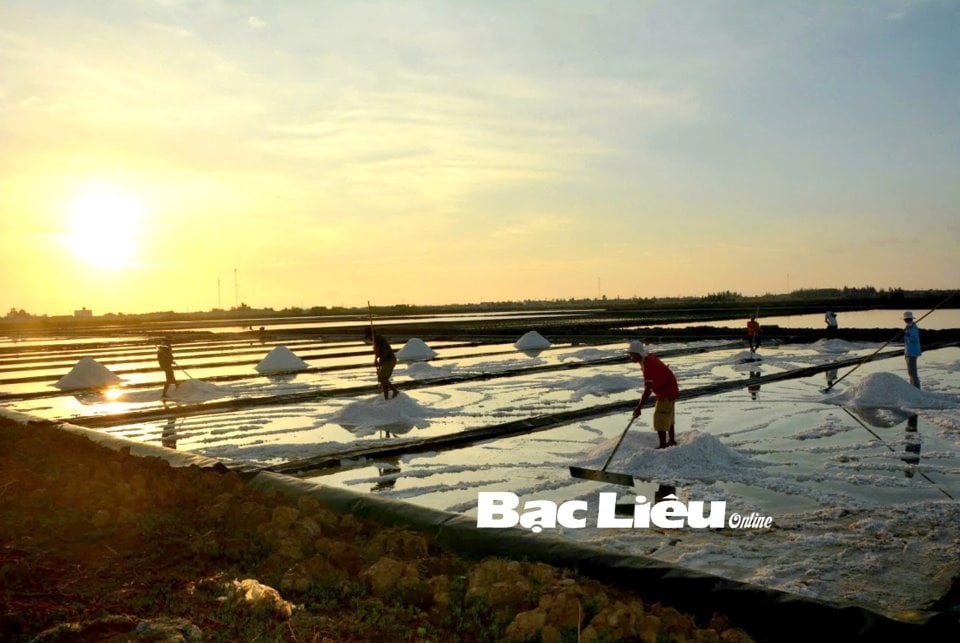
Sunrise over the salt flats.
Following in the footsteps of the salt-making heritage
According to the heritage profile of "Salt-making in Bac Lieu" (a document used in the application for inclusion in the national list of intangible cultural heritage), salt is described as: "one of the essential products in human life. Salt is not only a food and a very necessary seasoning for health, but also an important raw material for industry, medicine, fisheries, etc. Because of its diverse uses, the economic value of salt will be very large if the salt-making industry meets the quality and increasingly diverse demands of consumers."
“The land of Bac Lieu has salt called Ba Thac/ The longan fruit is thick, easy to peel, fragrant and delicious.” With a long history of salt making and accumulated experience, Bac Lieu is considered the salt land, once known as the Ba Thac salt land. The salt industry in Bac Lieu has made a significant contribution to the province's economic growth, and this region once had some of the largest salt field owners in the area at that time, such as Ba Ho Biet, Hoi Dong Trach, Hoi Dong Dieu, and especially the salt capitalist Ly Trung Nguyen who employed thousands of workers…
According to historical records, during the French colonial period, Bac Lieu had one of the largest salt-producing areas in the country. Before 1975, Bac Lieu's salt fields covered approximately 6,440 hectares, with an annual harvest of about 35,000 tons. Bac Lieu salt was exported to many countries around the world , including China, Japan, Laos, and Cambodia. In the 1980s, salt fetched a high price, sometimes even more expensive than rice. Salt farmers had a bumper harvest, and the salt industry flourished. Many modern houses sprang up in this salt-producing region.
The remnants of " Bac Lieu's Ba Thac salt-producing region " are still preserved in names such as Tu Muoi (salt storage warehouse) stretching nearly a kilometer along the Bac Lieu River (in Ward 2, Bac Lieu City), or Giong Me Canal (now the April 30th Canal) dug to transport salt from the coast to the city center for sale to the Saigon trading port, or upstream on the Hau River for export to Cambodia.
In Bac Lieu, there are many families with 3-4 generations who have preserved the salt-making profession! For example, Mr. Vo Hoang Nghiep (a member of the Doanh Dien Salt Cooperative, Dong Hai district), 74 years old, is the fourth generation in a family with 4 generations of salt makers; Mr. Nguyen Quoc Vinh, 75 years old, also a member of the same cooperative as Mr. Nghiep, has been making salt following in his grandfather's footsteps, starting from 1945 until now… Listening to these salt farmers tell stories from the salt fields is like listening to stories of generations of fathers passing down the traditional craft, facing numerous difficulties along the way.
Ba Thac delicious salt - Bac Lieu
Many people, after tasting Bac Lieu salt and comparing it to the saltiness of salt from other places, agree that "Bac Lieu salt leaves a sweet aftertaste, not a bitter one." They attribute this to the favorable natural conditions of the region; the seawater, climate, and weather in Bac Lieu are ideal for salt production, resulting in such delicious salt.
This traditional craft is also surrounded by stories passed down through generations, so the salt from "the land of the Prince" is not only delicious but also possesses the "soul of salt"! For example, there's the legend of the magical mill that ground salt and poured it into the sea, making the sea salty, and from that, salt crystals formed from seawater. In Bac Lieu specifically, salt making is also linked to certain beliefs. For instance, during the production process, one should avoid days considered "forbidden," such as the 5th, 14th, and 23rd of the lunar month. However, these forbidden days aren't strictly regulated, except for the day the brine is brought into the crystallization area. On this day, there's a simple ritual of offering boiled duck or a plate of fruit... praying for favorable weather and protection from storms.
We owe a debt of gratitude to the pioneers of the southern mangrove swamps who left Bac Lieu with an invaluable asset – its salt-making villages. This forms the basis for building a sustainable salt production area in the future. Salt-making technology has advanced; processes such as leveling the land, plowing, and threshing are now mechanized, replacing manual labor. However, salt farmers still retain the traditional production techniques passed down from their ancestors. Therefore, the salty taste with a hint of sweetness in Bac Lieu salt is a wonderful combination of traditional salt-making technology and modern technology. Over time, the salt-making villages in Bac Lieu have preserved their pristine beauty and the unique production processes of the coastal people.
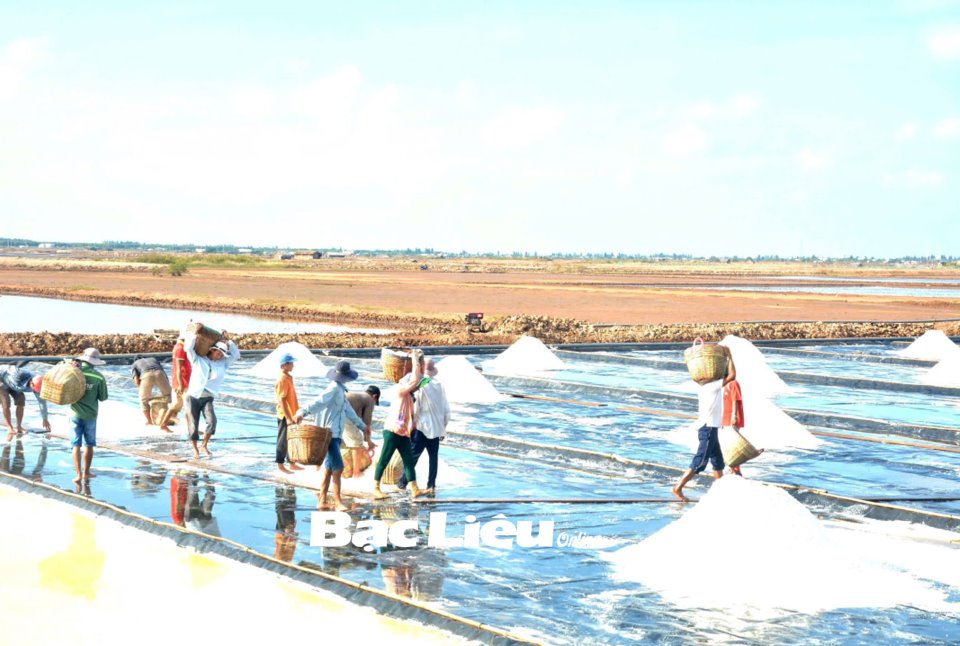
Salt farmers harvest salt in Dien Hai (Dong Hai district). Photo: CT
Opening up the future for heritage professions.
Paradoxically, while 19 out of 63 provinces and cities in Vietnam have salt-making industries, we still have to import salt to meet the demand for high-quality salt from consumers! And amidst this paradox, Bac Lieu is proud that, among many salt-producing provinces, "salt-making in Bac Lieu" has been recognized as a national heritage!
Pride is followed by worry. Salt-making has reached a new level – a national heritage – but even now, this "salty profession" is still plagued by sad stories! There are bumper harvests with low prices, and high prices with poor harvests, along with uncertain salt production due to unseasonal rains… (even though, during the production process, to increase labor productivity and reduce investment costs, salt farmers in Bac Lieu have continuously improved techniques to achieve higher efficiency). How can we not worry when salt farmers – those directly preserving this heritage profession – have toiled and sweat over an elaborate production process, facing countless hardships, yet still diligently pass on this arduous craft for centuries?
The inclusion of Bac Lieu's salt-making craft in the list of National Intangible Cultural Heritage by the Ministry of Culture, Sports and Tourism demonstrates both the State's respect and recognition of this traditional craft, while also placing a responsibility on preserving and promoting its value! More solutions are needed to expand salt-making areas, improve salt quality, and enhance the lives of salt farmers; develop tourism products that offer experiences in salt production, souvenir products made from salt, and medicinal products derived from salt; or organize annual salt festivals to promote and attract more tourists… More practically, relevant agencies should continue to implement supportive policies and mechanisms to help salt farmers stabilize their lives, strengthen guidance and transfer of modern scientific and technical applications to increase productivity and improve salt quality, helping salt farmers feel secure and committed to passing on the salt-making craft to future generations.
The Vietnam Salt Craft Festival - Bac Lieu 2025, a national-level event, will for the first time honor the salt craft and the pearl of the sea - Vietnamese salt. A series of activities within the Festival, encompassing all economic, cultural, and tourism sectors, will surely open a brighter future for the Vietnamese salt craft heritage and the salt-producing region of Bac Lieu.
CAM THUY
Source: https://baocamau.vn/nghi-ve-dat-muoi-bac-lieu--a41376.html







![When forestry is a 'weakness' for Nghe An?: [Part 3] Forest owners worry about the challenge of financial self-sufficiency](https://vphoto.vietnam.vn/thumb/402x226/vietnam/resource/IMAGE/2026/06/01/1780328200116_pu-hoat-014846_425-223223.jpeg)




![Transforming from Resolution 57: [Part 1] 'Digital Field' in the Heart of the City](https://vphoto.vietnam.vn/thumb/402x226/vietnam/resource/IMAGE/2026/06/01/1780313803412_2848-htx-nong-nghiep-tuan-ngoc-8-173833_249-173836.jpeg)







































































Comment (0)