

 |
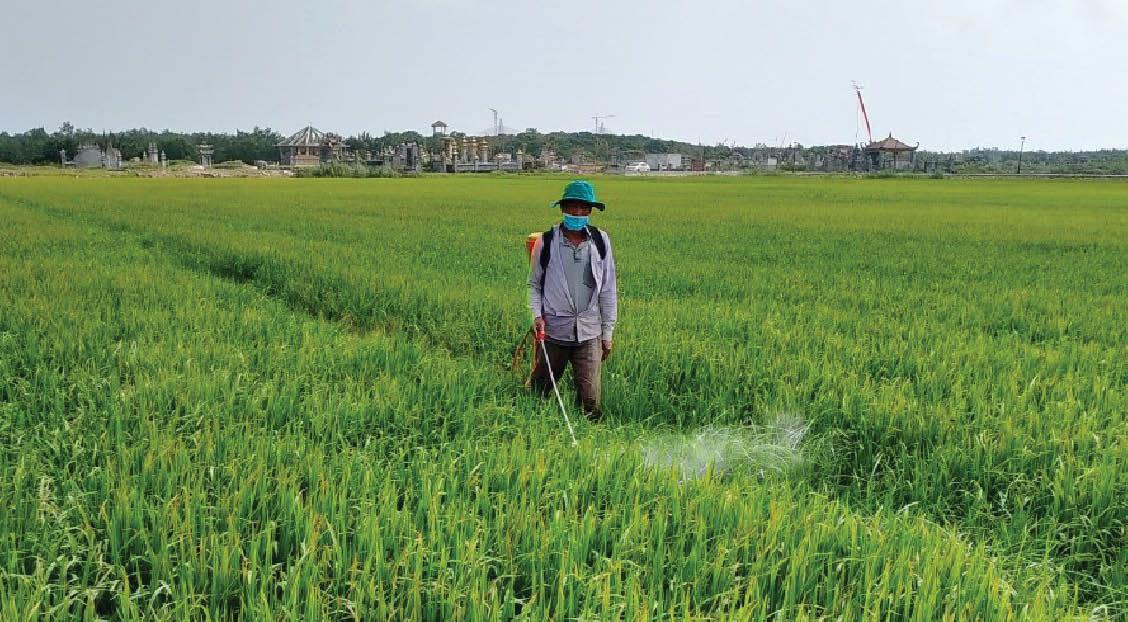
| Yellow leaf disease has appeared in some rice fields in Huong Phong ward. |
Proactive approach from the fields
This winter-spring season, Mr. Tran Dai Thuong in An Xuan Dong village, Quang An commune (Quang Dien district) planted HG224 and J02 rice varieties on 5 hectares. These are high-quality, short-day rice varieties. To ensure crop yield, from the beginning of the season until now, Mr. Thuong has strictly followed all technical procedures as guided by agricultural extension officers and the cooperative.
Mr. Thuong shared that, according to the cooperative's announcement, the weather will be affected by an upcoming cold front, bringing rain and cold temperatures, leading to an increase in damage to rice crops such as brown spot disease, leaf roller, neck blast, and grain discoloration... To protect their production areas, farmers have sprayed pesticides and applied technical measures as instructed by the cooperative and relevant authorities.
According to Mr. Tran Quang Hung, Director of An Xuan Agricultural Cooperative in Quang An commune, in response to unfavorable weather conditions that could cause heavy rain and frost damage during the rice flowering stage, the cooperative has instructed farmers on preventive measures; at the same time, it has prepared two pumping stations to operate at full capacity to meet the drainage needs of the entire 254.3 hectares of the cooperative's cultivated area.
Rice fields in Thuan Hoa Hamlet, Huong Phong Ward, Thuan Hoa District are showing signs of yellow leaf disease in some areas. Investigations reveal that most of the yellow leaf disease is occurring in areas planted with the 4B rice variety.
Mr. Nguyen Ngoc Binh, Director of Thuan Hoa Agricultural Cooperative, said that for the 4B rice variety, yellowing leaves are a physiological disease that occurs during the heading stage. The leaves will turn green again about a week after heading. The cooperative's total rice area is over 145 hectares, of which only 30 hectares are planted with the 4B rice variety, while the rest is planted with the J02 variety. The cooperative has guided farmers in spraying fungicides and other fungicides to prevent diseases in the rice plants.
According to Mr. Nguyen Ngoc Binh, the cooperative has contracted with technical staff from the Department of Crop Production and Plant Protection to regularly inspect and guide farmers on measures to control rice pests, especially in responding to rainy and cold weather to ensure crop quality.
Ensuring productivity and output.
For the 2024-2025 winter-spring crop season, the entire city has planted over 27,900 hectares, with the main area currently in the tillering and heading stage. Generally, the rice is growing and developing quite well. Pests and diseases affecting the fields include rice blast, affecting approximately 346 hectares (nearly 1.5%), mainly on J02, BDR999, local glutinous rice, and black glutinous rice varieties; rats affecting over 621 hectares (nearly 2.5%); and brown spot disease affecting 327 hectares (1.2%). According to Mr. Ho Dinh, Head of the Hue City Department of Crop Production and Plant Protection, pests and diseases such as stem rot, sheath rot, brown spot, brown scab, and various types of planthoppers are not widespread, with lower densities and damage rates compared to the previous season.
To protect the winter-spring crop and minimize damage caused by pests and diseases, the Department of Crop Production and Plant Protection has deployed staff in coordination with wards, communes, towns, cooperatives, etc., to guide farmers in regulating water properly, applying fertilizer at the right time and in a balanced manner to ensure good rice plant development. In addition, the unit has increased the number of staff going to the fields to inspect and monitor pests and diseases and weather developments in order to take timely control measures to minimize the impact on rice yield and production.
Source: https://huengaynay.vn/kinh-te/nong-nghiep-nong-thon/nhieu-bien-phap-bao-ve-lua-vu-dong-xuan-152162.html





Comment (0)