

Doctor Trinh Viet Bac (right) and his colleagues monitor a patient who has suffered cardiac arrest and is undergoing controlled hypothermia treatment. Photo: H. Dung |
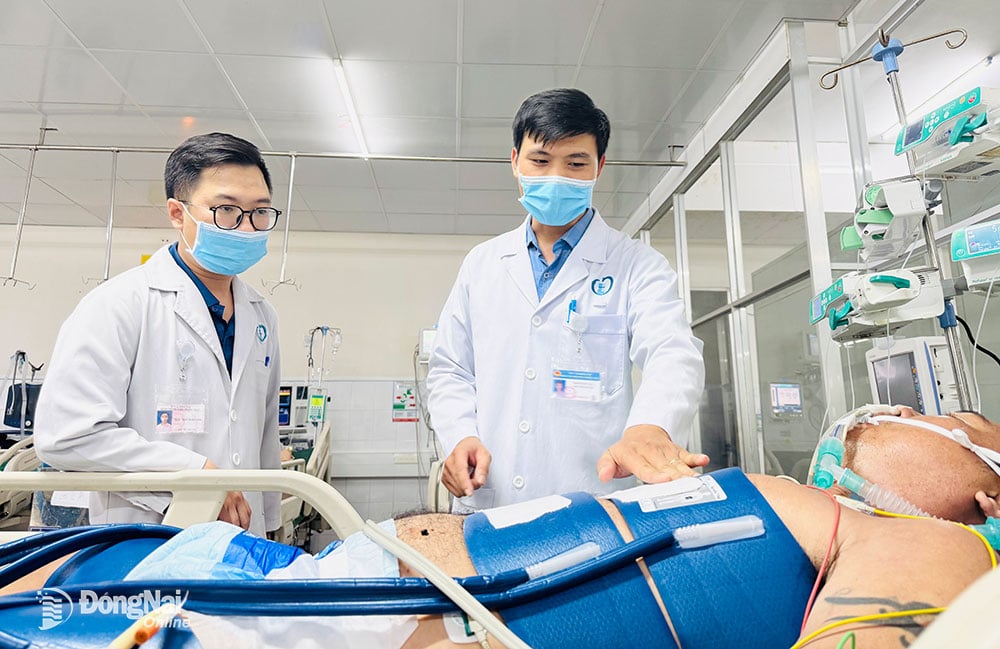
Because all the most critically ill patients are concentrated here, maintaining a clean environment and minimizing germs is extremely necessary to ensure the safety of patients' lives.
Boundless happiness
After two weeks of battling death alongside his colleagues to save the life of 4-year-old LAK, who suffered from fulminant myocarditis, Dr. Tran Le Duy Cuong (Deputy Head of the Intensive Care and Toxicology Department, Dong Nai Children's Hospital) can finally smile.
Standing by the bedside observing the child, Dr. Cuong said that when the boy was brought to the emergency room, he was in a very critical condition, with a high chance of death and could not be transferred to a higher-level hospital. In just the first night, the child's heart stopped four times. Doctors and nurses had to be constantly by the bedside, not daring to close their eyes all night. All of the child's vital signs were closely monitored, and any abnormal signs were immediately addressed.
“There were times when we thought we couldn’t save the patient because the disease was progressing too severely. But with determination and love for the patient, we did everything we could for them. Thanks to that, the patient’s condition gradually improved and is now conscious without any lasting effects. For us, this happiness is incomparable,” shared Dr. Cuong.
Ms. Luong Quynh Da Thao (residing in Long Phuoc commune, Long Thanh district, mother of baby LAK) shared: “The doctors and nurses have given my son a second chance at life. A thousand words of thanks cannot fully express the sincere gratitude my family feels towards the doctors and nurses of the hospital.” |
As for Dr. Trinh Viet Bac (Deputy Head of the Intensive Care and Toxicology Department, Thong Nhat General Hospital), he comes into contact with dozens of critically ill patients every day, requiring mechanical ventilation and oxygen, which makes him understand the value of life even more.
Dr. Bac recounted that most patients in the department are elderly, suffering from conditions such as pneumonia, chronic obstructive pulmonary disease, infections, and strokes. However, there are also very young patients, only children, and breadwinners of their families who have suffered traffic accidents, domestic accidents, or suicide attempts resulting in multiple injuries and very serious damage.
Dr. Bac confided: "Because of the strict infection control requirements, the nurses and orderlies in the department have to do all the patient care tasks. From carrying out the doctor's orders to feeding patients, giving them milk, bathing them, and helping with personal hygiene. Everyone is busy all day long."
As he spoke, Dr. Bac led us to visit several seriously ill patients who had recovered after a long period of treatment. For example, a female patient with severe complications from diabetes who had to be on a ventilator has now been weaned off the ventilator and is able to communicate. Or the case of a 38-year-old male patient who suffered from ventricular fibrillation and sudden cardiac arrest, but was promptly resuscitated and underwent coronary intervention…
The silences…
In a place like the Intensive Care and Toxicology Unit, where life and death hang in the balance, loss is inevitable. But witnessing patients die frequently doesn't mean the doctors and nurses here have become emotionally numb.
During his 8 years working at the Intensive Care and Toxicology Department of Dong Nai Children's Hospital, Dr. Ngo Thai Binh has experienced the full spectrum of emotions. From joy and happiness when patients gradually recover and are discharged, returning to the loving embrace of their families, to feelings of sadness and anguish when, despite doing everything possible, they could not save a patient.
Doctor Binh confided that when young patients didn't make it, he felt stressed and told himself he had to strive to learn more so he could do better and save more patients' lives.
For Dr. Bac, the initial reason he joined the Intensive Care and Toxicology Department was to challenge himself, to face difficult cases and overcome them. However, he and his colleagues couldn't always succeed despite their best efforts and dedication to the patients.
Dr. Bac recalled that before the Government 's Decree 100/2019/ND-CP on penalties for traffic violations on roads and railways was issued, the department continuously received patients with serious multiple injuries from traffic accidents. Despite issuing a hospital-wide red alert and mobilizing all necessary resources to save the patients, they ultimately did not survive. In one case, a patient was run over by a truck in the pelvic region. Doctors performed surgery, used the best medications, and transfused a total of 20-30 units of blood, stabilizing the patient before transferring them to a higher-level hospital. However, after only three months, the patient could not overcome "death" due to hospital-acquired infection.
To increase the chances of survival for critically ill patients, Dr. Bac believes that, first and foremost, it is necessary to strengthen community education so that as many people as possible know the correct initial first aid techniques and can receive them early in the community. For example, in cases of sudden cardiac arrest not caused by trauma, people can perform first aid and chest compressions to help the patient overcome the critical condition before taking them to the hospital for emergency treatment.
As for Dr. Bac, he continuously participates in training courses to improve his professional skills and expertise, such as studying for a Specialist Level I degree in hemodialysis and plasma exchange, learning more about ultrasound and electrocardiography, and acquiring additional techniques from other specialties. Thanks to this, since last year, the Intensive Care and Toxicology Department of Thong Nhat General Hospital has elevated continuous hemodialysis and plasma exchange techniques to a new level and made them routine, helping to save the lives of many critically ill patients.
Hanh Dung
Source: https://baodongnai.com.vn/xa-hoi/202504/noi-ranh-gioi-mong-manh-2434f32/

![[Photo] General Secretary To Lam working with Ambassadors and Heads of Vietnamese representative offices abroad attending the 14th National Congress of the Party](/_next/image?url=https%3A%2F%2Fvphoto.vietnam.vn%2Fthumb%2F1200x675%2Fvietnam%2Fresource%2FIMAGE%2F2026%2F01%2F25%2F1769334314499_image.jpeg&w=3840&q=75)


![[Photo Gallery] Overview of the two routes connecting the airport and the expressway in Nhon Trach](/_next/image?url=https%3A%2F%2Fvphoto.vietnam.vn%2Fthumb%2F402x226%2Fvietnam%2Fresource%2FIMAGE%2F2026%2F01%2F25%2F1769335015824_4-1_resized_20260125160737_20260125163345.jpeg&w=3840&q=75)
![[Photo gallery] Asphalt paving begins on Thong Nhat Bridge on the central arterial road in Bien Hoa.](/_next/image?url=https%3A%2F%2Fvphoto.vietnam.vn%2Fthumb%2F402x226%2Fvietnam%2Fresource%2FIMAGE%2F2026%2F01%2F25%2F1769323914106_1_20260125134108.jpeg&w=3840&q=75)





Comment (0)