

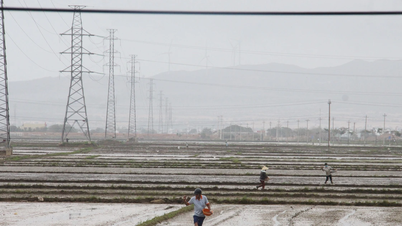
On the tenth day of the Lunar New Year, the rice paddies of Khanh Nhac commune were filled with the sounds of rice transplanters and the lively chatter of women planting rice, creating a festive atmosphere. This year's winter-spring crop saw 100% of the commune's rice fields being transplanted using both machines and by hand, following organic farming practices. This is the largest transplanted area in recent years, with 20% of the area covered by contracts for complete seedling and machine transplanting packages. After two seasons of applying this new model, costs and labor have been reduced.
Standing on the bank watching the rice transplanter working on her family's rice field, Ms. Dao Thi Lan, from Hamlet 1A, Khanh Nhac Commune, said: "In just one hour, more than 5 sao (approximately 0.5 hectares) of our family's rice fields were transplanted. This is the second time my family has signed a contract for a comprehensive transplanting service. From seed selection, sowing seedlings in trays, transplanting with a machine, combined with technical advice on care, this has significantly reduced seedling mortality and lowerd costs compared to hiring laborers. Previously, before land consolidation, my family had two plots of land. Now, consolidating them into one plot has greatly facilitated the introduction of mechanization into production. After transplanting, my family will focus on care, supplementing with NPK fertilizer according to the ratio to help the rice plants recover quickly, take root, and monitor for pests and diseases in the field to spray and control them promptly. With many years of experience, our rice crop always develops well and yields high productivity."
This winter-spring season, Khanh Nhac commune planted 600 hectares of rice using organic methods, mainly ST25, LT2, and Huong Com 4 varieties, with 20% of the area utilizing a comprehensive planting service. Accordingly, cooperatives select and purchase seeds and then supply them to contracted units for tray planting and machine transplanting at a price of 280,000 VND/sao (1 sao = 360 square meters), a reduction of 80,000-100,000 VND/sao compared to manual transplanting. During the seed soaking and germination process, the cooperatives regularly check the quality of the tray planting substrate and the sprinkler irrigation system, ensuring healthy seedlings that grow and develop quickly.
Because rice is transplanted by machine at a uniform density, it promotes the border effect, resulting in well-ventilated fields with fewer pests and diseases, contributing to environmental protection, and increasing yields by 10-15% compared to manual transplanting. Furthermore, using transplanting machines helps localities plan concentrated production areas with the same rice variety, facilitating care and harvesting, and contributing to a change in farmers' production mindset.
Mr. Pham Van Binh, Vice Chairman of the People's Committee of Khanh Nhac commune, said: "A new feature this year is that farmers have abandoned direct seeding and are now using tray seedling trays for machine and hand transplanting, which is convenient for monitoring and introduces mechanization into production. At the same time, we are encouraging farmers to use organic fertilizers to enhance the value of crops and build a brand of delicious, clean rice for the locality. By February 23rd, the commune had completed the spring rice planting and directed farmers to shift their focus to caring for the rice after transplanting."
In Khanh Thuy commune, the atmosphere of early spring production is equally bustling. This year's winter-spring crop in Khanh Thuy commune plans to plant over 400 hectares. For areas where sowing has already taken place, farmers are currently monitoring the second water intake into the fields, adjusting it to the height of the rice seedlings. When the water level reaches about 3-5 cm, they stop. Once the rice plants have about 3 leaves, they maintain a shallow water level in the fields to allow the rice plants to develop.
Mr. Le Van Nam, Deputy Director of Khanh Thuy Agricultural Cooperative, said: "As a locality with a large area of direct-seeded rice, to help farmers grasp the techniques and care process, the cooperative has assigned staff to regularly monitor the fields after transplanting and educate farmers to thin out areas where seedlings are growing too densely, so that the rice plants can tiller more easily. Having rice plants too densely also contributes to the increased development of pests and diseases. For direct-seeded rice, farmers should fertilize twice, using base fertilizers and top dressings to increase nitrogen and potassium. In addition, we also guide farmers to regularly inspect the fields. If they see signs of nutrient deficiency in the rice plants, they can supplement with fertilizers to increase nutrients for the grains. At this time, farmers should only apply NPK fertilizers, increasing potassium or foliar fertilizers."
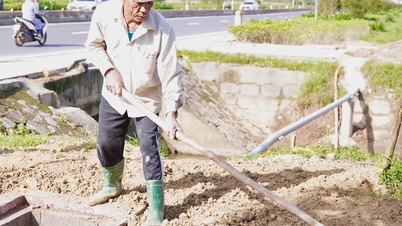
To date, in Khanh Thuy commune, there are still over 40 hectares of land planted with Alisma plantago-aquatica that are being harvested. After harvesting, households will proceed with plowing the land and sowing spring rice, ensuring it is done within the planting season.
For many years, the winter-spring crop has been identified as the main rice crop, yielding high productivity and making a significant contribution to the growth rate of the agricultural sector in Yen Khanh district. Therefore, from the beginning of the season, the district has focused intensely on directing and managing production, assigning officials to closely monitor each stage to achieve high efficiency. This year, Yen Khanh aims to plant over 7,300 hectares of spring rice using short-day, high-quality purebred rice varieties with good market demand such as Huong Binh, Nep Huong, Dai Thom 8, Bac Thom No. 7, and ST25.
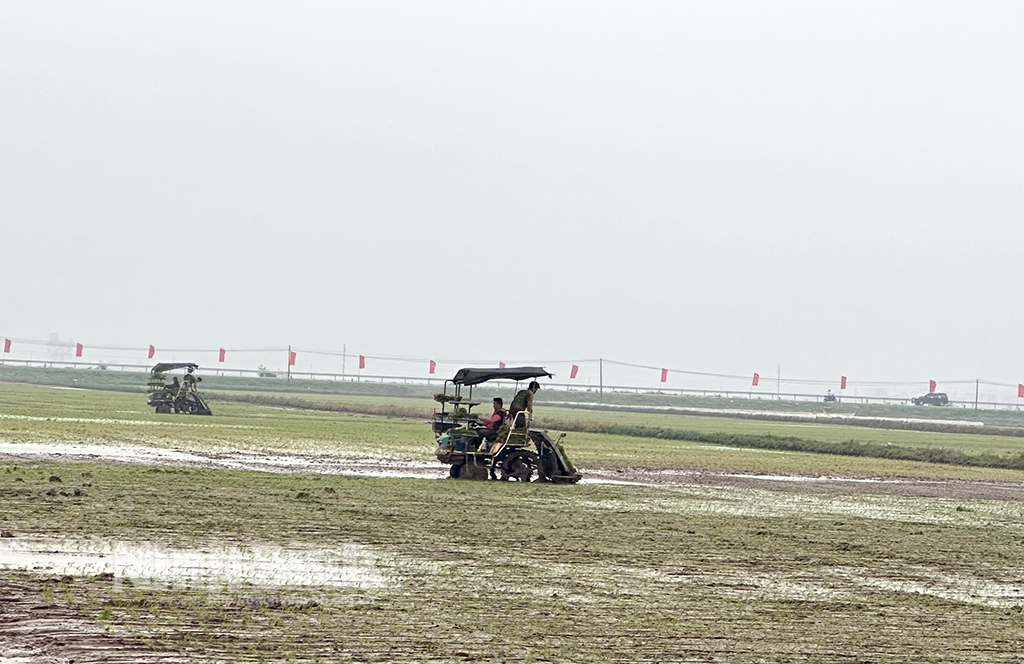
Comrade Nguyen Manh Toan, Deputy Head of the Agriculture and Rural Development Department of the district, said: Before Tet, to prepare for the spring crop, the communes proactively arranged the rice crop structure, varieties, and planting seasons to suit the local soil conditions, weather, and water regime, while still ensuring it was within the planting timeframe. At the same time, they intensified information and propaganda efforts through the local broadcasting system regarding the spring rice planting plan; urged people to clean the fields, mobilize land preparation equipment, and prepare the necessary conditions for spring rice planting.
Currently, in addition to traditional transplanting and sowing methods, many localities in the district have introduced rice transplanters into production, such as Khanh Nhac, Khanh Hong, Khanh Trung, Khanh Thanh, etc. Practical production shows that the advantages of machine transplanting using tray seedlings not only contribute to reducing labor, speeding up the planting process within the planting season, and ensuring appropriate row planting density to promote good rice growth and development, but also limit the appearance of weeds (also known as wild rice), helping to protect the crop.
Thanks to good preparation, after the Tet holiday, taking advantage of the warm, sunny weather, farmers in the district have returned to the fields to focus on sowing and planting spring rice, hoping for a bountiful harvest with favorable weather conditions. The entire district is striving to complete spring rice sowing and planting before February 25th.
Immediately after the planting season ends, communes and towns continue to focus on disseminating information and guiding farmers on techniques for caring for and protecting rice and other crops, helping newly transplanted rice quickly take root, recover its green color, develop well, and proactively prevent and control pests and diseases, and respond to changing weather conditions. Specifically, for newly transplanted rice, it is necessary to maintain a water level of 3-5 cm to increase the rice plant's resistance to cold; the first topdressing should be applied 10 days after transplanting. For areas where rice has developed seedlings, thinning, weeding, and soil aeration should be carried out. At the same time, farmers should be encouraged to gradually replace inorganic fertilizers with organic and microbial fertilizers, linked with the development of integrated pest management models, organic agricultural production models, and production along the value chain.
Text and photos: Tien Dat
Source

![[Image] Central Party Office summarizes work in 2025](/_next/image?url=https%3A%2F%2Fvphoto.vietnam.vn%2Fthumb%2F1200x675%2Fvietnam%2Fresource%2FIMAGE%2F2025%2F12%2F18%2F1766065572073_vptw-hoi-nghi-tong-ket-89-1204-jpg.webp&w=3840&q=75)



































































Comment (0)