

 |
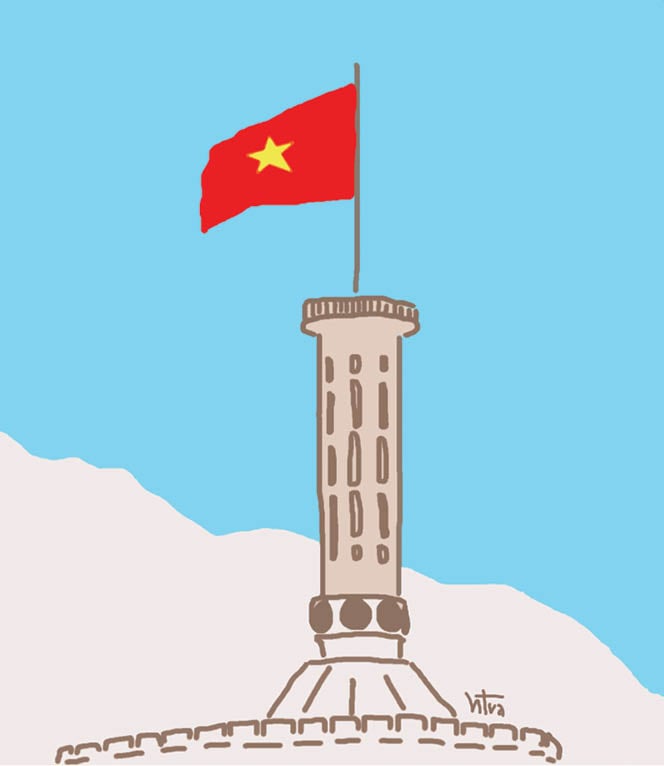
That highest point is the Lung Cu flagpole, on the summit of Dragon Mountain, 1,468 meters above sea level in Lung Cu commune - Ha Giang (formerly), now Tuyen Quang province.
The night before our trip to the Lung Cu flagpole, Thanh Ha, our tour leader, reminded us: "Tomorrow morning, let's wear Hue-style ao dai (traditional Vietnamese dress) and take a commemorative photo with the Lung Cu flagpole." Even though the destination was already planned, hearing our leader suggest wearing Hue-style ao dai filled all of us with joy.
Women, with their bustling fashion choices, possess a unique charm. My sisters and I also know how to choose ao dai (traditional Vietnamese dress) to leave our mark everywhere, showcasing the distinctive beauty of the ancient capital of Hue: ao dai in the style of the Nguyen dynasty's royal court, ao dai adorned with images of the Imperial Citadel, Truong Tien Bridge, Thien Mu Pagoda, and the purple ao dai of Hue. I silently admired the graceful women in their traditional Vietnamese women's attire (these ao dai dresses had accompanied them on their journey of over a thousand kilometers from Hue to Hanoi , and then to Ha Giang), realizing that within their love for the homeland lies a deep love for Hue, and within the grandeur of the nation lies the image of their hometown, represented by the ao dai, a very gentle, very Hue-like symbol, the land considered the cradle of the Vietnamese ao dai.
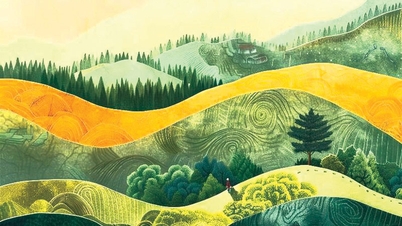
Climbing over 800 steps, precisely 839, leads to the foot of the Lung Cu flagpole. The higher you climb, the more you rest and look down into the valley below, the more your eyes are opened to the beautiful landscape of Ha Giang. You realize that this scenery is not only created by nature but also by human hands. Lung Cu – these mountains and valleys are millions of years old, with ancient, green, and towering rocky peaks, shaped like cat's ears, as if arranged by some divine hand. For thousands of years, people have left their mark on this land, their settlements and development reflected in the image of traditional houses with yellow earthen walls and characteristic yin-yang tiled roofs, and the legendary terraced rice fields.
The sun cast brilliant golden rays down upon the village, both near and far, a vibrant green. This season, the rice seedlings on the terraced fields are a tender green, and the hills are covered in the verdant hues of hard work and perseverance. From this high vantage point, the road winding along the mountain slopes, connecting clusters of houses, seems to stretch on endlessly, sometimes visible, sometimes hidden. The golden sunlight, like honey, pours abundantly over the vast valley. It's a picture of nature and human life intertwined, both dreamlike and real.
From this vantage point, I deeply feel the teachings of our ancestors about the "sacred spirit of the mountains and rivers," from ancient times to the present day, every inch of borderland is a part of the nation's body.
"The Lung Cu flag flies high."
Amidst the clouds of our homeland
The fence is as hard as stone.
"The borderlands are guarded by the spirit of the nation."
(Tran Trung Thanh)
Perched atop Dragon Mountain, at the foot of the Lung Cu flagpole, I listened to my heart and felt a deep empathy with writer Nguyen Minh Chau when he wrote: "Every homeland's sky is the sky of the Fatherland." The sky over Tuyen Quang today, in the early days of autumn, with its vast expanse of clouds and mountains, and the national flag flying high atop Dragon Mountain, this border region experiences a day of peace, a day of joy for the nation.
Source: https://huengaynay.vn/van-hoa-nghe-thuat/o-mom-tot-bac-cua-to-quoc-157169.html
![[Image] National Assembly discusses the implementation of the socio-economic development plan.](https://vphoto.vietnam.vn/thumb/1200x675/vietnam/resource/IMAGE/2026/04/20/1776696707422_ndo_br_img-20260420-185419-jpg.webp)


![[Photo] General Secretary and President To Lam meets with National Assembly delegates from ethnic minorities.](https://vphoto.vietnam.vn/thumb/1200x675/vietnam/resource/IMAGE/2026/04/20/1776696701056_a1-bnd-8331-3342-jpg.webp)









































































Comment (0)