

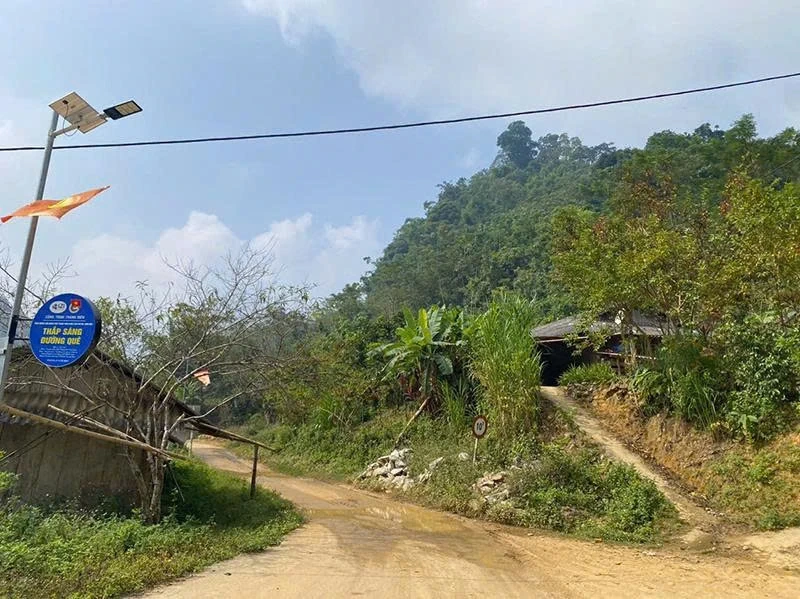
The road leading to Che Lau village in Na Meo commune now has electric lighting, giving the highland village a new look.
Speaking about the changes in Che Lau, Na Meo commune today, the villagers often mention Mr. Thao Van Sinh, born in 1954, a respected figure in the village. For him, mobilizing the Mong people cannot stop at just words. "We have to lead by example, do it first, and only when we see that it's right and beneficial will the people believe us," Mr. Sinh shared.
He demonstrated this viewpoint most clearly during times of complex situations. Around 2010, in Ché Lầu, some people who had gone away to work returned and embraced a "strange religion" with vague, unscientific stories, disrupting community life. As someone trusted by the villagers, Mr. Sinh, along with local officials, patiently explained and persuaded them. He spoke gently, saying that anything contrary to customs and state regulations should be abandoned, and that people should live in peace and harmony within their villages and homes.
In the past, funerals in Ché Lầu often lasted for many days, involving lavish slaughter of buffalo and cattle, leading to debt, borrowing, and the risk of disease outbreaks. In 2018, when the local authorities promoted civilized funeral practices among the Hmong people, Mr. Sinh's nephew passed away. He proactively coordinated with the government to organize a concise funeral within two days, placing the body in a coffin. "I did it first so that people could see that putting the deceased in a coffin didn't affect the family's peace, and there was no 'punishment' as rumored," he recounted.
From the practice of funeral rites, the dissemination of legal information in Ché Lầu gradually became more organized. People reduced deforestation for slash-and-burn farming, shifting to stable cultivation; village regulations and customs were reiterated in village meetings; and conflicts were resolved early to prevent them from escalating.
Today, Ché Lầu village is vastly different from the memory of a poor, backward Hmong village of the past. Electricity has reached the village, and concrete roads are gradually connecting the main road to each house. The previously makeshift houses have been rebuilt more sturdily, and there are even a few small grocery stores to serve daily needs. More importantly, the villagers' awareness has changed; funerals are now simpler, and bodies are placed in coffins; poverty has lessened, giving way to the vibrant sounds of a new life emerging amidst the mountains and forests.
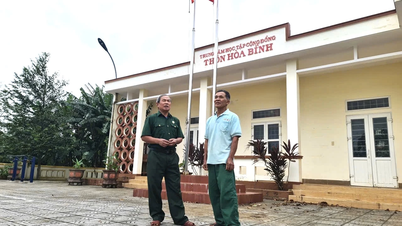
In Ché Lầu, law enforcement begins with changing the way of life within each family, while in Khẹo village, Bát Mọt commune, law is manifested very concretely through the border and boundary markers. Mr. Lang Minh Huyến, a community leader in the village, considers protecting the border as protecting the common home of the villagers. In village meetings, he often says concisely in Thai, "The border is our home. If we don't protect our home, others will come and live there." He repeats this simple saying when urging villagers not to abet smuggling, not to listen to temptations to illegally cross the border, and not to let drugs infiltrate the village. For him, disseminating legal information doesn't need eloquent words, but rather to speak about what the villagers value most. At times, road and bridge construction projects disrupted daily life, causing some households to become upset. Mr. Huyến, along with the village management board and commune officials, patiently explained the law to the villagers, helping them understand and avoid being incited to violate the law.
Despite his advanced age, Mr. Huyen regularly patrols and protects the border and boundary markers with the officers and soldiers of the Bat Mot Border Guard Post. Whether in scorching heat or freezing rain, once a month, his footprints are imprinted on the familiar forest paths.
Two individuals, two approaches, but a shared goal: gradually filling the gap in legal awareness in the villages through the credibility of those trusted by the people. Currently, the province has more than 1,500 community-based legal education and training centers (NCUTs) among ethnic minorities. These NCUTs are considered the "extended arms" of the Party committees and authorities in disseminating legal information, mediating conflicts, maintaining security and order, and preserving cultural identity at the grassroots level.
In implementing Decisions No. 12/2018/QD-TTg and 28/2023/QD-TTg of the Prime Minister, Thanh Hoa province has focused on training and equipping its community leaders with knowledge of law, national defense and security, and advocacy skills. In October and November 2025, 21 conferences on legal education and dissemination were held in 86 particularly disadvantaged villages, attracting 558 participants. The content focused on regulations relevant to daily life, emerging issues in mountainous and border areas, and communication skills appropriate to the customs and languages of each ethnic group. Through these efforts, the community leaders not only grasped legal regulations but also gained a better understanding of the tactics used by criminals exploiting mountainous terrain. They become the most effective propaganda force at the grassroots level – those who “speak so the people listen, act so the people believe,” contributing to spreading the spirit of the rule of law to every household and every village.
Text and photos: Minh Tam
Source: https://baothanhhoa.vn/phap-luat-vao-ban-tu-nhung-cau-chuyen-doi-thuong-272044.htm
![[Photo] Prime Minister Pham Minh Chinh receives the Governor of Tochigi Province (Japan)](/_next/image?url=https%3A%2F%2Fvphoto.vietnam.vn%2Fthumb%2F1200x675%2Fvietnam%2Fresource%2FIMAGE%2F2025%2F12%2F16%2F1765892133176_dsc-8082-6425-jpg.webp&w=3840&q=75)

![[Photo] Prime Minister Pham Minh Chinh receives Lao Minister of Education and Sports Thongsalith Mangnormek](/_next/image?url=https%3A%2F%2Fvphoto.vietnam.vn%2Fthumb%2F1200x675%2Fvietnam%2Fresource%2FIMAGE%2F2025%2F12%2F16%2F1765876834721_dsc-7519-jpg.webp&w=3840&q=75)

![[Image] Leaked images ahead of the 2025 Community Action Awards gala.](/_next/image?url=https%3A%2F%2Fvphoto.vietnam.vn%2Fthumb%2F1200x675%2Fvietnam%2Fresource%2FIMAGE%2F2025%2F12%2F16%2F1765882828720_ndo_br_thiet-ke-chua-co-ten-45-png.webp&w=3840&q=75)
![[Live] 2025 Community Action Awards Gala](/_next/image?url=https%3A%2F%2Fvphoto.vietnam.vn%2Fthumb%2F1200x675%2Fvietnam%2Fresource%2FIMAGE%2F2025%2F12%2F16%2F1765899631650_ndo_tr_z7334013144784-9f9fe10a6d63584c85aff40f2957c250-jpg.webp&w=3840&q=75)











































![[Live] Closing Ceremony and Award Presentation for the "Impressive Vietnam Tourism" Video/Clip Creation Contest 2025](https://vphoto.vietnam.vn/thumb/402x226/vietnam/resource/IMAGE/2025/12/17/1765974650260_z7273498850699-00d2fd6b0972cb39494cfa2559bf85ac-1765959338756946072104-627-0-1338-1138-crop-1765959347256801551121.jpeg)



















Comment (0)