

The local indigenous rights group FENAMAD said that in recent weeks, the reclusive tribe has been seen frequently emerging from the rainforest in search of food, seemingly fleeing from logging activity.
According to Survival International, the photos of the Mashco Piro tribe were taken in late June on the banks of a river in the Madre de Dios region of southeastern Peru, near the border with Brazil.
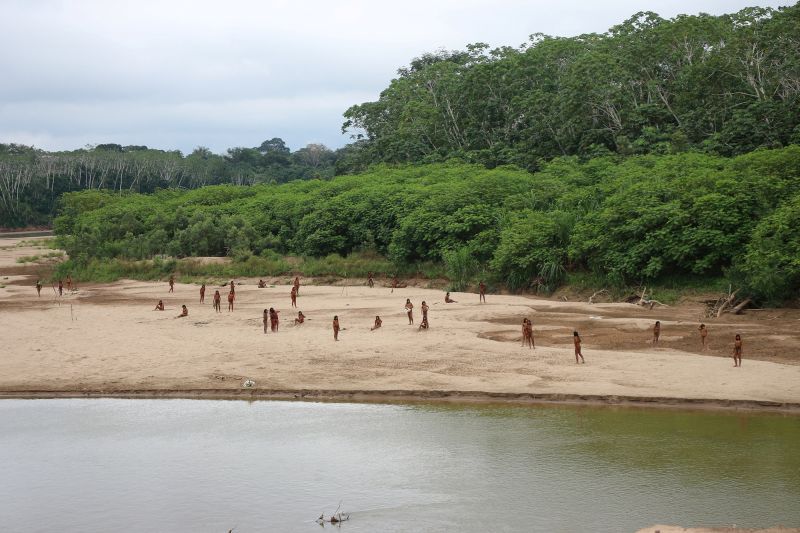
Members of the Mashco Piro tribe were seen emerging from the rainforest. Photo: Survival International
Caroline Pearce, director of Survival International, said: "These incredible images show a large number of Mashco Piro people living in isolation, just a few kilometers from where the loggers operate."
In recent days, more than 50 Mashco Piro people have appeared near the Yine village of Monte Salvado. Another group of 17 has appeared near the nearby village of Puerto Nuevo, according to an NGO that protects the rights of indigenous people.
According to Survival International, the Mashco Piro people live in an area situated between two nature reserves in Madre de Dios. They rarely appear in public and have little contact with the Yine people or anyone else.
Several timber companies currently hold logging rights in territories inhabited by the Mashco Piro people, such as Canales Tahuamanu, which has built over 200 km of roads for logging trucks. The company owns 53,000 hectares of forest in Madre de Dios for harvesting cedar and mahogany.
On June 28, the Peruvian government announced that it had received reports from local residents who saw Mashco Piro people on the Las Piedras River, 150 km from Puerto Maldonado, the capital of Madre de Dios.
Rosa Padilha, of the Indigenous Missionary Council of the Catholic Bishops of Brazil in the state of Acre, said that the Mashco Piro people have also been found on the other side of the Brazilian border.
"They were fleeing from loggers on the Peruvian side. At this time of year, they appear on the beach to collect tracajá (Amazonian turtle) eggs. That's when we found their footprints in the sand. They left behind a lot of turtle shells," she said.
Ngoc Anh (according to CNN)
Source: https://www.congluan.vn/phat-hien-bo-toc-chua-duoc-biet-den-o-amazon-cua-peru-post303928.html
![[Image] Hanoi Police officially crowned champions of V-League 2025/2026](https://vphoto.vietnam.vn/thumb/1200x675/vietnam/resource/IMAGE/2026/05/31/1780244769054_ndo_br_039d561b692be875b13a-jpg.webp)
![[Photo] The General Secretary, President and his wife begin their state visit to the Philippines.](https://vphoto.vietnam.vn/thumb/1200x675/vietnam/resource/IMAGE/2026/05/31/1780230559452_anh-man-hinh-2026-05-31-luc-19-28-11.png)


![[Photo] Solemn bathing ceremony and Buddha procession in Hue](https://vphoto.vietnam.vn/thumb/1200x675/vietnam/resource/IMAGE/2026/05/31/1780228263543_1-jpg.webp)
![[Photo] Admire the coral "masterpiece" amidst the million-year-old heritage of Dak Lak province.](https://vphoto.vietnam.vn/thumb/1200x675/vietnam/resource/IMAGE/2026/05/31/1780221235105_anh-man-hinh-2026-05-31-luc-16-53-27.png)





















![[Video] Sunset at Lap An Lagoon – Where the sun sets over the fishing nets](https://vphoto.vietnam.vn/thumb/340x192/vietnam/resource/IMAGE/2026/05/31/1780192137701_beach-landscape-sea-water-nature-grass-745871-pxhere-com.jpeg)

































![[Photo] Admire the coral "masterpiece" amidst the million-year-old heritage of Dak Lak province.](https://vphoto.vietnam.vn/thumb/402x226/vietnam/resource/IMAGE/2026/05/31/1780221235105_anh-man-hinh-2026-05-31-luc-16-53-27.png)






































Comment (0)