

After more than a year since the official commercialization of 5G networks, Vietnamese mobile operators are entering 2026 with the goal of completing and exploiting this new generation of mobile networks.
The speed difference is not significant compared to 4G.
Developing 5G in Vietnam is not simply about coverage and providing mobile voice and internet services. Unlike previous mobile technologies, the biggest difference of 5G is its potential for applications in daily life, as a means of bringing the most advanced technologies to end users.
Vietnam Post and Telecommunications Group (VNPT) announced it is collaborating with technology partners to develop applications that maximize the potential of 5G in the digital economy, e-government, and smart city services. MobiFone stated that, in addition to investing in telecommunications infrastructure, the network operator (now under the Ministry of Public Security ) is also focusing on developing service solutions based on 5G, including virtual reality (VR), IoT, and big data platforms, helping businesses and citizens fully exploit the benefits of this technology.
Theoretically, 5G download speeds can reach 10 Gbps compared to 1 Gbps of 4G, with extremely low latency that is almost instantaneous (only 1 ms). The ability to connect a large number of devices simultaneously and more stable connections enhance the experience in many areas, develop smart applications, and improve service quality. According to Viettel , applications of 5G technology are being deployed in major cities such as Hanoi, Ho Chi Minh City, Da Nang, and Hai Phong. For example, the ultra-low latency of 5G allows doctors to perform remote surgery, providing better treatment opportunities for patients in remote areas.
In telehealth, 5G enables real-time transmission of medical data, allowing patients to easily access consultations and health monitoring services without needing to visit a hospital. In smart factories, 5G helps plants deploy highly accurate automated robotic systems, optimizing production processes and reducing labor costs. In smart supply chain management, thanks to its ability to connect millions of IoT devices simultaneously, 5G supports real-time monitoring and coordination of the supply chain, minimizing risks and improving production efficiency. 5G facilitates the application of virtual reality (VR) and augmented reality (AR) technologies in classrooms, providing students with a more vivid and intuitive learning experience.
However, according to user feedback, at certain times the 5G speed difference compared to 4G is not significant due to high traffic volume. Experts believe that the measurement results also depend on the location of the base station, the number of simultaneous users, and the testing server.
Exploiting the potential of 5G networks is not just the responsibility of network operators; it also requires the government to make appropriate decisions and policies for its development.
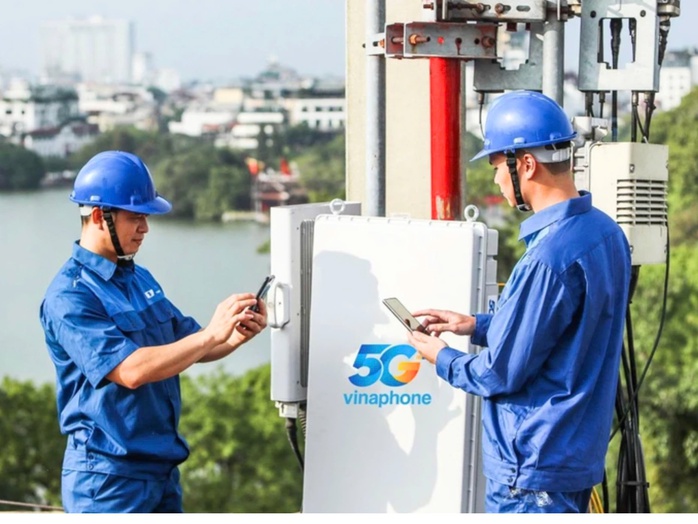
VNPT technicians install a 5G base station. Photo: VNPT
Expedite the expansion of the infrastructure network.
Currently, the three major mobile network operators, Viettel, VinaPhone, and MobiFone, are continuing to deploy 5G base stations. According to the Ministry of Science and Technology, by the end of 2025, 5G coverage will reach 90% of the population in Vietnam. According to the Digital Infrastructure Strategy Objectives for 2025 and orientations for 2030, 100% of provinces, cities, high-tech zones, concentrated information technology zones, research and development centers, innovation centers, industrial parks, train stations, seaports, and international airports will have 5G mobile services.
A representative from VNPT stated that the network operator has completed the deployment of 5G in all 34 provinces and cities. It is expected that by mid-2026, VNPT will expand 5G coverage in the C-band and simultaneously launch 5G on the newly licensed 700 MHz band. The network is projected to reach 16,000 5G base stations, with 50%-60% of the population nationwide covered, focusing on central areas of provinces and cities, national highways, and potential 5G areas such as industrial parks, ports, and airports. "The speed of 5G is estimated to increase 10-15 times compared to the current 4G. Businesses can leverage 5G for production automation, telemedicine, and smart cities…" - the VNPT representative informed.
Viettel announced that it has reached the milestone of installing 20,000 new 5G base stations in 2025, more than three weeks ahead of the schedule committed to the Government. By the end of December 2025, the total number of Viettel's 5G base stations across the network will reach 30,000, covering up to 90% of the outdoor area nationwide. Notably, Viettel is focusing on developing both traditional commercial 5G base stations and "Make in Vietnam" (Open RAN) stations with independent technology, supporting services such as gaming, the Internet of Things (IoT), and smart factories, helping to promote national digital transformation.
At a recent seminar titled "How has 5G commercialization impacted Vietnam's economy?" organized by the Information Technology Journalists Club, Ms. Nguyen Ha Thanh, Deputy General Director of Viettel Telecom, stated that the network aims to deploy an additional 15,000 base stations by 2026, increasing indoor coverage to nearly 85%. MobiFone, on the other hand, plans to have nationwide 5G coverage by 2025; in 2026, the network will invest heavily in 5G infrastructure as well as digital solutions and platforms serving smart cities, drone and UAV rescue, and autonomous vehicles…
The commercialization of 5G in Vietnam only began in early 2024, with the successful auction of 5G frequencies by Viettel and VNPT (March 2024) and MobiFone (July 2024). Building 5G network infrastructure requires not only significant technical investment but is also very expensive for network operators, especially given that subscriber growth is not as explosive as before. Compared to previous technologies, 5G requires many times more base stations. For example, to achieve 100% coverage of Vietnam, approximately 200,000 5G base stations are needed (compared to only 40,000-60,000 4G base stations).
Vietnam's internet ranking has changed significantly.
Thanks to the concerted efforts of various network operators, Vietnam's mobile internet ranking has improved significantly. According to the Speedtest Global Index in November 2025, the average mobile internet speed in Vietnam reached 146.64 Mbps, ranking third in ASEAN; specifically, 5G achieved download speeds of 447.03 Mbps, upload speeds of 99.26 Mbps, and latency of approximately 0.024 seconds. In the fixed internet sector, by the first half of 2025, the subscriber rate reached 24.4 per 100 people, and household fiber optic coverage reached 85.3%, higher than the global average. Along with infrastructure expansion, network operators have launched many daily and monthly 5G packages, priced from 10,000 VND/day or 100,000 - 135,000 VND/month.
Source: https://nld.com.vn/phat-trien-5g-thuc-chat-196260110202515051.htm


![[Image] Ho Chi Minh City simultaneously commences construction and breaks ground on 4 key projects.](/_next/image?url=https%3A%2F%2Fvphoto.vietnam.vn%2Fthumb%2F1200x675%2Fvietnam%2Fresource%2FIMAGE%2F2026%2F01%2F15%2F1768472922847_image.jpeg&w=3840&q=75)






Comment (0)