

A recent report in the US showed that about a quarter of pedestrians at intersections are glued to their mobile devices. "I don't think people realize how distracted they are or how quickly the changes are happening when they're walking and using their phones," said Wayne Giang, an associate professor at the University of Florida. He has spent considerable time researching the link between phone use and pedestrian accidents today.
According to the NYT , mobile devices can cause a state of "unconscious blindness," as some experts call it. Not only do they distract attention from surrounding traffic, but phones also alter mood, gait, posture, and hinder the ability to safely navigate from one point to another along a route.
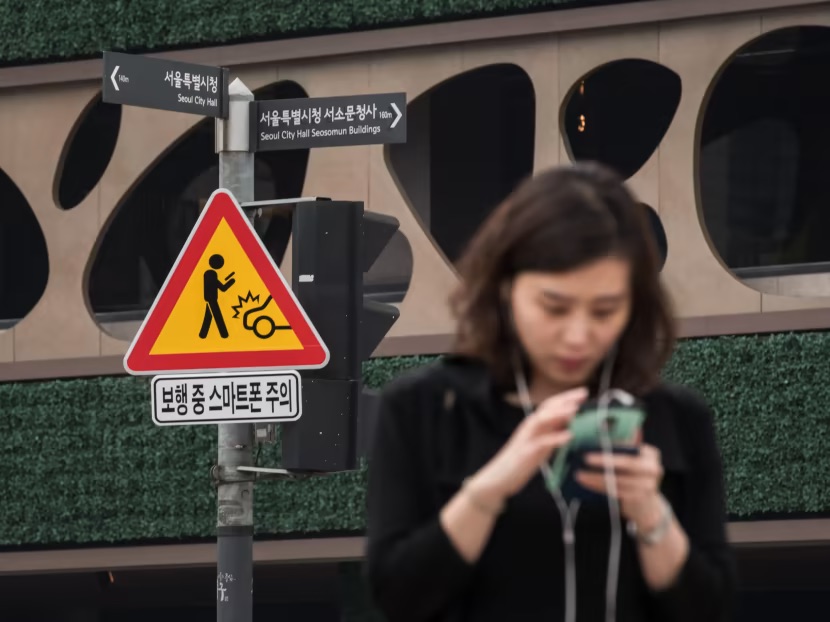
Using a phone while walking alters gait, speed, and mood, as well as increasing the risk of accidents for road users.
How do phones change walking behavior?
Associate Professor Wayne Giang suggests that people who use their phones while walking will instinctively adjust their walking style. A video recording of pedestrian activity showed that those who walked while using their phones moved 10% slower than those who focused on their steps.
Patrick Crowley, a project manager at the Technical University of Denmark, said: "You'll notice some changes in gait that reflect slower movement. People will take shorter strides and spend more time with both feet in contact with the road surface at the same time."
This change increases traffic flow on the pedestrian walkway. According to Elroy Aguiar, associate professor of physical science at the University of Alabama (USA), if walking is an important daily physical activity, then walking more slowly will have consequences for people's physical health.
Walking while looking down at your smartphone (when the natural posture is standing upright) increases the weight and pressure on the muscles in your neck and upper back, causing "text neck" (referring to the neck's altered shape to accommodate the bowed position when texting). Research published in the health journal Gait & Posture shows that these issues impair balance and increase the risk of tripping and falling.
Negative impact on mood
When scientists want to study stress, they often ask volunteers to perform multiple tasks simultaneously because this is a reliable way to induce a state of stress in a person.
In fact, there is evidence suggesting that using a phone while walking has a similar impact on brain function. An experiment on a treadmill showed that people who used their phones while walking produced more cortisol, a stress hormone (but too much of it can be harmful).

Several cities around the world have considered or passed regulations banning the use of mobile phones while walking.
A 2023 report published in New Zealand studied the psychological impact of walking outdoors (in a park) on two groups of people: those who used phones and those who did not. Elizabeth Broadbent, co-author of the study and Professor of Mental Health at the University of Auckland (New Zealand), said: "Overall, when people walk outdoors, they feel better, but that's what happened to the group who didn't use phones."
"For the group who were walking and using their phones at the same time, this effect was reversed. Instead of feeling positive, they tended to have less enthusiastic thoughts, less happiness, and lower levels of relaxation," Broadbent added.
The research team argues that these negative mental effects are a consequence of a "disconnection" from the surrounding environment, contradicting the widely accepted view that walking in natural spaces benefits mental health. "To reap the benefits, attention to the surroundings while walking is crucial. Even using a phone while walking is disruptive and can negatively impact mood," the professor explained.
The dangers of distraction
Most people know that using a phone while walking is dangerous. In some cities, such as Honolulu (Hawaii, USA) or Yamato (Japan), laws have even been passed to restrict distracted pedestrians. Associate Professor Wayne Giang used official data released by the US government between 2011 and 2019 to find nearly 30,000 pedestrian accidents related to phone use. While most accidents occurred while walking on streets or sidewalks, a quarter of them happened at home.
"Tripping over objects or falling down the stairs are real dangers," Mr. Giang emphasized.
Age is one of the main factors contributing to accidents involving mobile phones while walking. Young people aged 11 to 20 have the highest accident rates, followed by adults in their 20s (up to 29), 30s (up to 39), and 40s (up to 49). The research team suggests that this is because young people tend to use their phones more frequently than older age groups.
Mr. Giang advised that for safety, pedestrians should stop to check their phones, ideally moving away from areas where others are moving. If they cannot resist the habit of using their phones while walking, they should try to avoid using them and pay more attention to walking in areas such as stairs, crosswalks, complex roads, or uneven terrain. "These are places where accidents often occur," he said.
Source link

















































































































Comment (0)