


The dream is about to come true.
Previously, the Ho Chi Minh City Department of Transport had sought feedback from the Ministry of Transport , relevant departments, agencies, and units, and finalized the pre-feasibility study report for the Thu Thiem 4 Bridge and Can Gio Bridge projects, submitting it to the City's Appraisal Council at the end of 2023.
Currently, the city has established a grassroots appraisal council to review the pre-feasibility study reports of two projects in order to assess the investment policy. The Department of Transport, the Department of Planning and Investment, and other relevant departments and agencies will coordinate with the grassroots appraisal council to assess the investment policy of the aforementioned projects and submit them to the competent authority for consideration.
According to the pre-feasibility study report, the Can Gio bridge project, spanning the Soai Rap River and connecting Nha Be District with Can Gio District, is expected to have a total length of approximately 7 km, of which the Can Gio bridge itself is about 3 km long, with the remainder being the road section. The starting point is at the intersection of Road No. 2 and Road No. 15B in the Phu Xuan urban area, Nha Be District, about 500 m north of the Muong Ngang canal. It will then cross the Soai Rap and Cha rivers to connect with Can Gio District. The project's end point connects to the Rung Sac road, about 2.1 km south of the Binh Khanh ferry terminal. The Can Gio bridge project has a total investment of 11,087 billion VND.
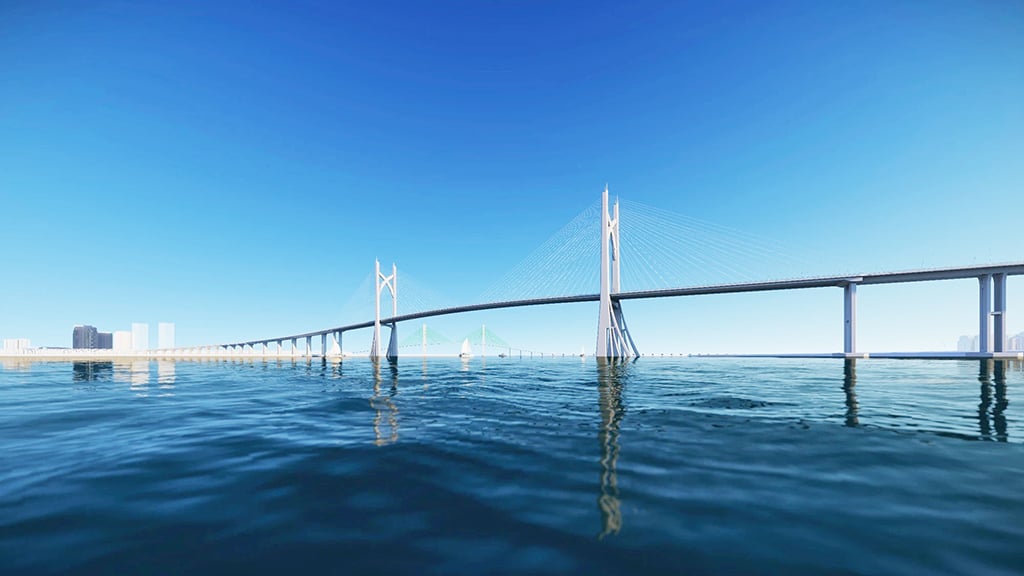
Perspective view of Can Gio Bridge
The architectural design for the Cau Gio Bridge, approved by the Ho Chi Minh City People's Committee in 2019, was a single-tower cable-stayed bridge (230 m high) designed to resemble the mangrove tree – a characteristic feature of Can Gio. However, during the research process, the consulting unit assessed that the above design had several shortcomings and high costs, so they proposed changing the design from a single-tower cable-stayed bridge to a two-tower bridge. The new design still retains the mangrove tree-shaped architectural concept and a navigable clearance of 55 m.
The adjustment of the architectural design plan for the Can Gio Bridge has been agreed upon in principle by the Standing Committee of the Ho Chi Minh City Party Committee. The City People's Committee is assigning the Department of Planning and Architecture to urgently advise and propose an architectural plan for the Can Gio Bridge that ensures the economic and technical efficiency of the project, to be completed this June.
This project tops the list of key projects in the district's transportation network development plan for the period 2023-2030, which the People's Committee of Can Gio District is currently researching and finalizing. In particular, whether the "dream" of an international transshipment port in Can Gio can become a reality largely depends on the speed of developing a road network connecting to the port to serve its operations and related economic services. Among these, the Can Gio bridge project is considered the most urgent.
Therefore, the Department of Transport is actively promoting preparations for the project from now until the end of 2024. If all goes smoothly, the Department of Transport anticipates that compensation, support, and resettlement will be implemented from 2024 to 2025. Following that, a bidding process will be organized to select an investor, and the project will commence in 2025, with completion in 2028.
Besides the Can Gio Bridge, the Thu Thiem 4 Bridge is also being proposed for design changes. The project, connecting the Thu Thiem Urban Area in Thu Duc City to District 7, is currently being studied for a design option that allows the main span to be raised and lowered, facilitating the passage of large ships, instead of the fixed 10-meter clearance as previously considered.
Specifically, the Thu Thiem 4 bridge has a total length of over 2 km, 6 lanes, and a normal clearance of 15 m, but the main span in the middle of the Saigon River can be raised to 45 m through two tower pillars and a lifting system. "However, to determine the clearance and design plan for the Thu Thiem 4 bridge span, the city will have to work with the Ministry of Transport to reach an agreement, because the area is currently being studied for a connection between the North-South high-speed railway and the Ho Chi Minh City - Can Tho railway. The project is expected to be submitted to the Ho Chi Minh City People's Council for investment approval this year, commence construction around April 30th next year, and be completed in 2028," a representative from the Ho Chi Minh City Department of Transport informed.
Along with the Thu Thiem 4 bridge, another landmark project in the heart of Ho Chi Minh City, the pedestrian bridge across the Saigon River, is also nearing approval. Construction is expected to begin on April 30, 2025, and the bridge is scheduled for completion in 2027, with an investment exceeding 1,000 billion VND.
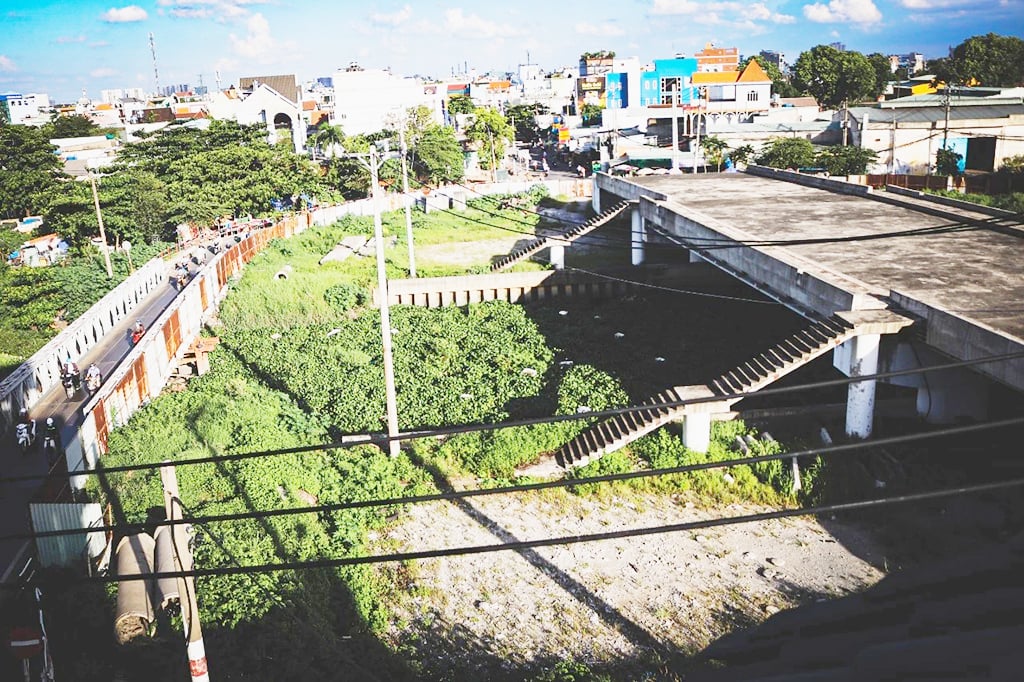
Construction on the unfinished Tan Ky - Tan Quy bridge officially resumed on June 21st and is expected to be completed in December of this year.
Construction on the "dormant" bridges has been restarted.
Not only has the deployment of new projects been accelerated, but a series of bridges that had been "shelved" for half a decade have also been restarted.
Mr. Luong Minh Phuc, Director of the Ho Chi Minh City Investment and Construction Project Management Board for Transportation Works (the investor), said that in December this year, the Rach Dia Bridge connecting District 7 and Nha Be District will be officially completed and put into use to serve the people. Since September 2023, after receiving 100% of the cleared land from the local authorities and relocating technical infrastructure one month later, the investor has continuously urged the contractor to focus on accelerating the construction progress. To date, the Rach Dia Bridge has completed 9 out of 10 abutments, completed the installation of bridge girders for 7 out of 9 spans, and is currently constructing the bridge deck. The approach roads have completed the roadbed treatment, load-reducing slab, and 95% of the drainage culverts have been installed. The units are continuing to work on the road foundations and retaining walls. The total volume of the Rach Dia Bridge project has reached approximately 69%.
Not only are residents in southern Ho Chi Minh City welcoming the new Rach Dia Bridge, but they are also experiencing triple joy as the Phuoc Long Bridge, located on Pham Huu Lau Street and connecting District 7 with Nha Be District, along with the Nguyen Van Linh - Nguyen Huu Tho intersection project, are expected to be completed by the end of the year. In reality, the existing Phuoc Long Bridge, spanning the Rach Dia Canal, has only two lanes and a narrow width. Even outside of peak hours, the heavy traffic volume causes frequent congestion. Therefore, the early construction and completion of the new Phuoc Long Bridge, along with the completion of all three key projects, will significantly contribute to reducing traffic pressure in southern Ho Chi Minh City.
In the northwestern gateway of Ho Chi Minh City, the Tan Ky - Tan Quy bridge project (Binh Tan District) has recently restarted after a six-year hiatus due to land acquisition issues and a change in investment method. This project spans the Tham Luong canal with a total length of 385 meters, including an 83-meter bridge section with four lanes and pedestrian walkways, and the remaining sections being approach roads at both ends. This is the first project in the city to switch from a BOT (Build-Operate-Transfer) model to using state budget funds. This unprecedented move required numerous conversion procedures, which have now been resolved.
According to Mr. Luong Minh Phuc, the new bridge is expected to be completed in December this year, coinciding with the expansion of Tan Ky - Tan Quy road and Tham Luong canal, effectively eliminating the "bottleneck" causing traffic congestion throughout the area.
It is clear that the period from now until 2026 in Ho Chi Minh City will be a time of bridges, as a series of key projects connecting the two banks of the river are officially completed and new projects are started.
Expanding the urban core area.
These billion-dollar bridges not only alleviate traffic congestion and facilitate trade, but also break down the architectural and landscape differences between the two banks of the Saigon River, improve the aesthetics of the riverside landscape, expand the urban core of Ho Chi Minh City, and create an economic breakthrough for the new Thu Thiem city.
A traffic expert
Source: https://thanhnien.vn/tang-toc-hang-loat-cay-cau-18524062520351747.htm
![[Photo] Prime Minister Pham Minh Chinh presides over a meeting of the Steering Committee for the construction of the nuclear power plant.](https://vphoto.vietnam.vn/thumb/1200x675/vietnam/resource/IMAGE/2026/02/13/1770947038316_dsc-1534-jpg.webp)













































































Comment (0)