

Busy making incense sticks in the days leading up to Tet (Lunar New Year).
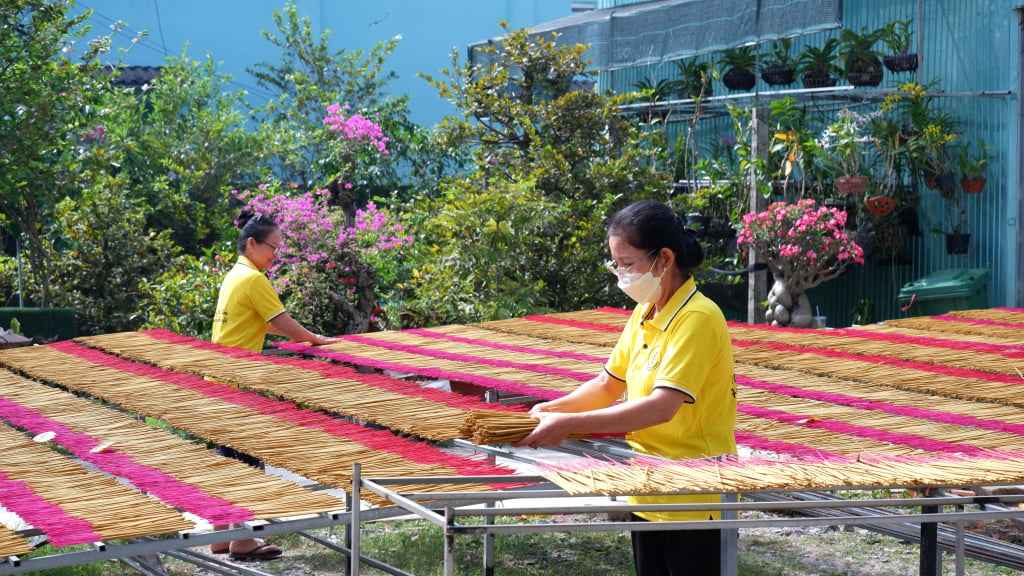
At the Van Linh Huong incense production facility (Long Hoa ward, Tay Ninh province), the atmosphere is busier than usual these days. From early morning, each step—splitting bamboo sticks, rolling incense sticks, bundling them, and drying them in the sun—is carried out continuously. According to Ms. Le Thien Tam, the owner of the facility, Tet (Lunar New Year) is a time when the demand for incense increases significantly due to religious and worship activities. The products are not only consumed within the province but also distributed to many other localities. However, along with the surge in orders, incense production facilities also face many difficulties. Fluctuating input material prices, scarce supply, and mass-produced industrial products create intense competition. In addition, the implementation of new regulations on taxes, electronic invoices, and production standards forces small-scale facilities to change their operating methods. According to Ms. Thien Tam, the OCOP 4-star certification has significantly contributed to enhancing the facility's reputation and expanding its market. This is not only a recognition of quality but also creates opportunities for Tay Ninh's traditional incense products to participate in trade promotion activities, gradually establishing their position in the market.
The rice paper oven burns brightly throughout the night.
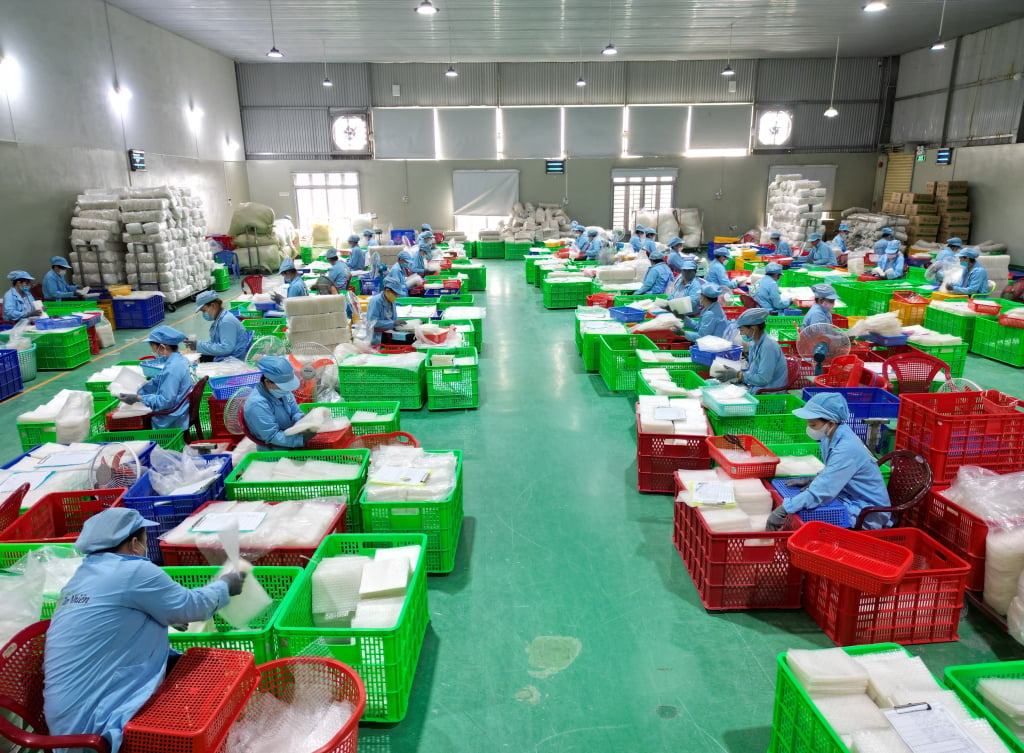
Along with incense making, the rice paper making village – one of Tay Ninh's culinary symbols – is also entering its peak production season. From early morning, the stoves of rice paper makers in Ninh Hung 1 hamlet, Ninh Thanh ward, are already ablaze. During the peak Tet season, the rice paper making process takes much longer than usual, sometimes until mid-afternoon to meet orders. Simultaneously with production, households are also busily packaging and transporting their products to the market. At Tan Nhien Co., Ltd., machinery operates continuously, and workers are working overtime to keep up with deadlines. According to Mr. Nguyen Ngoc Son, the company's business director, purchasing power during this year's Tet season is trending upwards as people's lives gradually stabilize. However, the business also faces pressure from rising raw material, labor, and transportation costs. Despite this, the company is striving to maintain stable prices and ensure product quality. In particular, the 5-star OCOP certification has opened up many opportunities for Tan Nhien rice paper in expanding its market, especially for export. "When approaching foreign partners, the OCOP program is seen as a guarantee of quality, making it easier for products to be accepted," Mr. Son said.
Busy making banh tet (traditional Vietnamese rice cakes) for the spring festival.
In the days leading up to Tet (Lunar New Year), as the scent of spring permeates every home, the hearth of Ms. Duong Thi Phuong Trinh (Duc Lap commune) burns brightly day and night. For over 10 years, she has been dedicated to making banh tet (traditional Vietnamese rice cakes) – a craft she learned from her mother-in-law – quietly preserving her family's nearly 30-year-old tradition while simultaneously providing a stable source of income for the entire family. Normally, her family makes about 80kg of sticky rice, but from the 20th day of the 12th lunar month onwards, production increases eight to ten times compared to normal days. To meet orders, she has to hire extra help. “We offer a wide variety of fillings, from banana, bean, mung bean, peanut, and black bean to vegetarian options. I also make them in various sizes to meet customer needs. Besides banh tet, I also make other traditional cakes like banh it and banh u… To keep up with the schedule, I wake up at over 2 a.m. every day to deliver the batches of cakes cooked the night before, and then prepare the ingredients for the next batch,” Ms. Trinh shared.

According to Ms. Trinh, Tet (Lunar New Year) is the busiest time for orders due to the demand for grave visits, offerings to the Kitchen God, ancestral worship, gifts, and charitable donations. In particular, charitable orders tend to surge from the 15th to the 20th of the lunar month, while from the 20th of the 12th lunar month to the 3rd day of Tet, her family is almost constantly busy.
“In peak years, I worked through the night. Although I was tired and my family advised me to cut back, I did it out of passion. Hearing customers praise the cakes made me very happy; I’ve been doing this for the past 10 years and I don’t feel tired at all. When I took over the family business, I also improved the flavor to better suit people’s tastes. To reduce labor, I invested in more machinery such as electric ovens for steaming banh tet and banh it (traditional Vietnamese rice cakes), and electric pots for cooking cakes. This Tet holiday, seeing the need, I even bought a cake tying machine,” added Ms. Trinh.
Traditional crafts during the Tet holiday season.
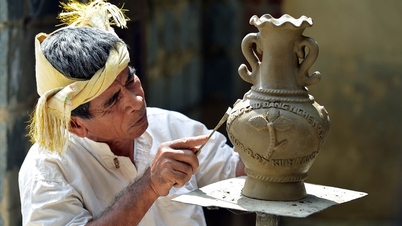
In the days leading up to Tet (Lunar New Year), the sounds of grinding machines and hammers resound in many craft villages. This is also a time of great prosperity for those who make a living polishing bronze incense burners, providing a stable income while contributing to the preservation of the traditional Vietnamese worship culture. In a small, time-worn house, pairs of incense burners and candlesticks are neatly arranged, waiting their turn to be "re-polished." This is where Mr. Ta Hoang Thanh (Long An ward) has spent over 40 years dedicated to the craft of polishing bronze incense burners – a job that demands meticulousness, patience, and carefulness in every step.

According to Mr. Thanh, polishing bronze incense burners is a seasonal job. The peak season is from the 15th day of the 12th lunar month to the Lunar New Year. During this time, he receives an average of 5-6 sets of incense burners per day, sometimes up to a dozen sets. Throughout the entire Tet season, the number of polished bronze incense burners reaches several hundred sets. To complete a set of incense burners, the craftsman must go through three main stages: washing, polishing, and applying powder. Of these, the polishing stage is considered the most important and difficult, because even a small mistake can ruin the entire set. Depending on the size, the time to complete a set of bronze incense burners is about 2-3 hours, with prices ranging from 300,000 to 500,000 VND per set. Mr. Thanh shared: "The difference in the design of the bronze incense burner also determines the difficulty level of the polishing process. Among them, the bamboo-eye incense burner is the most difficult to polish due to its many carved patterns, requiring the craftsman to work carefully by hand, taking more time than with regular models."
Ms. Nguyen Thi Tiet (residing in Long An ward) said: "Tet is the time when families focus on cleaning and decorating the ancestral altar. However, due to the busy end-of-year schedule, hiring someone to polish the bronze incense burners helps ensure that the worship items are clean, beautiful, and solemn."
Amidst the hustle and bustle of modern life, the busyness of traditional craft villages during Tet (Lunar New Year) not only reflects market demand but also demonstrates the enduring vitality of traditional crafts. Each incense stick, each rice paper wrapper, each sticky rice cake is not just a product but also embodies the dedication, experience, and pride of the artisans – those who are daily contributing to preserving the "soul" of Tet in their homeland.
Source: https://baotayninh.vn/tat-bat-vu-tet-ben-bi-giu-lua-nghe-138897.html

![[Photo] General Secretary and President To Lam works with the Party Committee of the Ministry of Health on the work of Vietnamese traditional medicine.](https://vphoto.vietnam.vn/thumb/1200x675/vietnam/resource/IMAGE/2026/05/20/1779294323718_a1-bnd-2978-3319-jpg.webp)
![[Photo] National Assembly Chairman Tran Thanh Man working with the Standing Committee of the National Assembly's Delegation Affairs Committee.](https://vphoto.vietnam.vn/thumb/1200x675/vietnam/resource/IMAGE/2026/05/20/1779294340023_ndo_br_1-1691-jpg.webp)
![[Image] "Journey of Hope" promotes the organ and tissue donation movement in Vietnam.](https://vphoto.vietnam.vn/thumb/1200x675/vietnam/resource/IMAGE/2026/05/20/1779294400833_1-8910-jpg.webp)




























































Comment (0)