

The Ministry of Education and Training is seeking public opinion on the draft Decree detailing some provisions of the Law on Vocational Education and Training (VET). Among these, the proposal to regulate the allowance for arduous, hazardous, and dangerous work for teachers in public VET institutions has attracted considerable attention.
Closer to the conditions of vocational training
Based on the current practice of vocational education and training, Meritorious Teacher and Master Lam Van Quan, Chairman of the Ho Chi Minh City Vocational Education and Training Association, observed that teachers teaching practical skills undertake a very unique type of labor, which is both pedagogical and technical-production labor.
Vocational education teachers frequently work in environments with high-powered machinery and equipment, chemicals, dust, noise, vibrations, high or low temperatures, and even potential risks of workplace accidents and occupational diseases.
The draft decree clearly defines the arduous, hazardous, and dangerous factors as a basis for considering eligibility for allowances, reflecting a more practical approach that is closer to the current conditions of vocational training and education.
"In the context of vocational education and training (VET) facing a shortage of high-quality practical teachers - especially in engineering, technology, and manufacturing sectors - the allowance policy will contribute to improving work motivation, retaining talented individuals, and building more confidence in the education staff," affirmed Meritorious Teacher and Master Lam Van Quan.
Sharing the same view, Ms. Tran Phuong, Principal of Viet Giao Vocational College (Ho Chi Minh City), believes that the proposed allowance system aims to ensure the rights and health of vocational teachers.
According to Ms. Tran Phuong, the salaries and allowances of vocational teachers are still low compared to income in businesses, making many highly skilled individuals reluctant to teach. Therefore, supplementing allowances will somewhat increase the attractiveness of vocational education and training, helping to reduce the number of skilled teachers leaving schools to work in businesses, and at the same time encouraging skilled craftsmen and artisans to participate in teaching.
With a proposed allowance ranging from 0.1 to 0.4 times the base salary, equivalent to approximately 10% to 40% of a teacher's basic salary, Ms. Phuong commented that this is not a very large amount but is sufficient to create a stable source of supplementary monthly income.
"This allowance is calculated based on the actual number of practical teaching hours of teachers in hazardous occupations and will be paid along with their monthly salary. Notably, this allowance is not included in social insurance contributions, meaning teachers will receive the full amount of this support in cash," Ms. Phuong explained.
Dr. Dang Van Sang, Principal of Ho Chi Minh City Polytechnic College, commented that this allowance regulation correctly recognizes the unique characteristics of teaching work in vocational education, which differs from general education or higher education.
In parallel with allowances, Dr. Dang Van Sang proposed that there should be additional regulations on the responsibility for investing in protective equipment and safety technology ; and strengthening the inspection and evaluation of the practice environment. From there, the long-term goal should be to reduce harm in the educational environment, rather than simply "paying for risks".
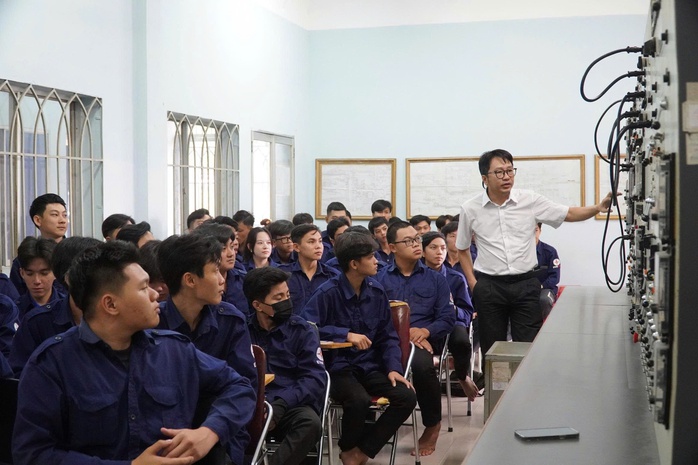
Lecturers from Ho Chi Minh City Power College guide students on simulated power systems.
It's highly feasible!
According to experts, the new regulations on allowances for arduous, hazardous, and dangerous work for vocational education teachers are essentially a continuation and improvement of Government Decree 113/2015/ND-CP. Maintaining this policy not only helps fill the "legal gap" when the new Vocational Education Law comes into effect but also ensures the vital interests of the teaching staff.
In fact, the feasibility of this regulation is highly rated thanks to two core factors. Firstly, the policy is built on a solid legal foundation and years of implementation experience. Secondly, the vocational training system already operates smoothly with the process of reviewing allowances based on hazard levels. Therefore, the application of the new updates will proceed smoothly without causing disruption or confusion.
In addition to paying allowances, some vocational training institutions are also proactively improving working conditions for teachers in specialized fields.
According to Circular 05/2023 of the Ministry of Labour, Invalids and Social Affairs (now the Ministry of Interior), Viet Giao Vocational College has two majors listed as arduous, hazardous, and dangerous: tourism guiding and culinary arts.
For the kitchen practice room, the school has invested in a ventilation system and protective equipment (heat-resistant gloves, smoke masks) to minimize risks for teachers and students. For future field trips related to the tourism industry, the school will implement additional measures to ensure health and safety, such as providing insurance, preparing first aid kits, and having tour guides available.
"Although the allowance is intended to compensate for the risks, the top priority remains minimizing those risks. Compared to other sectors, these two sectors will receive more attention regarding occupational safety and environmental hygiene practices," emphasized Ms. Tran Phuong.
Experts believe that if this draft is approved and implemented effectively, this allowance policy will have a positive impact on the teaching staff – especially those dedicated, skilled teachers who are committed to their profession and want to contribute to the younger generation.
"If this can be achieved, I am confident that this is a policy that is both humane and creates a genuine impetus for the development of vocational education and training, thereby contributing to improving the quality of human resources for the economy," commented Meritorious Teacher Lam Van Quan.
Special allowance scheme up to 85%
According to the draft decree, Article 21 stipulates a special allowance regime applicable to teachers who teach integrated subjects, teachers who are artisans, those with high vocational skills who teach practical subjects, and teachers who teach students with disabilities.
Teachers who teach integrated subjects, or who are outstanding artisans or hold a national vocational skills certificate of level 4 or higher, or a craftsman of level 5/6, 6/7 or higher, or equivalent, and teach practical subjects in colleges or vocational schools, are entitled to a preferential allowance of 40%.
In the case of teaching at schools, classes, centers for people with disabilities or inclusive education development centers, teachers are entitled to a preferential allowance of 85%, plus a job responsibility allowance equal to 0.2 times the basic salary.
Source: https://nld.com.vn/them-phu-cap-giu-chan-thay-day-nghe-196251231195031134.htm





![[Photo] President Luong Cuong and his wife attend the Spring Homeland Art Exchange Program 2026](https://vphoto.vietnam.vn/thumb/1200x675/vietnam/resource/IMAGE/2026/02/08/1770565939066_ndo_br_1-6752-jpg.webp)

































































Comment (0)