

Over the past period, the State Bank of Vietnam (SBV) Provincial Branch has intensified its digitalization efforts, building databases to serve the SBV's monetary and banking management and operation; connecting and exploiting national and specialized databases based on a centralized data aggregation and analysis platform; and actively implementing the Project on developing data applications on population, identification and electronic authentication to serve national digital transformation in the period 2022-2025, with a vision to 2030, as per Decision No. 06/QD-TTg dated January 6, 2022, of the Prime Minister (Project 06), yielding significant results.
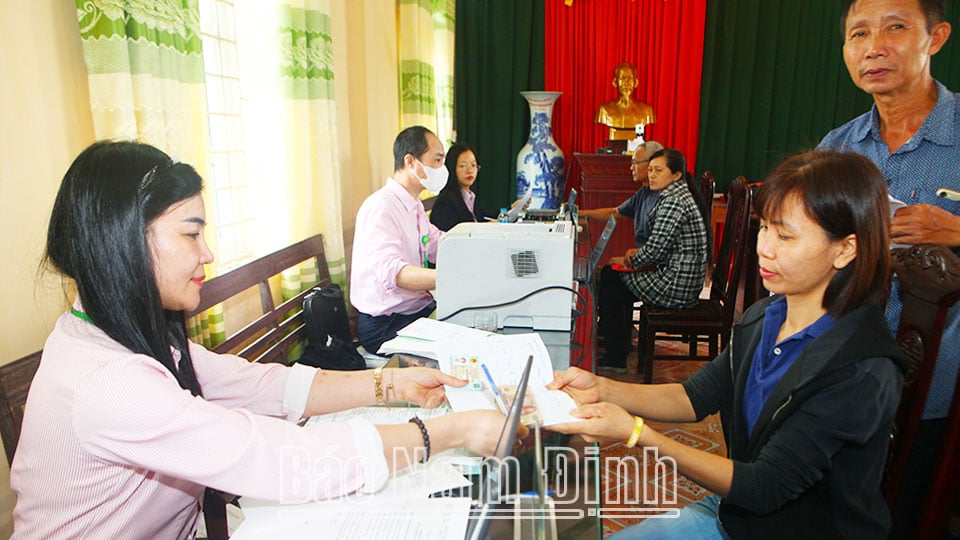 |
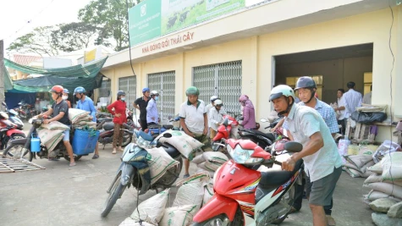
| Disbursement of policy credit funds at the transaction point in Lien Minh commune (Vu Ban district). |
To date, the State Bank of Vietnam's provincial branch has digitized several components of administrative procedure documents on the document management and operational system since 2020 and has modified the electronic one-stop service software to allow digitization of documents and processing results of administrative procedures from June 1, 2023. In March 2024, the branch digitized and updated 23 administrative procedure resolution documents onto the State Bank of Vietnam's electronic one-stop service software. In addition, the State Bank of Vietnam's provincial branch continues to coordinate with the Provincial Police, relevant departments and agencies to connect specialized services with the electronic identification and authentication system, the national database on population, and develop and apply it to the Citizen Identity Card (CCCD) and the VNeID application to provide electronic identification and authentication services in cashless payments, account opening, etc. The State Bank of Vietnam's provincial branch has directed credit institutions and payment intermediaries to apply preferential policies on payment and intermediary service fees for customers, prioritizing customers belonging to groups receiving social welfare policies. By the end of March 2024, the number of beneficiaries receiving payments through accounts was 33,352 people with a total payment amount of VND 37.9 billion per month.
Following the banking sector's plan and the coordination plan between the Ministry of Public Security and the State Bank of Vietnam, credit institutions in the area are cooperating with the Provincial Police to expand customer authentication solutions via chip-embedded citizen identification cards and implement customer authentication solutions via the VNeID application for opening accounts and using electronic banking services. Initially, credit institutions in the area have been cleaning and synchronizing customer data; deploying customer authentication applications via chip-embedded citizen identification cards and the VNeID application for opening and using banking services; The pilot model of "Cashless Payment" has been implemented in high schools, centers, and educational institutions; hospitals, centers, and medical facilities in the province. The service of paying tuition fees through banks has been successfully implemented in 354 schools in the province. In March 2024, banks collected 83,824 transactions totaling 52.6 billion VND. Regarding hospital fee payments, the Vietnam Joint Stock Commercial Bank for Industry and Trade, Bac Nam Dinh Branch, and the Vietnam Bank for Agriculture and Rural Development, Nam Dinh Branch, have signed cooperation agreements to collect payments at 11 hospitals and medical facilities; in March, the banks collected 1,537 transactions totaling 5.8 billion VND.
In addition, the State Bank of Vietnam's provincial branch issued a plan to implement the pilot model of "unsecured loans for poor households and people with meritorious services," and also sent a document requesting the Provincial Police, the Department of Labor, War Invalids and Social Affairs to coordinate with the Department of Administrative Management of Social Order ( Ministry of Public Security ) to implement solutions to "clean up" information on poor and near-poor households and people with meritorious services to serve as a basis for lending to these groups. To strengthen measures to prevent, deter, and handle "illegal lending" activities, the State Bank of Vietnam's provincial branch also actively directed credit institutions to promote online disbursement and apply the National Database on Population in the appraisal and evaluation of customers for lending. To date, 15 out of 25 credit institutions have implemented online lending through their banking applications, serving 5,900 customers with outstanding loans totaling VND 1,892 billion, accounting for 1.8% of the total outstanding loans in the area; 16 out of 25 units have applied the National Database on Population in the process of appraising and evaluating customers for lending based on citizen information on the VNeID app, the website dichvucong.gov.vn, and the results of scanning QR codes on citizen identification cards…
The implementation of Project 06 by the provincial banking sector still faces many difficulties and obstacles. The tasks for implementing Project 06 are carried out according to the plan of the State Bank of Vietnam and the headquarters of credit institutions, making it difficult to determine specific tasks and implementation roadmaps in the area. The cost of data cleaning is considerable for all customers. Transactions interacting with chip-based ID card readers have slow response times and high transaction fees, affecting customer experience. The "cleaning" of customer data for payment accounts and the application of chip-based ID card and VNeID solutions for customer authentication have not been implemented for all customers because many people do not come to the counter to complete the transaction, have changed their contact information, or the bank has notified them but the customers have not updated their information. The implementation of tuition and hospital fee payments through banks is slow because many schools and hospitals lack the necessary technical infrastructure, software, and centralized, standardized data, making it difficult to connect for electronic payments. Furthermore, many hospitals and schools are not yet ready to adopt cashless tuition and hospital fee payments due to concerns about legal procedures and regulations, and bank service fees. Regarding the implementation of the pilot model (Model 20), the Social Policy Bank and commercial banks in the area do not yet have a database of poor households, near-poor households, and people with meritorious services that has been "cleaned up." Currently, the Social Policy Bank is still providing loans to poor and near-poor households based on lists of poor and near-poor households confirmed by the commune-level People's Committees.
To further promote the application of population data in banking operations, the provincial banking sector continues to closely follow the directives and guidelines of the State Bank of Vietnam regarding the connection to the National Population Database, the electronic identification and authentication system for public services, and the operations of the State Bank of Vietnam. It is crucial to understand the roadmap and results of the banking sector's implementation in connecting to the National Population Database, the electronic identification and authentication system for socio-economic development; the application of citizen authentication via chip-embedded citizen identification cards and the VNeID software when providing banking services; and the connection and exploitation of the National Population Database for banking operations. Coordinate with relevant units to implement assigned tasks according to the Plans of the Provincial Project 06 Task Force, especially the pilot model "Cashless payment at high schools, centers, educational institutions; hospitals, centers, and medical facilities in the province" and the pilot model "Implementation of unsecured loans for citizens: poor households, people with meritorious services" according to Plan No. 64/KH-TCTTKĐA dated October 31, 2023 of the Provincial Project 06 Task Force. Continue to direct credit institutions to strengthen the implementation of solutions to prevent, deter, and handle "illegal lending" activities. Ensure security, order, and information security during the digital transformation process.
Text and photos: Duc Toan
Source


![[Image] Central Party Office summarizes work in 2025](/_next/image?url=https%3A%2F%2Fvphoto.vietnam.vn%2Fthumb%2F1200x675%2Fvietnam%2Fresource%2FIMAGE%2F2025%2F12%2F18%2F1766065572073_vptw-hoi-nghi-tong-ket-89-1204-jpg.webp&w=3840&q=75)


























































































Comment (0)