

 |
| Minh Thang Cooperative purchases chili peppers after harvest, ensuring a stable market for farmers. |
When taking risks turns into profits.
The story of chili peppers in Hop Hoa village began with Mr. Le Dai Thang, Party Secretary and Village Head, who pioneered bringing this crop to a land previously only familiar with rice and corn more than two decades ago. In the 2000s, poverty still plagued the people. They cultivated rice and corn year-round, but life remained difficult. In that context, the idea of change began to take root in Mr. Thang. And so, he decided to try his hand at a crop that was not unfamiliar: chili peppers, but one that required large-scale, commercial cultivation.
“Back then, farming rice and corn for so long didn’t make us any better off. I kept thinking, if I didn’t change, I’d be stuck in the same situation my whole life,” Mr. Thang recounted, his gaze fixed on the vibrant red fields before him.
It was a risky decision. His family tried to dissuade him, and his neighbors were skeptical. For many, chili peppers weren't a crop that could provide a livelihood like rice or corn. But he quietly went to learn from other chili-growing regions. He traveled to Van Hoi, Vinh Phuc (formerly), and even to Bac Giang and Bac Ninh to bring back seeds for trial cultivation.
The early days were not easy at all. There was no market, no traders came to buy, so he had to cycle around carrying sacks of chili peppers to sell. Some days he traveled dozens of kilometers, his shirt soaked with sweat. But then, the results exceeded his expectations; the money he earned surprised even himself. Each plot of chili peppers yielded a revenue of 30 million dong, a very large sum at that time. "That much money could buy two gold bars or build a small house. It was a gamble that turned into profit," Mr. Thang recalled, his smile still shining with pride.
The practical results have changed people's thinking. From just a few initial households, the area planted with chili peppers has gradually expanded. Less productive fields have been converted and rotated appropriately to increase productivity. Currently, out of 90 households in Hop Hoa village, 60 have switched to growing chili peppers. As a result, nearly 70% of households have become relatively well-off or wealthy. The total area planted with chili peppers in the village is about 3.5 hectares, with an average yield of over 28 tons/ha. The average selling price of chili peppers fluctuates around 60,000 VND/kg. "Before, the village still had poor households, but now there are none left," Mr. Thang shared.
Mrs. Pham Thi Sinh, 70 years old, who has spent her whole life working in the fields, nimbly picked ripe chili peppers while sharing: "Since I started growing chili peppers, I've finally had some income and savings. Now that I'm old, I'm so happy to see my children and grandchildren less burdened. Chili peppers support the whole village, not just one family."
"Joining hands" to make it big.
While chili farmers previously had to find their own markets, now traders come directly to the fields. The Son Thuy chili fields are gradually shifting from small-scale production to large-scale specialized farming. In this transformation, the role of Mr. Tran Van Thang, Director of Minh Thang Cooperative, is a highlight. Starting with 1-2 acres of chili in 2013, he persevered in expanding production despite facing much skepticism.
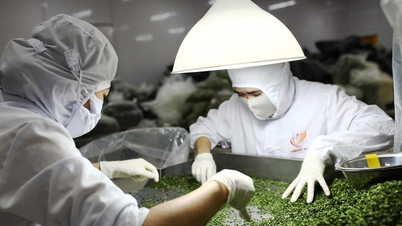
By 2018, he boldly leased two acres of land, earning hundreds of millions of dong each harvest. Not stopping there, he aimed for sustainable production by investing nearly 500 million dong to build a cold storage facility and a workshop spanning over 500 square meters, and establishing a cooperative in 2021.
From here, a production-consumption chain is formed. The cooperative not only purchases chili peppers but also supplies F1 seeds, provides technical guidance, and guarantees the purchase of the farmers' products.
Son Thuy chili peppers are now available in many markets such as China, South Korea, and Thailand, and are also supplied to domestic processing plants. The scale of the cooperative has expanded to approximately 100 hectares, with dozens of households participating.
In years with good prices, chili peppers can fetch 100,000 - 120,000 VND/kg. With one hectare of chili peppers, many households earn around 400 million VND per harvest. Besides providing high income, this model also creates jobs for about 30 local laborers, with an average income of 9 million VND/month during the harvest season.
As a member of the cooperative, Mr. Nguyen Van Hoi from Dong Xe village happily shared: his family earned about 400 million VND this season. “Here, we still call Mr. Thang ‘Thang the chili farmer,’ because he’s always thinking about chili, talking about chili, and working with chili, helping the villagers get rich from chili,” Mr. Hoi humorously recounted.
Comrade Tran Van But, Deputy Secretary of the Party Committee and Chairman of the People's Committee of Son Thuy commune, said: The entire commune currently has about 70 hectares of chili pepper cultivation, mainly converted from less productive rice and corn land. Chili peppers have been identified as one of the key directions in the local agricultural restructuring. In the coming time, Son Thuy will continue to expand the area in a concentrated manner, linking production with consumption and building a brand for chili peppers. The goal is not only to get rich in the short term, but also to achieve long-term sustainable development.
Today, in Son Thuy, the term "millionaire" has become familiar. These are honest, down-to-earth farmers who are bold enough to embrace change and remain dedicated to their land. Amidst the vibrant red fields, chili peppers not only bring economic value but also ignite hope for a new direction. Decisions once considered "risky" have now borne sweet fruit, transforming the face of an entire rural area.
Text and photos: Mai Dung
Source: https://baotuyenquang.com.vn/kinh-te/202604/trong-ot-o-son-thuy-13b3c90/








































































Comment (0)