

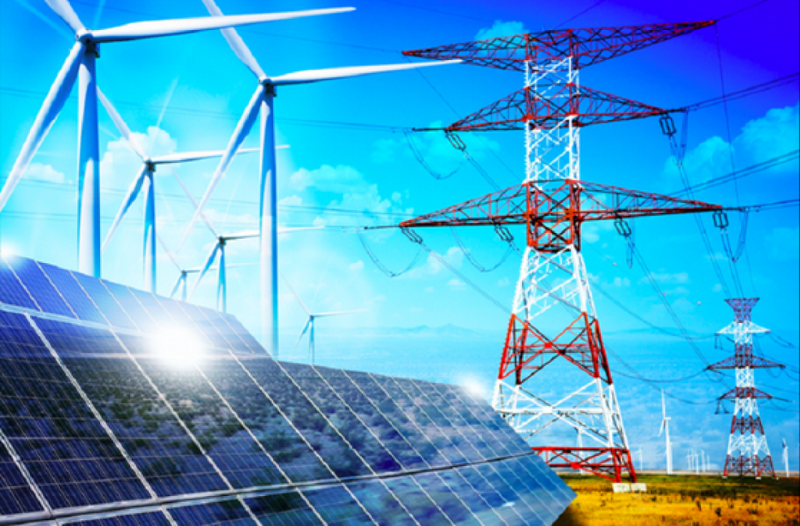
The Decision clearly states the scope and boundaries of the planning: Planning for the development of power sources and transmission grids at voltage levels of 220 kV or higher, industry and services on renewable energy and new energy in Vietnam for the period 2021 - 2030, with a vision to 2050, including grid connection projects with neighboring countries.
Strive for commercial electricity to reach about 500.4 - 557.8 billion kWh by 2030
The specific goal is to provide enough electricity for domestic demand, meeting the socio -economic development target with an average GDP growth rate of about 10.0%/year in the period 2026 - 2030, about 7.5%/year in the period 2031 - 2050.
Of which, commercial electricity: In 2030, it will reach about 500.4 - 557.8 billion kWh; in 2050, it is expected to reach about 1,237.7 - 1,375.1 billion kWh.
Electricity production and import: In 2030, it will reach about 560.4 - 624.6 billion kWh; in 2050, it will reach about 1,360.1 - 1,511.1 billion kWh.
Maximum capacity: In 2030, about 89,655 - 99,934 MW; in 2050, about 205,732 - 228,570 MW.
By 2030, strive to have 50% of office buildings and 50% of houses using self-produced and self-consumed rooftop solar power (serving on-site consumption, not selling electricity to the national power system).
Regarding equitable energy transition , renewable energy sources (excluding hydropower) will be strongly developed for electricity production, reaching a rate of about 28 - 36% by 2030. By 2050, the renewable energy rate is expected to reach 74 - 75%. Building a smart grid system capable of integrating and safely and effectively operating large-scale renewable energy sources.
Regarding the development of industrial ecosystems and renewable energy services , it is expected that by 2030, 02 inter-regional industrial and renewable energy service centers will be formed, including electricity production, transmission and consumption; renewable energy equipment manufacturing industry, construction, installation, related services, building renewable energy industrial ecosystems in areas with great potential such as the North, South Central, and South when there are favorable conditions.
Develop renewable energy sources and produce new energy for export to Singapore, Malaysia and other partners in the region. By 2035, strive to have an electricity export capacity of about 5,000 - 10,000 MW, possibly higher depending on the needs of the importer on the basis of high economic efficiency, ensuring domestic energy security and national defense security.
Maximize power generation from renewable energy
Regarding the power source development plan, the Decision clearly states: Maximize the development of power sources from renewable energy (wind power, solar power, biomass power, etc.), continue to increase the proportion of renewable energy in the structure of power sources and electricity production.
Specifically, promote the development of onshore, nearshore and offshore wind power, solar power, especially water surface solar power in accordance with the absorption capacity of the system, the capacity to release the power grid, the cost of electricity and reasonable transmission costs associated with ensuring the operational safety and general economy of the power system, making the most of the existing power grid infrastructure. Prioritize and encourage the development of wind power, solar power (including solar power on the roofs of houses, commercial centers, roofs of construction works, factory roofs, industrial parks, solar power at production and business establishments) for on-site consumption, not connected or not selling electricity to the national grid. The development of concentrated solar power must be combined with the installation of storage batteries with a minimum rate of 10% of capacity and stored for 2 hours.
By 2030, total onshore and nearshore wind power capacity will reach 26,066 - 38,029 MW.
By 2030, the total onshore and nearshore wind power capacity will reach 26,066 - 38,029 MW (total technical potential in Vietnam is about 221,000 MW). Priority will be given to arranging new planned wind power sources in localities with good wind potential and difficult economic conditions.
Maximize the potential of offshore wind power in our country (about 600,000 MW) to produce electricity and new energy: The total offshore wind power capacity serving domestic electricity demand is about 6,000 - 17,032 MW, expected to operate in the period 2030 - 2035. Orientation to reach 113,503 - 139,097 MW by 2050.
The estimated offshore wind power capacity for new energy production is about 15,000 MW in 2035 and about 240,000 MW in 2050.
Vietnam's solar power potential is about 963,000 MW.
Vietnam's solar power potential is about 963,000 MW (ground - 837,400 MW, water surface - 77,400 MW and rooftop - 48,200 MW). By 2030, the total capacity of solar power sources (including concentrated solar power and rooftop solar power, excluding solar power sources according to Clause 5, Article 10 of Electricity Law No. 61/2024/QH15) will reach 46,459 - 73,416 MW; by 2050, the total capacity is 293,088 - 295,646 MW.
In addition, prioritize and encourage the development of biomass power, electricity produced from waste and solid waste to utilize agricultural and forestry by-products, wood processing, promote afforestation, and environmental treatment in Vietnam. By 2030, the total capacity of biomass power sources will be about 1,523 - 2,699 MW; electricity produced from waste and solid waste will be about 1,441 - 2,137 MW; geothermal power and other new energy will be about 45 MW. Orientation to 2050, biomass power will be about 4,829 - 6,960 MW; electricity produced from waste and solid waste will be about 1,784 - 2,137 MW; geothermal power and other new energy will be about 464 MW.
Maximizing the potential of hydropower resources
The Decision also clearly states: Maximize the economic and technical potential of hydropower sources (total maximum potential in Vietnam is about 40,000 MW) on the basis of ensuring the environment, protecting forests, and protecting water security. Selectively expand existing hydropower plants for reserve capacity; exploit hydropower on irrigation lakes and reservoirs to take advantage of hydropower resources. By 2030, the total capacity of hydropower sources, including small hydropower, will reach 33,294 - 34,667 MW, with a target of 40,624 MW by 2050.
Developing pumped storage hydropower plants with a capacity of about 2,400-6,000 MW by 2030
Regarding power storage sources, develop pumped-storage hydropower plants with a capacity of about 2,400-6,000 MW by 2030; by 2050, pumped-storage hydropower capacity will reach 20,691-21,327 MW to regulate load, reserve capacity and support the integration of large-scale renewable energy sources.
Storage batteries are developed to serve system needs and combine with renewable energy, distributed near wind and solar power centers or on the power system at load centers. By 2030, it is expected to reach a capacity of about 10,000 - 16,300 MW; by 2050, the capacity of storage batteries is expected to reach 95,983 - 96,120 MW to match the high proportion of renewable energy.
In addition, prioritize and encourage the development of cogeneration power plants, power plants using residual heat, blast furnace gas, and by-products of technological lines in industrial facilities.
Phase 2030 - 2035: Putting into operation Ninh Thuan Nuclear Power Plants 1 & 2
Developing nuclear power sources in accordance with the direction approved by the National Assembly in Resolution No. 174/2024/QH15 dated November 30, 2024, Resolution No. 189/2025/QH15 dated February 19, 2025 on special mechanisms and policies for investment in the construction of the Ninh Thuan Nuclear Power Project, and Directive No. 01/CT-TTg dated January 3, 2025 of the Prime Minister. In the period 2030 - 2035, Ninh Thuan Nuclear Power Plants 1 & 2 will be put into operation with a scale of 4,000 - 6,400 MW. In the period up to 2050, the system needs to add about 8,000 MW of nuclear power to provide base power and can increase according to demand.
For coal-fired thermal power: Only continue to implement projects that are already in the planning and under construction until 2030. Orientation to implement fuel conversion to biomass/ammonia for plants that have been operating for 20 years when the cost is suitable. Stop operating plants that are over 40 years old if fuel conversion is not possible.
For gas-fired thermal power: Prioritize the maximum use of domestic gas for power generation. In case of a decrease in domestic gas output, supplement with natural gas or LNG. Develop projects using LNG and synchronous LNG import infrastructure with appropriate scale, using modern technology. Implement a roadmap to convert fuel to hydrogen when the technology is commercialized and the price is suitable.
Flexible power sources: Invest in developing flexible power sources to regulate load, maintain stability of the power system to absorb large-scale renewable energy sources. By 2030, it is expected to develop 2,000 - 3,000 MW. The target for 2050 is up to 21,333 - 38,641 MW.
Boosting electricity imports from Southeast Asian countries and the Mekong Sub-region
Regarding electricity import and export: Effectively connect and exchange electricity with countries in the region, ensure the interests of all parties, enhance the safety of the electricity system; promote electricity import from Southeast Asian countries (ASEAN) and the Greater Mekong Subregion (GMS) with hydropower potential. Pay attention to investing and exploiting electricity sources abroad to supply electricity to Vietnam. In 2030, import about 9,360 - 12,100 MW from Laos according to the Agreement between the two Governments and take advantage of import capacity suitable to connection conditions from China with reasonable scale; orienting to 2050, import about 14,688 MW. If conditions are favorable and prices are reasonable, it is possible to increase the maximum scale or advance the time of importing electricity from Laos to the Northern region.
Prioritize the development of renewable energy sources for export. By 2030, increase the scale of electricity exports to Cambodia to about 400 MW. It is expected that by 2035, the scale of electricity export capacity to Singapore, Malaysia and other partners in the region will reach about 5,000 - 10,000 MW and maintain a scale of 10,000 MW until 2050, possibly higher depending on the needs of the importer on the basis of high economic efficiency, ensuring domestic energy security and national defense security.
Power supply structure
By 2030: Total capacity of power plants serving domestic demand (excluding export) is 183,291 - 236,363 MW, of which:
Onshore and nearshore wind power 26,066 - 38,029 MW (accounting for 14.2 - 16.1%);
Offshore wind power of 6,000 - 17,032 MW to be put into operation in the 2030-2035 period, progress can be accelerated if conditions are favorable and prices are suitable;
Solar power (including concentrated solar power and rooftop solar power, excluding solar power sources according to Clause 5, Article 10 of Electricity Law No. 61/2024/QH15) 46,459 - 73,416 MW (accounting for 25.3 -31.1%);
Biomass electricity 1,523 - 2,699 MW, electricity produced from waste 1,441 - 2,137 MW, geothermal electricity and other new energy about 45 MW; can be developed on a larger scale if there are enough raw materials, high land use efficiency, environmental treatment needs, grid infrastructure allows, electricity prices and transmission costs are reasonable;
Hydropower 33,294 - 34,667 MW (accounting for 14.7 - 18.2%), can develop further if the environment, forest protection, and water security are ensured;
Nuclear power 4,000 - 6,400 MW put into operation in 2030 - 2035, progress can be accelerated if conditions are favorable;
Storage source 10,000 - 16,300 MW (accounting for 5.5 - 6.9%); Coal-fired thermal power 31,055 MW (accounting for 13.1 - 16.9%); Domestic gas-fired thermal power 10,861 - 14,930 MW (accounting for 5.9 - 6.3%); LNG thermal power 22,524 MW (accounting for 9.5 - 12.3%);
Flexible power source (thermal power using LNG, oil, hydrogen fuel... with high operational flexibility) 2,000 - 3,000 MW (accounting for 1.1 -1.3%);
Pumped storage hydropower 2,400 - 6,000 MW;
Import 9,360 - 12,100 MW of electricity from Laos and China (accounting for 4.0-5.1%, maximizing the scale of electricity import from Laos according to the Agreement between the two Governments or accelerating the time of electricity import from Laos to the Northern region if conditions are favorable).
For coal-fired power sources facing difficulties in deployment, borrowing capital and changing shareholders, the processing process will be updated to adjust the structure of wind, solar and biomass power sources to suit the needs.
Regarding participation in direct power purchase agreements (DPPA) and new energy production: According to statistics, currently the number of large customers consuming 1 million kWh/year or more accounts for about 25% of the total electricity output of the entire system (with about over 1,500 customers).
By 2030, the scale of electricity exports to Cambodia will increase to about 400 MW. It is expected that by 2035, the capacity of electricity exports to Singapore, Malaysia and other partners in the region will be about 5,000 - 10,000 MW, possibly higher depending on the needs of the importer on the basis of high economic efficiency, ensuring domestic energy security and national defense security.
Grid development plan
Phase 2025 - 2030: New construction of 102,900 MVA and renovation of 23,250 MVA of 500 kV transformer stations; new construction of 12,944 km and renovation of 1,404 km of 500 kV lines; new construction of 105,565 MVA and renovation of 17,509 MVA of 220 kV transformer stations; new construction of 15,307 km and renovation of 5,483 km of 220 kV lines.
Orientation for the period 2031 - 2035: Newly build 26,000 - 36,000 MW of high-voltage direct current (HVDC) converter stations and 3,500 - 6,600 km of high-voltage direct current (HVDC) transmission lines. Newly build 73,800 MVA and renovate 36,600 MVA of 500 kV transformer stations; newly build 7,480 km and renovate 650 km of 500 kV lines; newly build 44,500 MVA and renovate 34,625 MVA of 220 kV transformer stations; newly build 4,296 km and renovate 624 km of 220 kV lines.
Orientation for the period 2036 - 2050: Newly build 26,000 - 36,000 MW of HVDC station capacity and 3,600 - 6,700 km of HVDC lines; newly build 24,000 MVA of high-voltage AC converter stations (HVAC stations) above 500 kV and 2,500 km of HVAC high-voltage AC transmission lines above 500 kV; newly build 72,900 MVA and renovate 102,600 MVA of 500 kV transformer stations; newly build 7,846 km and renovate 750 km of 500 kV lines; newly build 81,875 MVA and renovate 103,125 MVA of 220 kV transformer stations; 5,370 km of new construction and 830 km of 220 kV transmission lines renovation.
Investment capital needs
The decision clearly states that in the period of 2026 - 2030: Total investment capital for developing power sources and transmission grids is equivalent to 136.3 billion USD, of which: investment for power sources is about 118.2 billion USD, and power transmission grid is about 18.1 billion USD.
Orientation for the period 2031 - 2035: Estimated capital demand for development investment in power sources and transmission grid is equivalent to 130.0 billion USD, of which: investment in power sources is about 114.1 billion USD, transmission grid is about 15.9 billion USD, will be determined in the following plans.
Orientation for the period 2036 - 2050: Estimated capital demand for development of power sources and transmission grid is equivalent to 569.1 billion USD, of which: investment for power sources is about 541.2 billion USD, transmission grid is about 27.9 billion USD, will be determined in the following plans.
Source: https://hanoimoi.vn/van-hanh-nha-may-dien-hat-nhan-ninh-thuan-1-2-trong-giai-doan-2030-2035-699189.html











































































Comment (0)