

 |
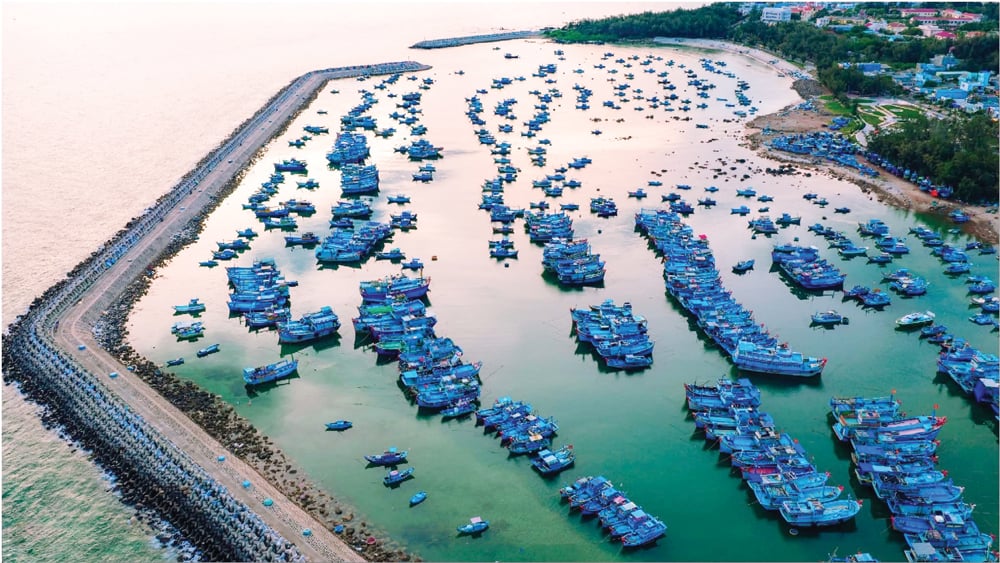
| The marine economy is a new driving force for Lam Dong. |
According to Decision No. 759/QD-TTg dated April 14, 2025, of the Prime Minister, Lam Dong province, Binh Thuan province, and Dak Nong province will merge into a new province named Lam Dong. The new Lam Dong province will have an area of 24,233 km² and a population of 3,324,400 people. After the merger, Lam Dong will become the largest province in the country by area.
Currently, although the three provinces of Lam Dong, Binh Thuan, and Dak Nong differ in natural conditions and socio-economic factors, the newly merged Lam Dong province, with its unique potential in geography, resources, human capital, and infrastructure, is facing a great opportunity to build an effective regional linkage structure. The merger will create a large territory with uniform natural conditions, making it easier to comprehensively plan the development of high-tech agriculture , ecotourism, agricultural processing industries, and renewable energy.
The merger of Lam Dong, Binh Thuan, and Dak Nong provinces is not only a matter of reorganizing administrative boundaries, optimizing resources, exploiting economic potential, promoting regional linkages, forming major economic centers, creating conditions to enhance competitiveness and attract investment, in line with the trend of international integration, but also a strategic development solution. In the current regional development context, organizing an interconnected economic space among localities is a prerequisite for effectively exploiting local potential, enhancing regional linkages, and promoting sustainable, balanced, and efficient development.
Architect Tran Ngoc Chinh - President of the Vietnam Urban Planning and Development Association, former Deputy Minister of Construction - believes that reorganizing the economic space in conjunction with the development of urban systems in this inter-region will contribute to building a new economic driving force in the Southern Central Highlands and the South Central Coast region, especially in the orientation of developing Da Lat into a political, cultural, scientific, and technological center of the region and the whole country.
Located at the intersection of the Central Highlands, Southeast, and South Central regions, the three provinces of Lam Dong, Binh Thuan, and Dak Nong have the potential to become an important inter-regional bridge between the inland and the sea. Lam Dong stands out with its high-tech agriculture, tourism, and research and education potential. Dak Nong has strengths in energy, minerals, and agriculture and forestry. Binh Thuan is a center for marine economy, tourism, and renewable energy.
The connection between major cities like Da Lat - Gia Nghia - Phan Thiet opens up an effective cross-regional development axis. Da Lat could become a regional center for culture, science, and technology. Phan Thiet aims to be a center for coastal tourism, logistics, and marine services. Gia Nghia plays the role of an energy hub and goods transshipment center. In terms of tourism, Lam Dong province, with its long and beautiful coastline, as well as its forests, mountains, and artificial lakes, will offer diverse and unique ecological experiences. The "highland - coastal" product chain, when connected, will attract a large number of domestic and international tourists.
Currently, Da Lat is considered the tourism and high-tech agricultural "capital" of Lam Dong province, while Dak Nong has great potential in minerals and renewable energy. The merger will create a central urban area with strong appeal, capable of becoming a new economic growth pole of the Central Highlands, promoting investment, attracting high-quality human resources, and improving the lives of people in the region.
Following the merger, the new province will have Lien Khuong and Phan Thiet international airports, the North-South railway, the North-South expressway, the Dau Giay-Lien Khuong expressway, a planned railway connecting Da Lat and Phan Thiet, seaports, and several inland waterways capable of inter-regional connectivity. The completion of upgrades to National Highways 28B and 55 and the construction of the Dau Giay-Lien Khuong expressway will ensure seamless inter-provincial connectivity. The construction of a cargo transshipment port at Ke Ga will enhance import and export capacity. The development of a modern logistics system will serve the global supply chain.
However, alongside the expected potential and benefits, the merger of the three provinces into a new administrative unit poses many challenges in organizing economic development space in a synchronized and sustainable manner. These challenges relate not only to planning but also to institutions, economic structure, and the specific socio-cultural factors of each region.
Architect Tran Ngoc Chinh also noted that one of the major obstacles in connecting economic development spaces is the weak transportation and logistics infrastructure system. Although large projects are underway, East-West connectivity, especially from the highlands to the coast, remains limited, lacking horizontal connectivity between provinces; particularly inter-district and inter-commune transportation. In addition, freight transport routes, inland port infrastructure, and warehousing facilities are also underdeveloped.
 |
| Ta Dung is an attractive tourist destination. Photo: SangDL |
Thus, the merger of Lam Dong, Binh Thuan, and Dak Nong to form a new administrative unit is a groundbreaking step, but the difficulties in organizing a synchronized and efficient economic space cannot be overlooked. Challenges from infrastructure, institutions, economic differentiation, and socio-natural characteristics require a well-structured, scientific regional planning strategy, along with flexible and appropriate transition support mechanisms. Only by successfully addressing these difficulties can the merger truly become a catalyst for sustainable development in the Southern Highlands in the future.
For many years, Da Lat City has been known as an important tourism, economic, and cultural center of Lam Dong province and the Central Highlands region. It is a globally recognized destination for resort tourism and high-tech agriculture, attracting tourists and domestic and foreign investors, and strongly associated with the image of the Southern Central Highlands. Da Lat's economic role has extended beyond Lam Dong province and has a significant influence in the Central Highlands and South Central regions. In the Lam Dong provincial planning, Da Lat City is planned to develop as the administrative, political, economic, cultural, tourism, and scientific and technological center of the Central Highlands; Da Lat and its surrounding areas are planned to become a high-quality tourism center in Southeast Asia, an attractive destination for tourists from developed, high-income countries. Compared to Gia Nghia (Dak Nong) or Phan Thiet (Binh Thuan), Da Lat does not have a very large population, but it possesses unique urban characteristics: it is a Class I city directly under the provincial administration, with a developed system of services, education, and healthcare. These are favorable conditions for building and operating the provincial-level administrative apparatus after the merger.
According to architect Tran Duc Loc, Vice President of the Lam Dong Provincial Planning and Architecture Association, the new Lam Dong will not stop at being a "unified province" but will become a "convergent province" - a place where many cultural regions coexist, develop, dialogue, and spread. It will be a unique administrative, economic, and cultural entity, leading the country in its multi-regional, multi-sectoral, and multi-identity planning model, commensurate with its ranking as the largest province in the country in terms of natural area.
Professor Mai Trong Nhuan, former Director of Hanoi National University, hopes that Lam Dong will become a green and clean agricultural product supermarket for the whole country and an ideal resort destination for domestic and international tourists. Lam Dong is not only a leading locality in high-tech agriculture, but also possesses the golden conditions to become a "health recharging station" - a place where nature, technology, and sustainable living are combined.
Source: https://baolamdong.vn/kinh-te/202506/van-hoi-hoi-tu-0c53663/

![[Image] The 14th Party Congress implements the content on personnel work.](/_next/image?url=https%3A%2F%2Fvphoto.vietnam.vn%2Fthumb%2F1200x675%2Fvietnam%2Fresource%2FIMAGE%2F2026%2F01%2F22%2F1769088146286_ndo_br_1-6165-jpg.webp&w=3840&q=75)


![[Photo] Voting for the 14th Central Committee of the Communist Party](/_next/image?url=https%3A%2F%2Fvphoto.vietnam.vn%2Fthumb%2F1200x675%2Fvietnam%2Fresource%2FIMAGE%2F2026%2F01%2F22%2F1769082445591_chi-9961-jpg.webp&w=3840&q=75)


Comment (0)