

 |
| Edufarm Hue staff care for and walk horses around the farm. Photo: Edufarm |
Hue cultural researcher Nguyen Xuan Hoa says that the ancient capital region was once very close to horses. In Sia, horse-drawn carriages used to travel on the dirt roads. In the royal court, cavalry, horse riders, saddles, and costumes of the Nguyen Dynasty are still preserved to this day.
Hue boasts picturesque landscapes. Thien An Hill, with its pine forests rustling in the sun and gentle slopes stretching like a green carpet; Bach Ma Mountain – a windy mountain range blending with the grass, trees, and sky; Tam Giang Lagoon – vast and expansive… All of these could become ideal horseback riding routes.
In the trend of green tourism and slow travel, horseback riding is a quiet, unpretentious activity for those who want to harmonize with nature. In the effort to find new directions for Hue tourism, horseback riding is a promising suggestion. But how can we avoid falling into a model of mere borrowing, and preserve the essence of Hue in every step?
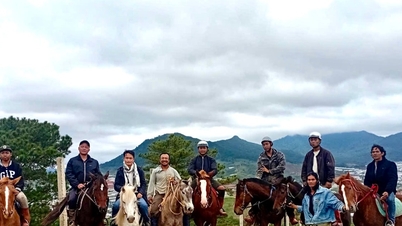
At the Imperial Citadel, the image of horses has made a brief comeback with horse-drawn carriage services, albeit on a small scale, but like a prelude to something new. Meanwhile, at the Edufarm Hue Farm and Tourist Area, located near the ancient town of Bao Vinh, a horse-riding and nature-viewing experience is in operation. This is an eco-friendly farm where visitors can ride horses along dirt paths bordering the fields and participate in rustic experiences.
 |
| The children enjoyed the experience of caring for horses. Photo: Edufarm |
Mr. Nguyen Minh Chau (An Cuu ward) recounted that his first horseback ride at Edufarm made him "feel like he was stepping out of all his preconceived notions about Hue." When the horse stopped on the wide grassy slope, he "felt something very natural, very lively." For Mr. Thin (Edufarm manager), horseback riding is just one piece in the puzzle of agricultural experiences that the farm wants to create. The model aims to help children learn to be close to nature, understand and love animals. "When you understand the animals, the feeling of riding a horse will be much safer and more enjoyable," Mr. Thin said.
Regarding horseback riding tourism, researcher Nguyen Xuan Hoa suggested that Hue should develop it based on its own cultural values, rather than copying Da Lat or other places. Hue could exploit the image of ancient horse-drawn carriages, recreate horseback riding in the Imperial Citadel, or build photo spots associated with the imperial court. But achieving the "real" level is not easy. "Horse riding is not a common habit; it requires serious training, a large herd of horses, high care costs, and very strict safety requirements. A genuine horseback riding tour for 15-20 guests means needing a corresponding herd of horses, leading to a significant economic challenge," Mr. Hoa said.
Mr. Hoa further analyzed that while spaces like Thien An and Bach Ma are beautiful, the key point remains whether investors see the profit and dare to take the plunge. Just riding horses isn't enough. If Hue wants to go the distance, it must create a supporting service ecosystem.
From a management perspective, Ms. Tran Thi Hoai Tram, Director of the Hue City Department of Tourism, shared that horseback riding tourism has potential but can only become a genuine product when businesses participate with a long-term vision. “We hope to see more new and unique tourism models to extend the length of stay for tourists. Horseback riding tourism can certainly become a highlight, but it must be thoroughly researched and done professionally,” Ms. Tram said.
 |
| Bach Ma boasts ideal routes for horseback riding experiences. Photo: Le Tho |
According to Ms. Tram, horseback riding is not just about "serving guests with horses," but a whole system of investment, stables, personnel for care and training, safety standards, experiential itineraries linked to Hue's identity, and connections to surrounding services. Hue has advantages such as hills, forests, ecological farms, and heritage spaces, but superficial implementation will make it difficult for the product to thrive.
"The commitment of the business is the decisive factor. If there is a serious investor, the Department of Tourism is ready to provide maximum support, from procedures and connecting potential destinations such as Thien An, Bach Ma, and the suburban hills… to promoting and advertising the product," Ms. Tram said.
Looking at the reality here, potential doesn't mean a smooth road, as Hue lacks breeding facilities, trainers, safety standards, and even the minimum requirements for a type of tourism that demands high standards.
I know it's difficult, but I still hope that one spring day, very soon, on the slopes of Thien An hill or the path leading up to Bach Ma mountain, the sound of horse hooves will become a familiar and comforting sound, opening up a new path, both strange and familiar, just like the beauty of spring in the ancient capital inviting visitors from afar.
Source: https://huengaynay.vn/du-lich/vo-ngua-mo-cung-duong-162589.html
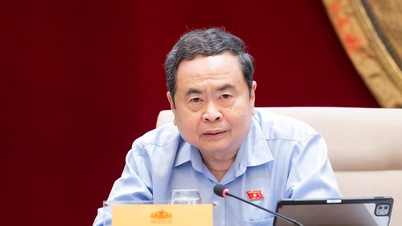
![[Photo] National Assembly Chairman Tran Thanh Man working with the Standing Committee of the Law and Justice Committee](https://vphoto.vietnam.vn/thumb/1200x675/vietnam/resource/IMAGE/2026/05/21/1779378929214_ndo_br_1-4610-jpg.webp)
![[Photo] General Secretary and President To Lam presides over a working session with the Central Policy and Strategy Committee on the development of the materials industry.](https://vphoto.vietnam.vn/thumb/1200x675/vietnam/resource/IMAGE/2026/05/21/1779359935432_a3-bnd-3129-1412-jpg.webp)





















































Comment (0)