

On the occasion of the 115th anniversary of his birth (July 10, 1910 - July 10, 2025), readers have the opportunity to return to " Echoes of a Bygone Era , " "The Da River," and other essays imbued with the national spirit, to better appreciate a Nguyen Tuan always present in the beauty of language, in the standards of his writing, and in his ultimate passion for beauty. As writer Nguyen Dinh Thi once remarked: "Nguyen Tuan was a man who spent his whole life searching for beauty and truth."
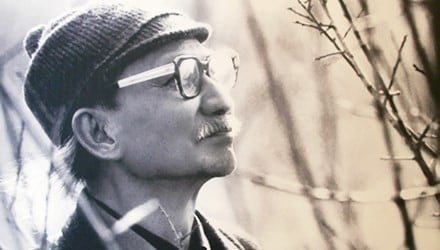
Nguyen Tuan and the spring in Hanoi .
Nguyen Tuan was born on July 10, 1910. He came to writing as a spiritual journey, where beauty was a horizon that never ceased to beckon. According to Professor Phong Le, passion and dedication to the profession – that's a common trait among many who choose writing as a career, not just Nguyen Tuan. But for Nguyen Tuan, this was truly unique; literary creation had to be a noble profession. A language that is distinctly Vietnamese and distinctly Nguyen Tuan – that was the highest goal Nguyen Tuan achieved, from his earliest works to his last.
Nguyen Tuan chose his own path. He did not choose critical or analytical writing, but rather used his pen to preserve and honor. Amidst a literary trend leaning towards criticism, he quietly sought out the beauty that had been and was being lost, cherishing cultural values and the character of talented individuals, transforming them into vibrant art in every page of his writing.
A guardian of national cultural heritage in the flow of modernity.
Among his works, "Vang bóng một thời" (A Glimpse of the Past ) – the work that brought him fame – is a spiritual legacy, a cultural epic. Old pleasures like tea drinking, poetry recitation, lantern parades, and calligraphy, under his pen, become living rituals imbued with the national spirit. Nguyen Tuan doesn't dwell on the past with tears; he preserves it through language. Hidden within each word is a melancholic yet not mournful perspective, solemn yet not clichéd. Nguyen Tuan created a world where beauty is celebrated like a religion. With his masterful pen and a heart that cherishes heritage, Nguyen Tuan preserved traditional beauty as a way of preserving the nation's essence in the flow of modernity.
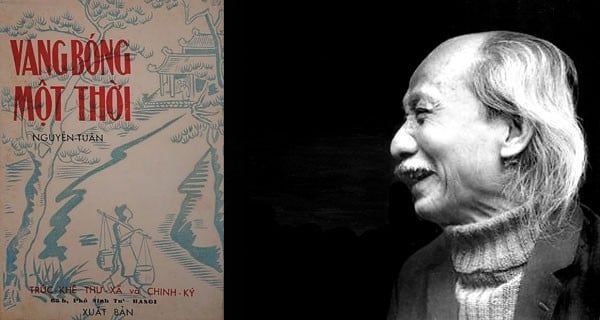
Nguyen Tuan established his reputation with his writing style, "Echoes of a Bygone Era."
Besides *Vang bóng một thời* (A Glimpse of the Past) , Nguyen Tuan also wrote many other works about the landscapes of Vietnam, the flavors of the country, and the soul of the nation, such as: *Pho* (Vietnamese noodle soup), *Cây Hà Nội* (Hanoi Trees), *Cốm* (Vietnamese sticky rice flakes), *Giò lụa* (Vietnamese pork sausage), *Tờ hoa* (Flower Sheet), *Tình rừng* (Love of the Forest)... These are beautiful, unique, and masterful literary works that, besides Nguyen Tuan, would be difficult for any other writer to replicate.
"The King of Essays"
In his introduction, Professor Phong Le emphasized that Nguyen Tuan was a man who "reached beauty and truth." Appearing on the literary scene in the late 1930s and early 1940s, Nguyen Tuan immediately established his name with a literary work that almost encapsulated and crystallized all the essence that makes up the perfection and excellence of a writing style: "Echoes of a Bygone Era." With such an impressive beginning as " Echoes of a Bygone Era ," Nguyen Tuan approached the August Revolution with a complete dedication to living with the times, with contemporary, tangible life.
If, in the earlier period, Nguyen Tuan was passionate about depicting beauty in tradition, after the August Revolution, he chose to set aside his artistic ego and immerse himself in the collective self of the community. From a Nguyen Tuan who once wrote as a way of asserting his individuality amidst turbulent times, he embarked on a new path – living and writing with the nation, allowing his personal talent to shine within the great current of the revolution and the lives of the people. Works such as "The Ferryman on the Da River," "Campaign Love," "The Joyful Road," "Hanoi, We Fought the Americans Well," etc., are milestones that show a Nguyen Tuan who remains talented, but is more profound, more deeply connected, and closer to the people than ever before.
Among them, the essay "The Ferryman on the Da River" is a prime example of the blossoming of Nguyen Tuan's style in the new era. Under his pen, the Da River is not merely a geographical entity, but becomes a vibrant character. At times it "complains," "pleads," at other times it "provokes," "mocks," and then suddenly "roars like a thousand raging buffaloes in a forest of bamboo and reeds ablaze with fire." But at other times, it "flows like a lyrical lock of hair, its head and ends hidden in the clouds of the Northwest sky." Rarely has a writer been able to imbue rivers, rocks, and mountains with such profound nuances and emotions.
For Nguyen Tuan, the essay was not just a genre. It was his domain, where he placed his personal ego alongside national sentiment, where all boundaries could be overcome through imagination and culture. People called him "the king of essays" not because of the quantity, but because of the quality: he transformed spontaneity into art, the flow of emotion into a tightly structured narrative, and profound knowledge into writings that deeply moved people.
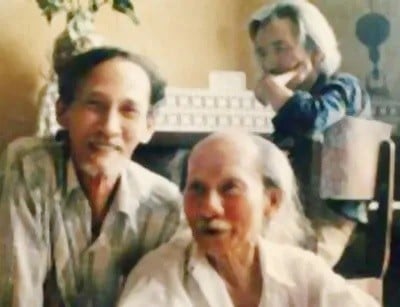
Nguyen Tuan (center) with Bui Xuan Phai and Van Cao.
"Each word seems to have its own unique mark."
Throughout his life, Nguyen Tuan was always deeply aware of his responsibility and had a profound love for everything related to "our language"—the place where the soul of national culture is crystallized.
His vocabulary is both rich and refined, both classical and modern, full of emotion yet highly disciplined. A single sentence by Nguyen Tuan can be as long as a piece of music, but the rhythm is precise and the tempo clear.
In his work, "every word seems to bear its own unique mark." He could describe the color of the sea in Co To by referring to the "color of Kim Trong's robe" during the Thanh Minh festival - a bold yet profound association, both evocative of image and soul.
Researchers praise the linguistic "feasts" in Nguyen Tuan's writings and have even suggested compiling a dictionary of Nguyen Tuan's language – including terms like "Phai Street," "island district," etc., which he contributed to the common vocabulary of the Vietnamese language. It is understood that this entire shimmering realm of language is the culmination of a life of experience, passionately collecting every precious nuance of his mother tongue…
Many later linguists still remember Nguyen Tuan as someone who enriched the Vietnamese vocabulary through his meticulousness and creative prowess.
For nearly half a century, Nguyen Tuan spent his writing life as an artist, keeping the flame alive. It's not easy to find a writer whose works and life both radiate such artistic dedication. He once said, "To write like a flower, you must work as diligently as a bee making honey." His entire life was the industriousness of a bee wandering through a garden of words, silently absorbing beauty to extract sweet nectar for his literature.
Nguyen Tuan passed away in 1987, but his influence remains present in every book and every literature lesson, as a reminder that beauty, if cherished to the fullest, will always have a worthy place in the human soul.
Returning to Nguyen Tuan is returning to a soul that spent its life searching for beauty—not the flashy kind, but the profound beauty found in culture, language, way of life, and writing. It is this meticulous talent that has created a legacy that, when reread by each generation, inspires them to live more slowly, more deeply, and more subtly.
thethaovanhoa.vn
Source: https://baolaocai.vn/115-nam-ngay-sinh-nha-van-nguyen-tuan-nguoi-suot-doi-di-tim-va-sang-tao-cai-dep-post648303.html






































































Comment (0)