

Lesson 1: Remarkable Development
The shift in production mindset, from traditional small-scale livestock farming in the early years after liberation to high-tech livestock farming in recent years, has helped many households escape poverty and become wealthy. Simultaneously, it has improved the quality of livestock products. Along with this, the market for these products has gradually expanded not only domestically but also internationally.
PROMOTING THE APPLICATION OF SCIENCE AND TECHNOLOGY
According to the Department of Livestock and Veterinary Medicine of Tien Giang province, in recent years, many livestock farmers have boldly invested in cold storage systems, automatic drinking water systems, feed silos, and automatic egg collection systems, helping to save labor and reduce costs; at the same time, effectively controlling the living conditions of livestock. Among these, one of the outstanding applications is the temperature and humidity sensor system in livestock barns, a device considered a "powerful assistant" that helps farmers adjust the environment appropriately, limit disease outbreaks, and increase herd productivity.
Precise control of temperature and humidity not only improves animal health but also shortens growth time and reduces losses in livestock farming. In addition, a closed-loop waste treatment system using microbial composting tanks, combined with solar energy, has helped many farms minimize pollution; at the same time, utilizing livestock manure to produce organic fertilizer, both protecting the environment and generating additional income from by-products.
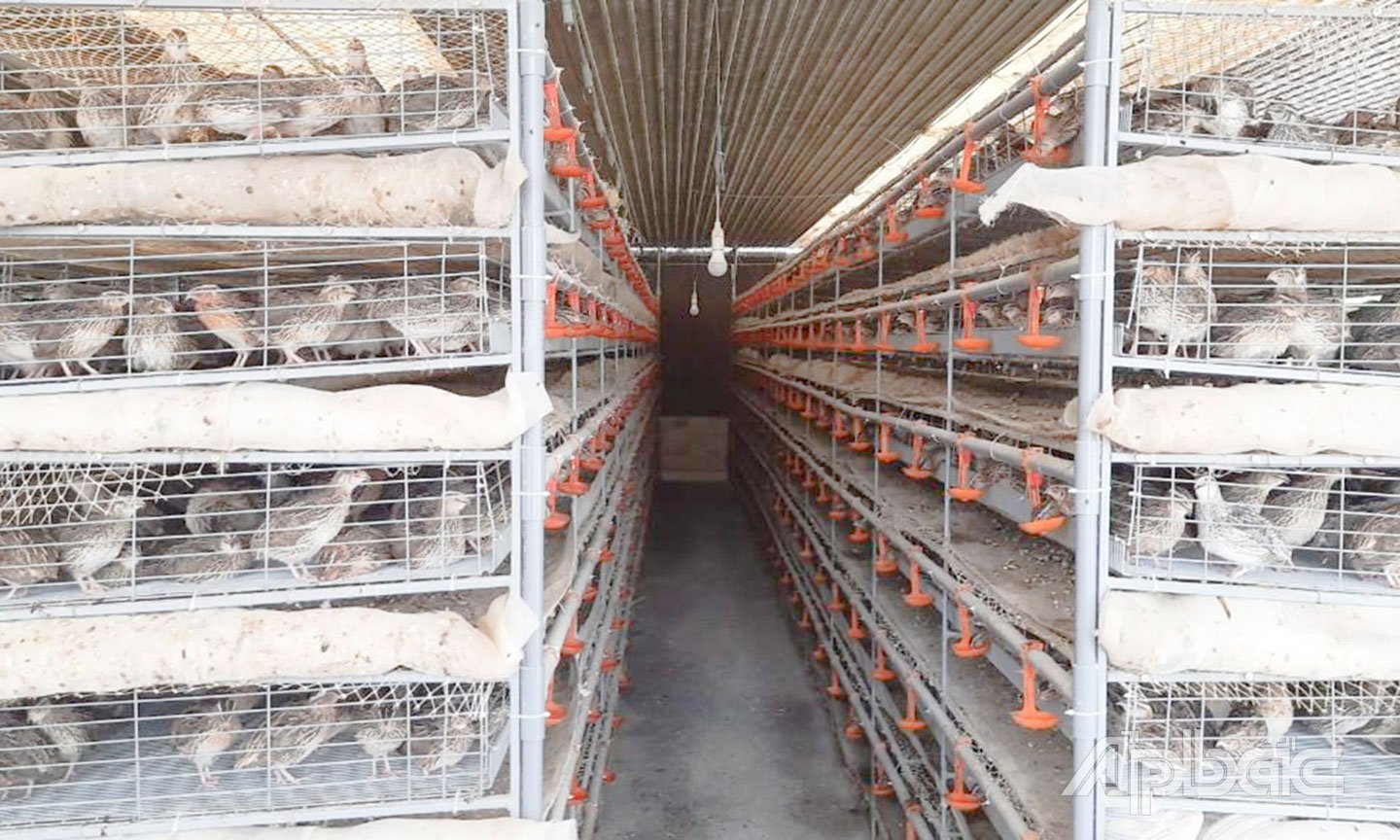 |
| Applying science and technology to quail farms in Tien Giang province. Photo provided by the Department of Livestock and Veterinary Medicine. |
Over the years, many livestock farming models applying advanced scientific and technological advancements have yielded outstanding results. Among them, the antibiotic-free quail farming model, producing quail eggs for export to the Japanese market, has become a breakthrough in the practical application of scientific and technological progress. This is the result of a provincial-level scientific research project focusing on the use of natural supplements such as organic acids, turmeric powder, and EM biological preparations. These substances not only increase egg production but also improve the quality of the yolks, giving them a beautiful, deep yellow color, meeting the stringent requirements of demanding markets. More importantly, this model reassures consumers about food safety, eliminating antibiotic residues in the product – a crucial factor in agricultural exports. The benefits of this model have helped many households increase their income compared to traditional farming, opening up a direction for the development of clean and organic livestock farming in Tien Giang province.
Furthermore, the gradual increase in the scientific and technological content of livestock products, the connection between production and the market, and the formation of a production-consumption linkage chain, along with the synchronized implementation of six key areas: breed management; restructuring of scale; application of new science and technology and production according to GAP standards; production reorganization; market development; and support policies, have yielded significant results for the industry.
Many products such as black chickens, bantam chickens, quail, and bird's nests have been branded and included in the OCOP program, helping to increase product value and expand consumer markets. These certified establishments not only receive priority technical support but are also connected to businesses, supermarkets, and large distribution channels, reducing dependence on traders and informal markets. A prime example is the black chicken egg product, which currently supplies over 360 million eggs annually to the market and enjoys stable consumption in major domestic retail systems; similarly, Tien Giang bird's nests have been exported to the Chinese market, affirming the sustainable development potential of the province's livestock industry.
PRODUCTION AND CONSUMPTION LINKAGE
For many years, the "bumper harvest, low prices" dilemma has been a constant worry for livestock farmers, leading to unstable incomes and hindering sustainable development. However, recently, Tien Giang province has made significant strides by promoting chain linkage models in the production and consumption of livestock products – a fundamental solution to address the output problem and create momentum for the industry's development. Therefore, more and more effective livestock linkage models are being implemented through coordination between cooperatives, businesses, and individuals. In particular, cooperation with large companies such as CP, Japfa, and GreenFeed… brings many practical benefits to farmers. Not only do they receive support in terms of breeding stock, feed, technology, and infrastructure, but they also have guaranteed product sales at stable prices, helping to minimize risks when the market fluctuates.
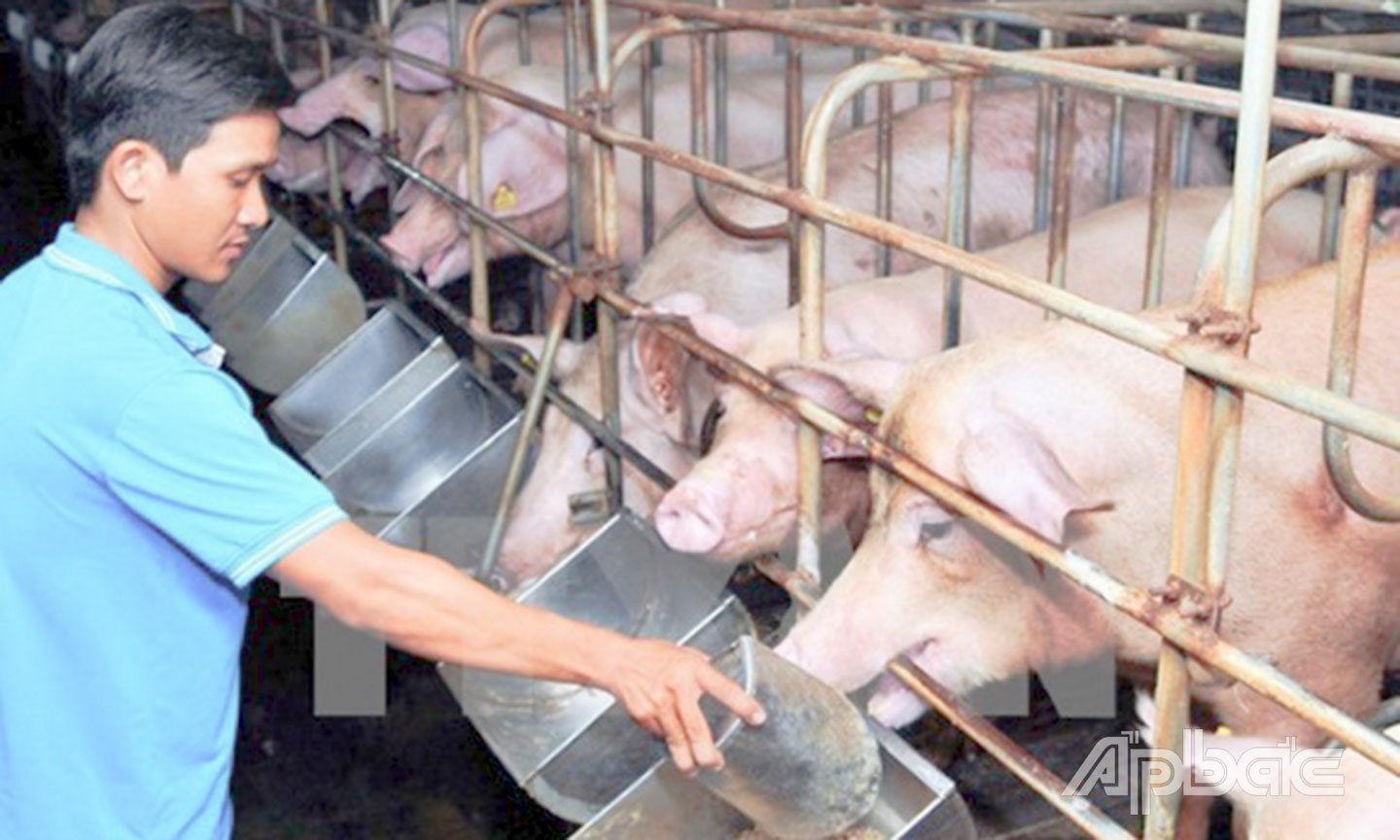 |
| Applying science and technology to pig farms in Tien Giang province. Photo provided by the Department of Livestock and Veterinary Medicine. |
To address the issue of output for the province's livestock products, Ms. Ho Huynh Mai, Deputy Head of the Department of Livestock and Veterinary Medicine of Tien Giang province, stated: "Every year, the department disseminates, mobilizes, and encourages organizations and individuals to access Resolution 07/2019 dated July 12, 2019, of the Tien Giang Provincial People's Council, which stipulates policies to support the linkage of production and consumption of agricultural products in the province. In particular, household livestock farming should gradually shift to farm-scale livestock facilities or build production and consumption chains through cooperatives and associations."
This also includes selecting high-yielding, high-quality livestock breeds; applying science and technology in designing livestock facilities and animal care and feeding processes; maintaining and promoting the effectiveness of product brands: VietGAP standards, animal disease-free facilities, "One Commune One Product" (OCOP), safe food supply chains; and using antibiotic alternatives to enhance product value, ensuring both reputation and food safety for consumers.
The biggest difference lies not only in technology or organizational models, but also in the significant shift in the mindset of livestock farmers. From small-scale, uncontrolled farming dependent on traders, many households in Tien Giang have now proactively adopted modern production methods. They focus on applying advanced techniques, effective disease prevention, adhering to biosafety procedures, and especially participating in production-consumption linkages. Many models have shifted towards organic farming, without antibiotics, meeting the increasingly high demands for quality and food safety; at the same time, expanding opportunities to access domestic and international markets.
The robust development of advanced livestock farming models in Tien Giang has not only helped increase people's incomes but also comprehensively transformed the face of the local livestock industry. Clear orientation, application of high technology, linking production with consumption, and building product brands have made Tien Giang a shining example of agricultural development in general and the livestock industry in particular in the Mekong Delta. This also demonstrates the importance of shifting from a traditional production mindset to a market-oriented economic mindset, creating a solid foundation for the local livestock industry to develop in a modern, sustainable direction and integrate deeply with the region and the world.
The linkage between production and consumption in the livestock industry in Tien Giang has opened up a new and correct direction for the province, not only helping people escape the vicious cycle of "bumper harvest, low prices," but also creating a solid foundation for the development of smart, sustainable agriculture and global integration.
HỮU THÔNG
(to be continued)
Source: https://baoapbac.vn/kinh-te/202506/nganh-chan-nuoi-huong-phat-trien-ben-vung-than-thien-voi-moi-truong-bai-2-nang-tam-gia-tri-1046189/


![[Photo] General Phan Van Giang welcomes Chinese Defense Minister Dong Jun.](https://vphoto.vietnam.vn/thumb/1200x675/vietnam/resource/IMAGE/2026/03/18/1773808281415_giao-luu-bien-gioi-vntq-lan-10-6829-5690-jpg.webp)























































Comment (0)