

Having met at a competition on clean energy and sustainable development, five students from different universities quickly hit the same wavelength and collaborated on a special project to create a clean power source.
One step lights up for 30 seconds.
In early October 2023, the team began researching the Stepnergy project. With the bold idea of harnessing energy from people's commutes in crowded cities, the team started studying numerous documents related to converting kinetic energy into electrical energy.
According to group leader Chu Ngoc Mai (currently pursuing a distance learning bachelor's degree at Oregon State University), 90% of Vietnam's high-rise buildings rely on electricity from the national grid. Meanwhile, alarming figures exist: 73% of Vietnam's electricity production comes from coal and natural gas, and 40% of CO2 emissions originate from energy-intensive buildings.
Another member, Dao Thanh Tam, an architecture student at the Ho Chi Minh City University of Architecture, argued that energy consumption is increasing with socio -economic development. Therefore, using "energy mats" will contribute to meeting the needs of electronic devices that consume low to medium amounts of energy.
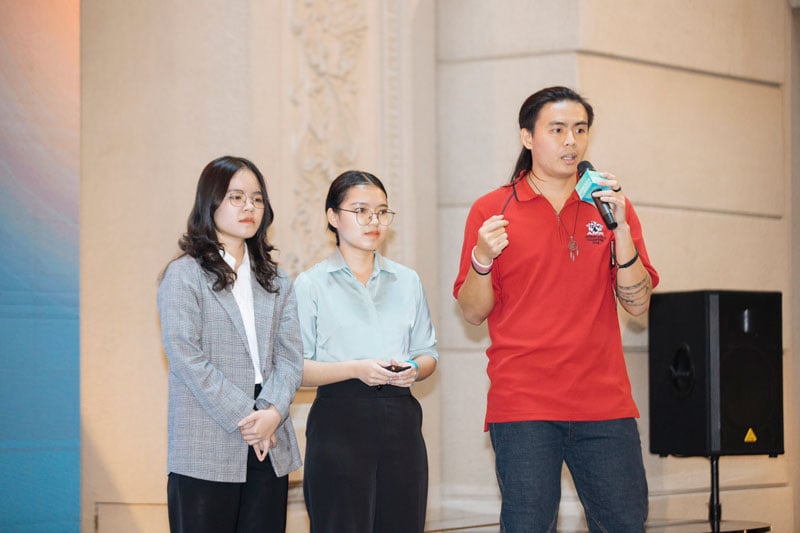
A group of students collaborated on the Stepnergy project with the goal of generating clean electricity from people's footsteps. (Photo: Provided by the subject)

Explaining the operating principle, Ngoc Mai said that the Stepnergy device applies piezoelectric technology. Each device has three parts: an electromechanical generator, and electromagnetic bricks to harvest energy from people's footsteps. The electromagnetic bricks are connected to each other to form an energy mat. When a person steps on them, the bricks deform, causing the generator to create rotational movement, thereby generating clean energy. The generated electricity can be used immediately or stored for use with low-energy consuming devices such as streetlights, indoor light bulbs, public phone charging stations, etc.
"According to published studies, each step a person takes can generate enough energy to power an LED light bulb for 30 seconds. This is considered a clean and inexhaustible energy source," Ngoc Mai added.
In the early stages of the research, the team faced many difficulties because none of its members had a background in energy science. However, with the goal of creating a clean power source to contribute to the energy transition and reduce carbon emissions, the members all strived to learn and research further to complete the project to the best of their ability.
Applications in education
A survey conducted at Ho Tram Primary School (Ba Ria - Vung Tau province) revealed that with 3 m² of Stepnergy equipment installed, approximately 13,474 Wh of electricity per month can be generated (after accounting for 20% losses), equivalent to 2,694,800 mAh of clean energy. This amount of electricity is sufficient to charge 598 smartphones or power 50 20W LED bulbs for 13 hours; reducing CO2 emissions by 32-40 kg.
Piezoelectricity technology can be combined with other renewable resources such as solar and wind energy to utilize energy more effectively. This technology has been applied in many major cities in Europe, but the cost of purchasing the "energy mat" panels is quite expensive, averaging around $1,600/m2. "Instead of transferring technology or buying entire energy panels from abroad, we hope to successfully research and develop our own device for Vietnamese people at an affordable price, convenient, and easy to use anywhere," Ngoc Mai hopes.
Mr. Phi Gia Khanh - Artelia Vietnam Company, an expert in energy efficiency and green building - said that in recent years, many households and businesses have begun to pay more attention to energy equipment, mainly solar energy. In densely populated areas like Ho Chi Minh City, the application of solar energy collection equipment is mostly concentrated on rooftops and building terraces. Therefore, placing Stepnergy devices in crowded areas is an innovative idea to utilize this inexhaustible source of clean energy.
However, according to Mr. Khanh, applying Stepnergy in practice is a very long journey, with the most difficult challenge being the financial aspect. "Stepnergy is most feasible in STEM education (a form of education that combines different subjects). Students can learn about the process of generating clean electricity while running and playing," Mr. Khanh suggested.
Associate Professor Vu Thi Hanh Thu, lecturer at the Faculty of Physics - Engineering Physics, University of Science - Vietnam National University Ho Chi Minh City, assessed the project as having very good social significance. To apply it in practice, the team needs to demonstrate the feasibility of the material and whether the investment is commensurate with the conversion efficiency. "If the team discovers a new material that is both inexpensive and durable with high conversion efficiency, this project is likely to receive investment funding or technology transfer for wider application," Associate Professor Vu Thi Hanh Thu stated.
In February 2024, the Stepnergy project will travel to Prince Sultan University (Arabia) to participate in the finals of the Venture Z startup competition.
Source: https://nld.com.vn/bien-buoc-chan-thanh-dien-sach-196240127205229095.htm










































![[Video] Sunset at Lap An Lagoon – Where the sun sets over the fishing nets](https://vphoto.vietnam.vn/thumb/1200x675/vietnam/resource/IMAGE/2026/05/31/1780192137701_beach-landscape-sea-water-nature-grass-745871-pxhere-com.jpeg)



























Comment (0)