

Scooters are becoming increasingly popular in Vietnam, but not everyone knows how to use them to maximize fuel efficiency. The following tips on how to ride a scooter fuel-efficiently will not only help you save fuel but also extend the lifespan of your vehicle.
Let the engine run for 1 to 2 minutes before driving.
After a long period of inactivity, you should let the engine idle for 1 to 2 minutes before riding. For scooters, users should maintain a steady throttle when first starting the vehicle, then gradually increase the throttle.
This will allow the gasoline and engine oil enough time to reach the parts and provide adequate lubrication, ensuring smooth machine operation and also being very effective in saving fuel.
Keep the throttle at a steady speed.
An article in the Labor Newspaper points out that one of the common reasons why scooters consume more fuel than usual is the way users ride them. Therefore, to save fuel on your scooter, you should avoid sudden acceleration and deceleration; keep the throttle at a stable and appropriate speed, and gradually reduce the throttle when encountering situations on the road.
Most modern scooters have an optimal speed of 40 to 50 km/h for the most efficient fuel economy.
Don't move too slowly.
This is advice for everyone who rides a motorbike and wants to save fuel. Not only scooters, but all types of motorbikes consume more fuel when traveling at slow speeds. "Slow" here means 5-10 km/h because at slow speeds, the centrifugal force doesn't actively transfer motion to the wheels.
According to experts, for a wheel to rotate once, the engine must rotate 25 times. Therefore, to maintain a steady speed, the vehicle needs to be above 10 km/h. At this speed, the vehicle must accelerate to increase thrust, which increases heat generation and decreases fuel consumption significantly.
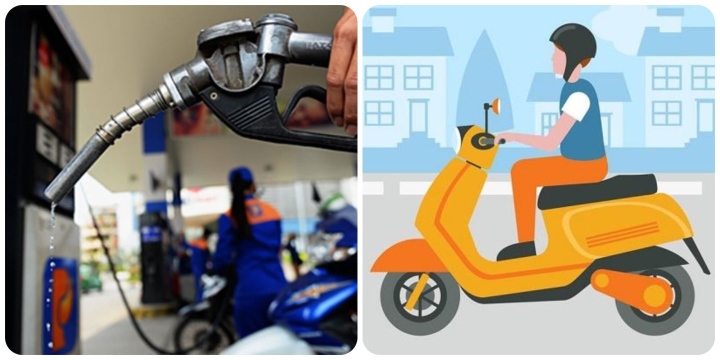
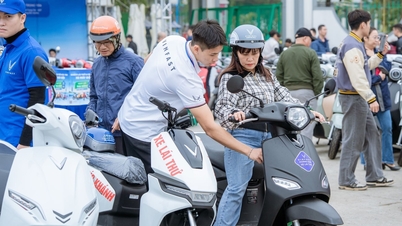
To save fuel, experts recommend letting your car idle for 1 to 2 minutes after a long period of inactivity before driving again. (Illustrative image)
Turn off the engine when the vehicle is stopped for more than 20 seconds.
When stopping for more than 20 seconds, such as at a red light, users should turn off the engine to save fuel and reduce emissions.
Avoid simultaneously pressing the accelerator and braking.
According to Vietnamnet, some people have the habit of braking and revving the engine simultaneously when stopped at a red light. However, this is harmful to the vehicle because it causes the clutch shoes to burn out quickly, and if done frequently, it will cause the clutch bell to jerk, resulting in poor acceleration and increased fuel consumption.
Make sure your tires are properly inflated.
Underinflated tires can easily cause instability while driving and, of course, increase fuel consumption. Conversely, overinflated tires can increase the bumpiness and reduce the ride comfort.
Please note that you should only inflate the tires to the correct pressure, ideally to the correct pressure for each type of tire.
Avoid sudden acceleration after stopping at a red light.
Many people, after stopping at a red light, often suddenly accelerate to make their car speed off. However, this action causes the car to consume several times more fuel than normal.
To save fuel, after the traffic light turns green, you should accelerate gradually and shift gears smoothly.
Regularly service your vehicle.
Components such as belts, air filters, electronic fuel injection systems, carburetors, spark plugs, etc., directly affect fuel consumption. Therefore, to save fuel, you should regularly take your vehicle for maintenance and periodic inspections.
You should also change your car's engine oil regularly to ensure more efficient engine operation and better fuel economy. Using oil with excessively high viscosity will require more energy and time to pump the oil to the lubrication points, thus increasing fuel consumption.
Above are some tips for riding a scooter efficiently and saving fuel. Please take a look!
Thanh Thanh (Compiled)
Beneficial
Emotion
Creative
Unique
Source


















![[Photo] Prime Minister Pham Minh Chinh receives the Chinese Ambassador to Vietnam](https://vphoto.vietnam.vn/thumb/1200x675/vietnam/resource/IMAGE/2026/04/05/1775397481797_ndo_br_dsc-5512-jpg.webp)






























































Comment (0)