

BEN THANH MARKET STREET - A HUB FOR TRANSPORTATION AND TRADE
At the beginning of the 20th century, this was a massive civil construction project with a floor area of over 10,000 m², situated at a vast intersection, very close to Catinat (Dong Khoi) and Charner (Nguyen Hue) streets. The land connected to La Somme (Ham Nghi) street, leading directly to the Saigon Port. On the other hand, it bordered Galliénie street - the new road leading into Cholon. Because of this prime location, the French authorities moved the original Ben Thanh Market - originally a wooden covered market on Charner Avenue - to this location.
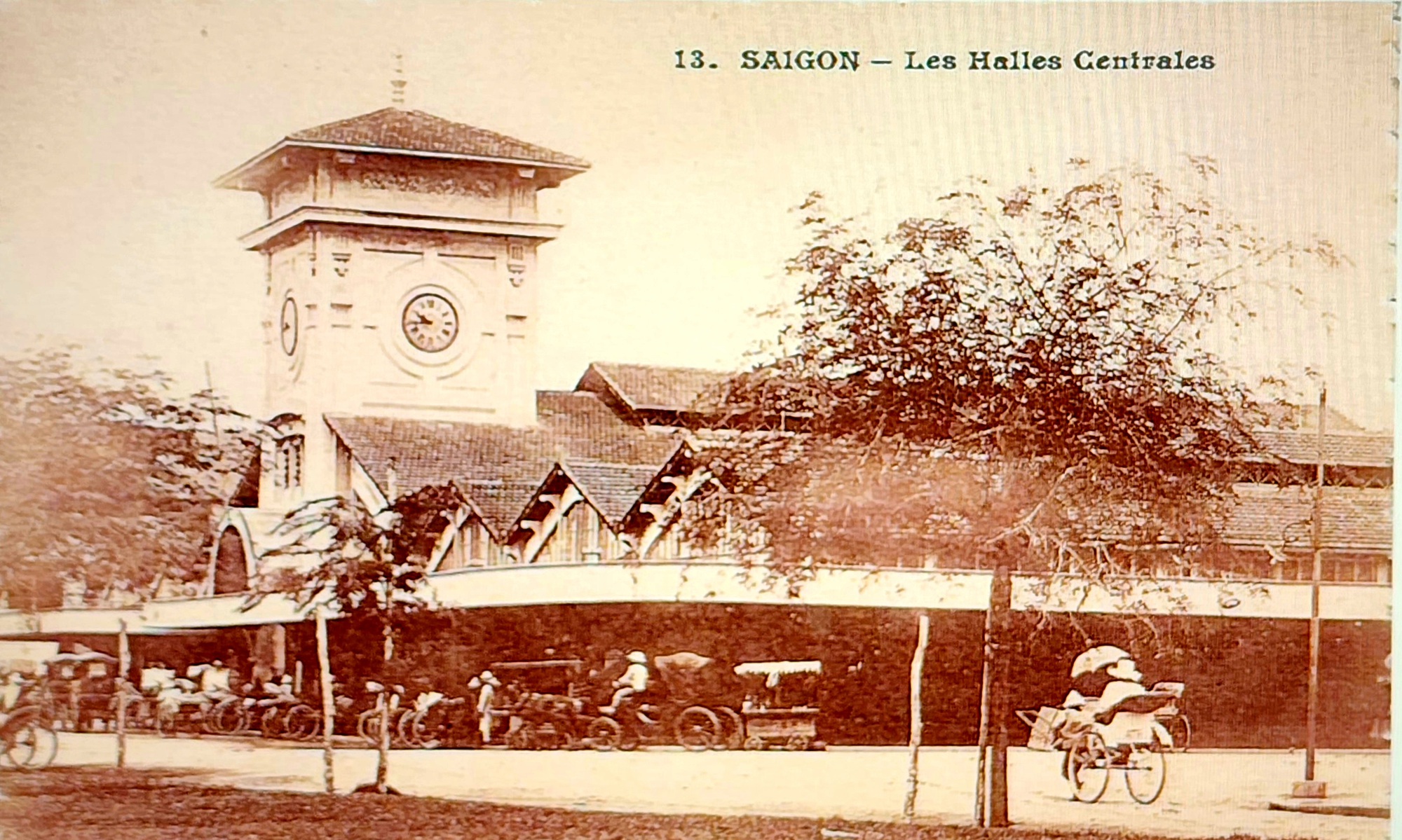
Ben Thanh Market in its early days, 1914
Photo: Postcard collection of Philippe Chaplain
When designing the new market, the designers may have been inspired by the model of the Paris Central Market Les Halles (1769), which had a main gate and buildings constructed in the style of massive workshops (the French did not use the name Ben Thanh Market but called it Les Halles Centrales de Saigon - Saigon Central Market). However, Ben Thanh Market still has its own unique and distinctive design. The entire market building resembles a majestic fortress, with four sides having imposing entrance gates, highlighted by a majestic clock tower on the main facade (South Gate). The market buildings are arranged into four blocks running lengthwise and two blocks running horizontally. Each row has two tiled roofs spaced apart to allow light and air circulation below.
From the outside and above, the market looks like a grand and well-maintained factory. Inside, sturdy steel arches form a spacious, high-ceilinged structure. In 1918, during a visit to Saigon, journalist Pham Quynh said that the giant clock tower of Ben Thanh Market gave a feeling of "solidity and strength like a fortress." Its shape and decoration were simple, like a four-sided watchtower, but the lines and decorative motifs on the exterior were in the Renaissance style, expressing strength and elegance. Notably, prominently displayed at the top of the tower, enclosing the lightning rod, is a gourd-shaped structure, symbolizing prosperity in Eastern philosophy.
Surrounding the market are three rows of three-story townhouses, arranged in a U-shape, built around the same time. The roads on either side of the market were once a bus station, later a coach station. Near the market is the central train station (now 23 September Park). After 111 years of existence, despite some changes in exterior architecture and interior layout, Ben Thanh Market, along with the three streets of Phan Chu Trinh, Le Thanh Ton, and Phan Boi Chau, remains the busiest market area in the city. It has witnessed many significant economic, cultural, and political events. To this day, Ben Thanh Market remains a popular symbol of a prosperous Saigon.
Binh Tay Market Street
The market is built on a large plot of land (17,000 m²), formerly a shipyard, in Binh Tay village, hence the name Binh Tay Market (the French called it Marché Central de Cholon, Cholon Central Market). It features French-Chinese architecture and shares the same grand citadel-like design as Ben Thanh Market. The clock tower is designed in the style of a two-story watchtower, reminiscent of ancient Chinese citadels. The upper roof features two dragon statues, while the lower roof has four dragon statues radiating in four directions. All the roofs of the market stalls are adorned with dragon imagery and covered with East Asian-style tiles. Furthermore, the four walls of the clock tower are not solid but have ventilation louvers in the shape of stylized Chinese characters for "double happiness."
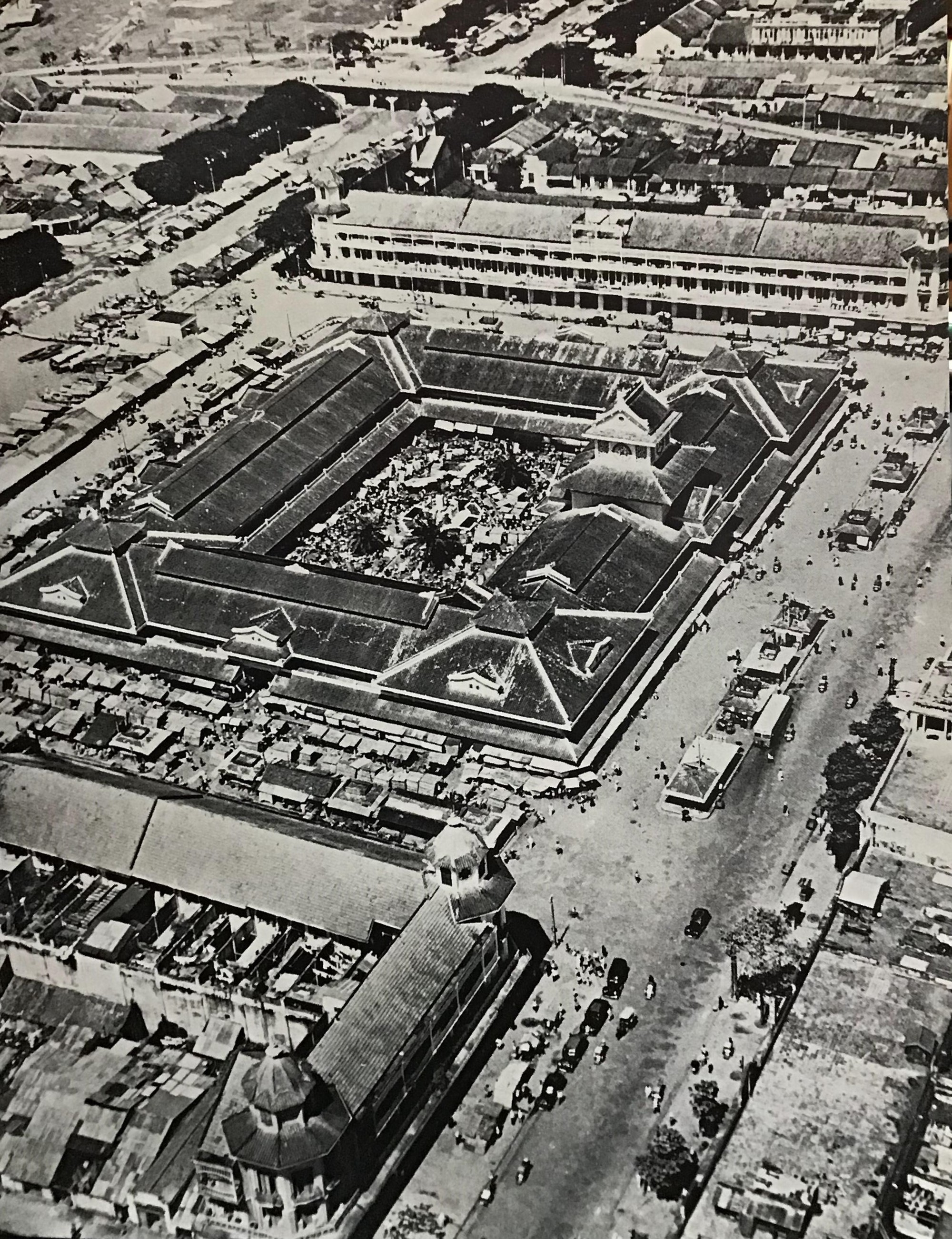
Aerial photograph of Binh Tay Market Street area, 1950s
Photo: Postcard collection by Nguyen Dai Hung Loc
From an aerial view, Binh Tay Market's design resembles the Chinese character "khẩu" (meaning mouth, symbolizing prosperity), with a central square surrounded by covered market stalls along all four sides. In the center of the square stands a statue of Mr. Quach Dam (1862-1927), a businessman who donated land and funds for the market's construction. At the foot of the statue is a pond surrounded by four bronze dragon statues. The placement of the pond in the center of the market is an expression of feng shui principles, where water symbolizes wealth.
The back of the market borders the Hang Bang canal, which is also a waterway for transporting goods, connecting to the Mekong Delta. Surrounding the market are three rows of three-story townhouses, serving both as shops and residences. At the end of each row of townhouses, the roof rises in a two-story bell shape, with tiled eaves covering the lower part, reflecting a harmonious design.
Europe - Asia. Sadly, those three rows of old houses were demolished to make way for townhouses in the 1990s. Binh Tay Market was a wholesale and retail market selling many goods for the whole of South Vietnam, marking the birth of the modern New Cholon area, following the Old Cholon area (around the District 5 Post Office ). Ben Thanh Market Street and Binh Tay Market Street are two ancient streets, attractive tourist destinations for everyone. (to be continued)
Source: https://thanhnien.vn/cap-doi-pho-thi-sung-man-185250413213243559.htm
![[Photo] Voting for the 14th Central Committee of the Communist Party](/_next/image?url=https%3A%2F%2Fvphoto.vietnam.vn%2Fthumb%2F1200x675%2Fvietnam%2Fresource%2FIMAGE%2F2026%2F01%2F22%2F1769082445591_chi-9961-jpg.webp&w=3840&q=75)


![[Image] The 14th Party Congress implements the content on personnel work.](/_next/image?url=https%3A%2F%2Fvphoto.vietnam.vn%2Fthumb%2F1200x675%2Fvietnam%2Fresource%2FIMAGE%2F2026%2F01%2F22%2F1769088146286_ndo_br_1-6165-jpg.webp&w=3840&q=75)





Comment (0)