

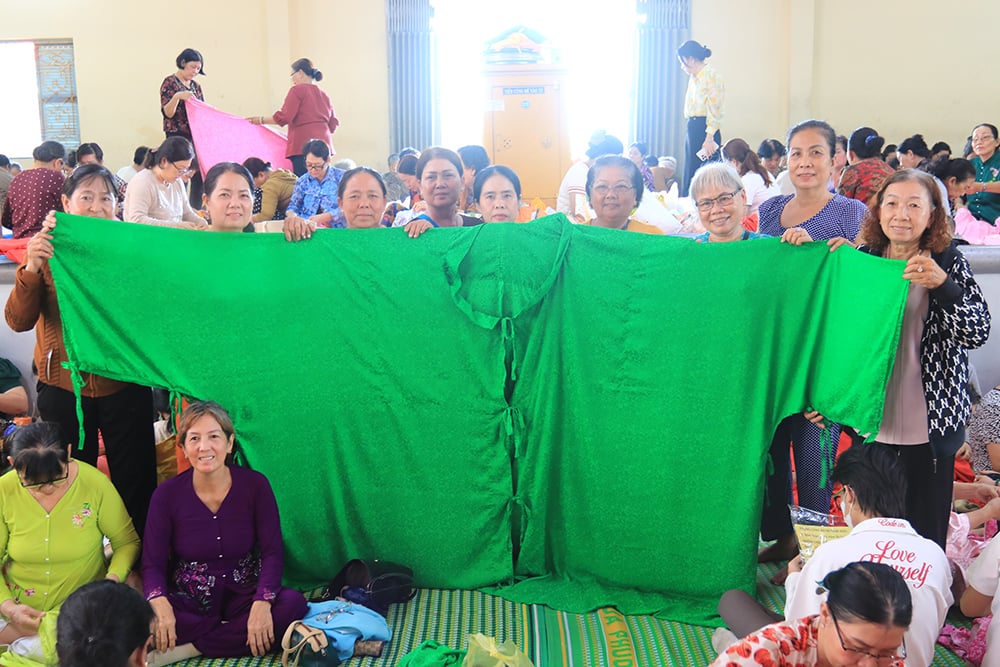
The Lady of the Land is not only the embodiment of a deity, but also the crystallization of patriotic traditions, the spirit of national harmony, and respect for the role of women in the community. Many estimate that the Lady of the Land is perhaps the most frequently offered robes in the country, with hundreds of robes of various colors and styles donated annually by pilgrims. The number of robes is so large that the Management Board of the Mount Sam Temple has to organize a lottery, holding a bathing and robe-changing ceremony for the Lady every two weeks. Each time, many robes are draped over the statue, sharing the blessings with the donors and fulfilling their wishes.
If the Goddess never lacked new clothes to wear, why is there a custom of offering her clothes? The answer goes back 200 years, when border raiders encountered the statue of the Goddess near the summit of Mount Sam. Greed took over, and they tried to move it, but only managed to budge it a short distance. The villagers mobilized hundreds of strong men, driven by their faith, hoping to bring the Goddess down the mountain for worship. Only when the Goddess stepped into the field and instructed nine virgin girls to carry her down did the process go smoothly. Besides building a shrine, the villagers quickly sewed clothes for the statue, beginning an important part of their folk culture.
Therefore, before the peak of the annual Lady of the Land Festival, on the morning of the 15th day of the 4th lunar month, without any announcement from the Management Board of the Sam Mountain Temple or any reminders, hundreds of women from all over gather at the temple grounds on Sam Mountain (Chau Doc City). This is an inner garment, 8 meters wide, with only a collar, sleeves, and ties; it has no buttons. Depending on their devotion, people buy fabric to have it made, but it's usually high-quality brocade or soft satin. The basic principle is to use bright, vibrant colors (red, blue, yellow, pink, etc.), avoiding black, white, or dried betel nut. Every two weeks, the Lady of the Land is given four new garments, meaning 96 garments are needed for the whole year (104 in a leap year).
To produce these hundreds of shirts, during the "Shirt Sewing Festival," each woman worked tirelessly from early morning until late at night, only taking short breaks for lunch. Remarkably, every stitch was sewn by hand, without the use of machinery. According to old stories, when sewing machines became common, people came up with the idea of sewing all the shirts by machine, which would be faster and more beautiful. However, when they prayed to the Goddess, the answer was "no." Therefore, the shirts offered to the Goddess have continued to be sewn by hand for decades.
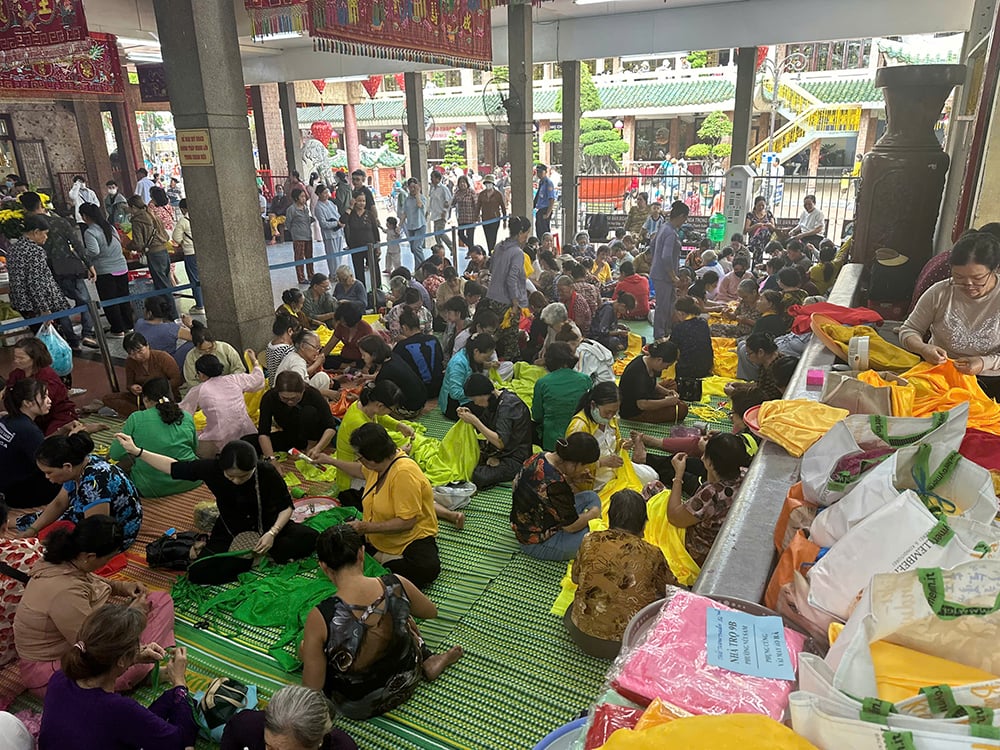
“I’ve lived near the Goddess from childhood to adulthood, but I’ve been busy working far away, so I rarely have the opportunity to participate in the Goddess Festival. Every year, I can only see the scenes of sewing clothes and carrying the statue of the Goddess on social media and in newspapers. This year, I had time to participate in sewing the Goddess’s clothes, and I felt very excited and happy. If I didn’t know how to do something, I asked the women, and they gave me very detailed instructions,” said Ms. Cao Thi Kheo (54 years old). Ms. Huynh Thi Huong (42 years old) has 6-7 years of experience sewing the Goddess’s clothes. On the appointed day, she and her sisters went to buy fabric, arrived at the Goddess’s temple before sunrise, and diligently sewed three clothes continuously. When everything was finished, the moon was high in the sky… “We pray for good health. We only have one day a year to ‘pay our respects’ to the Goddess, so we will definitely continue this activity until we can no longer do so. Next year, the number of participants will be greater than the previous year. Anyone who has something to do can leave early and hand over the work to someone else to help out; there’s no obligation to finish before leaving,” Ms. Huong shared.
Behind the tradition of sewing the Goddess's robes lies the profound meaning of the community's religious and cultural practices, passed down from generation to generation. Take the story of Mrs. Quách Minh Hương (residing in Châu Thành district, Đồng Tháp province). At over 90 years old, she has traveled to Châu Đốc city to sew the Goddess's robes for over 50 years, only interrupted for a few years by the COVID-19 pandemic. “When I had children, I brought them along; when I had grandchildren, I brought them along; the whole family came to the Goddess's temple together. Now, my eyesight is failing, my hands tremble, and I don't sew as well as I did when I was young and healthy. But in return, my children and grandchildren are very good at 'carrying over' the tradition,” she happily recounts. Many generations of women, like Mrs. Hương's family, continue this folk tradition, with each generation succeeding the previous one, preserving the customs and beliefs intact.
The task of sewing the robes for the Goddess is undertaken solely by skilled and experienced women. However, this doesn't mean leaving everything to women. Men willing to help take on the tasks of cooking vegetarian meals, preparing drinks, and handling other minor chores. All these elements intertwine, completing a vibrant picture of a miniature community within the temple grounds, where people are bound together by a belief in a better future, by hospitality, and by a selfless generosity!
Source: https://baoangiang.com.vn/chiec-ao-dang-ba-a420777.html


![[Photo] Delegates attending the third day of the 14th National Congress of the Party](/_next/image?url=https%3A%2F%2Fvphoto.vietnam.vn%2Fthumb%2F1200x675%2Fvietnam%2Fresource%2FIMAGE%2F2026%2F01%2F22%2F1769055445099_ndo_br_1-jpg.webp&w=3840&q=75)




Comment (0)