

Stick to the basics
After implementing the reorganization of the administrative apparatus with the operation of the 2-level local government model, in many communes and wards in Hanoi , the working atmosphere has many positive changes. Despite facing pressure from personnel changes, reassignment of tasks and adjustment of functions and tasks between departments, many localities have quickly stabilized the organization, maintaining a smooth administrative operation. Cadres, civil servants and workers in wards and communes are not only doing administrative work but also conveying the spirit of a government that serves faster and closer to the people.
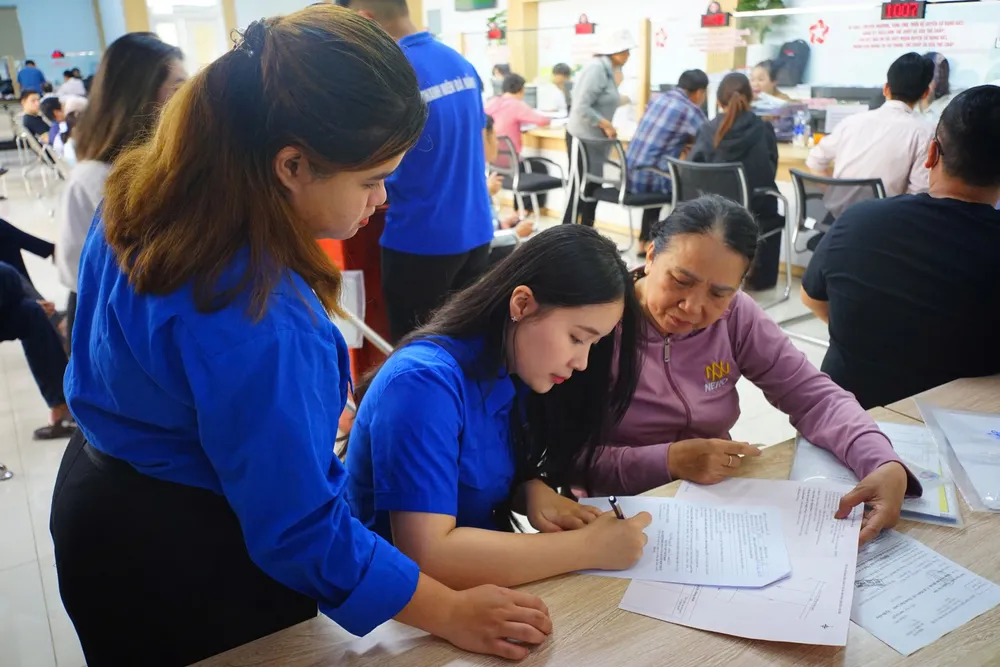
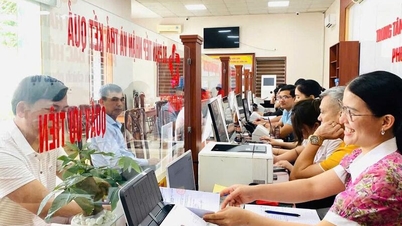
Despite it being late afternoon and a weekend, the public administrative service point of Kien Hung ward (Hanoi) was still quite crowded with people coming to complete administrative procedures. Ms. Vuong Thi Huyen, a staff member at the Kien Hung ward public administrative service point, shared that for the past month, the staff have been working almost 9-10 hours a day. The ward has assigned staff to guide people enthusiastically and cheerfully; and is gradually and strongly applying digital platforms. The entire process of handling documents is now digitized.
According to Ms. Nguyen Phuong Anh, Deputy Head of the Culture and Social Affairs Department of Kien Hung Ward People's Committee, residents who come to the ward's public administrative service point are given attentive guidance. Obtaining a queue number, submitting documents, searching for information, or receiving results are all easy and quick. Each staff member not only fully implements professional procedures but also acts as a bridge between the government and the people, demonstrating a spirit of service through their approachability, proactiveness, and flexibility in handling work.
In Ban Co Ward (HCMC), Mr. Bui Duy Hung, Vice Chairman of the Vietnam Fatherland Front Committee and Secretary of the Ward Youth Union, still remembers the first days of taking on the task when the agency headquarters was severely degraded after many handovers. “We had to go to each house, mobilize each table, each chair, and even ask for a potted plant to beautify the agency. The headquarters is not only a place to work, but also a place to welcome people, a place to create trust and attachment,” Mr. Bui Duy Hung said. Thanks to the consensus of the whole collective, after only 2 weeks, the headquarters had a spacious and cozy appearance. Mr. Bui Duy Hung also coordinated with the Youth Union and colleges and universities to organize a program to support people at the ward's Public Administration Service Center. Young people in the "Green Summer" campaign directly assisted the elderly, guided them step by step in filling out documents, making many people moved to write thank you letters. Every thank you, every smile from the people, motivates everyone to try harder in their work each day.
As a young cadre assigned to be in charge of the ward's activities, Ms. Tran Thi Thanh Tam, Vice Chairwoman of the Vietnam Fatherland Front Committee of the ward and Secretary of the Hoa Hung Ward Youth Union (HCMC), shared that the current workload is much heavier than before. There are days when, instead of finishing work at 5 p.m., she and her colleagues stay until the evening to complete the report for the next day, as well as regularly connect with each neighborhood. According to Ms. Tam, through such grassroots visits, direct connections have been created and many intermediate steps in the activities have been shortened.
Energetic and creative
Throughout the country, exemplary behavior has been spreading in many places, from urban to remote areas, in many different ways. For example, after the policy of merging commune levels, in Lao Cai province, young cadres who are ethnic minorities volunteered to work in remote and disadvantaged areas of the province, with the desire to contribute their youth to the work of streamlining the apparatus and improving the effectiveness and efficiency of state management at the grassroots level. After the reorganization, Che Tao commune - a unique and disadvantaged commune of the province - received 20 cadres from other places who volunteered to work. Volunteering to Che Tao commune, Ms. Ly Thi Them, Head of the Department of Culture and Society, said that as a young person, she wanted to have practical experiences and be responsible to the community. For her and many other colleagues, the smiles of the people and the socio -economic development of the commune are worthy compensation for their contributions. Many young officials in the current government apparatus not only perform their professional duties well but also spread a spirit of dedication and willingness to take on challenging tasks.
Many young officials working in communes and wards in Hanoi are commuting long hours with an increasing workload. Nguyen Tien Phuc, Vice Chairman of the Vietnam Fatherland Front Committee and Secretary of the Youth Union of Ha Dong Ward, shared that while the workload has increased significantly, this poses a challenge for young people holding important positions at the grassroots level. To effectively manage his duties, Nguyen Tien Phuc proactively uses technology to coordinate work. He created a Zalo group with the participation of branch secretaries, assigning clear tasks, and organized a network of deputy secretaries from former wards to oversee each task. He also took courses on AI to apply technology in processing documents and managing union activities. According to him, technology helps reduce pressure and improve efficiency, especially in the two-tiered local government model.
Also in Hanoi, Ha Dong ward established a team of young volunteers to assist residents with administrative procedures at the ward's Public Administrative Service Center. This young force has become a "bridge" between the government and the people, helping to ensure that all processes are carried out quickly and efficiently.
The young generation’s understanding of technology is also a big advantage. They proactively use Zalo, fanpages, and online groups to receive feedback, propagate policies, and provide timely information to each household. A ward leader in Ho Chi Minh City believes that the current generation of young officials is the decisive factor in the success of the 2-level local government model. They are a new source of energy, bringing a new breeze to the grassroots apparatus, helping the government get closer to the people and serve them better.
After the merger, Thanh Khe ward has a population of approximately 201,240 people, making it the most populous ward in Da Nang City. Every day, the ward's Public Administrative Service Center receives nearly 600 people coming to complete administrative procedures. Amidst the bustling crowds, it's easy to spot young Youth Union officials, wearing blue volunteer shirts, patiently guiding people through each step, from scanning QR codes to get queue numbers and filling out forms on computers to checking documents against a checklist.
At the online application support area, the atmosphere was always bustling but orderly. Many elderly people, their hands trembling as they held their phones, were confused about where to start, and were immediately helped by the young volunteers. Some sat close by, pointing out each item on the screen; others gently explained each step, encouraging them: "It's okay, sir/madam, just take your time." Despite the increased pressure during peak hours, the young volunteers remained calm, cheerful, and willing to repeat the process if people didn't understand. After receiving assistance with her application, Mrs. Nguyen Thi Lai (65 years old, residing in Thanh Khe ward) happily said: "I'm old now, and I'm slow at using phones, let alone computers. Luckily, these young volunteers provided dedicated support, guiding me step by step. It's very precious."
According to Mai Hong Anh, Secretary of the Thanh Khe Ward Youth Union, many union members have attended community digital technology training courses, so they are proficient in using the technology, have a firm grasp of the procedures, and are capable of handling both online support and resolving on-site issues.
- Dr. Tran Anh Tuan, President of the Vietnam Association of Administrative Sciences, former Deputy Minister of the Ministry of Interior:
Currently, with the 2-level local government model, each cadre and civil servant performs more tasks and is in charge of more areas than before. The young cadres are the pioneering force, both having the ability to access technology and daring to innovate management thinking. When the apparatus is streamlined, the capacity requirements are higher, forcing young cadres to constantly learn and improve their skills to meet the people's expectations.
- Mr. NGUYEN TUC, Member of the Presidium of the Central Committee of the Vietnam Fatherland Front:
What is valuable about the young generation of cadres is the spirit of selfless dedication, the desire to develop their full potential for the common good. That enthusiasm is very valuable, completely different from the "holding the seat" mentality that existed in a group of cadres in the past. Compared to our generation, today's young cadres are far superior in terms of education, science, and technology, and have the conditions to develop in all situations. That spirit of progress, willingness to sacrifice, and willingness to contribute is very necessary in the current period.
Source: https://www.sggp.org.vn/chinh-quyen-dia-phuong-2-cap-tang-toc-ngay-khi-khoi-dong-bai-3-can-bo-tre-tu-tim-viec-de-lam-post806043.html
![[Photo] Prime Minister Pham Minh Chinh holds a phone call with the CEO of Russia's Rosatom Corporation.](/_next/image?url=https%3A%2F%2Fvphoto.vietnam.vn%2Fthumb%2F1200x675%2Fvietnam%2Fresource%2FIMAGE%2F2025%2F12%2F11%2F1765464552365_dsc-5295-jpg.webp&w=3840&q=75)
![[Photo] Closing Ceremony of the 10th Session of the 15th National Assembly](/_next/image?url=https%3A%2F%2Fvphoto.vietnam.vn%2Fthumb%2F1200x675%2Fvietnam%2Fresource%2FIMAGE%2F2025%2F12%2F11%2F1765448959967_image-1437-jpg.webp&w=3840&q=75)







![[Infographic] Preventing students from making their own firecrackers: 7 things parents need to know](https://vphoto.vietnam.vn/thumb/402x226/vietnam/resource/IMAGE/2025/12/11/1765466656703_img_0320_20251211183542.jpeg)



























![[OFFICIAL] MISA GROUP ANNOUNCES ITS PIONEERING BRAND POSITIONING IN BUILDING AGENTIC AI FOR BUSINESSES, HOUSEHOLDS, AND THE GOVERNMENT](https://vphoto.vietnam.vn/thumb/402x226/vietnam/resource/IMAGE/2025/12/11/1765444754256_agentic-ai_postfb-scaled.png)





































Comment (0)