

Over the past period, the Provincial Civil Judgment Enforcement Department has consistently focused on inspection and self-inspection in civil judgment enforcement activities. This has contributed to ensuring discipline and order in the performance of official duties, while also helping civil judgment enforcement agencies promptly detect, correct, and handle violations and shortcomings, thereby improving the effectiveness of all aspects of their work.
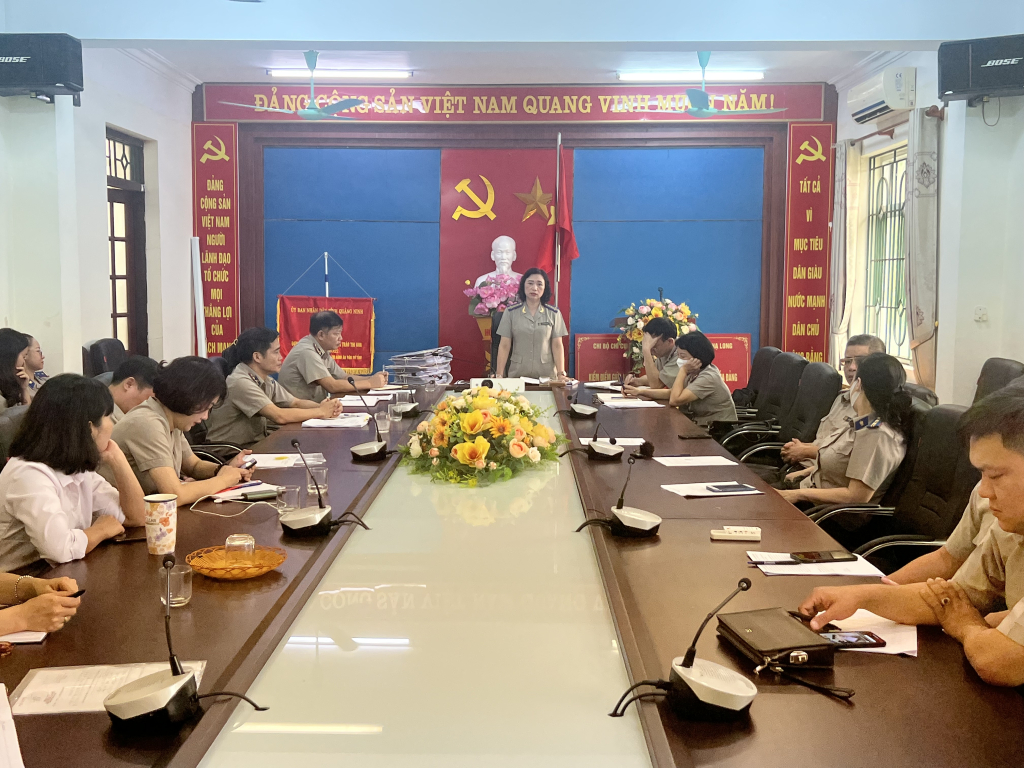
Mr. Hoang Duc Nam, Deputy Director of the Provincial Enforcement Department, stated: Identifying inspection and self-inspection as key tasks, the Department annually issues and proactively implements plans for inspecting enforcement work and preventing corruption and negative practices. The Department and its branches issue decisions and plans for self-inspection within their units; they also develop and implement internal self-inspection plans for units within the provincial enforcement system in accordance with the regulations on inspection in enforcement. Heads of units evaluate and are responsible for the results of self-inspections and reviews conducted by their subordinates.
The inspection focuses on the progress of case resolution, the implementation of procedures for civil judgment enforcement, and the fulfillment of targets and tasks assigned to sub-departments and enforcement officers; the work of receiving citizens and resolving complaints and denunciations... Emphasis is placed on inspecting key cases, cases related to bank credit, social insurance, recovery of money and assets for the State, cases of public interest, cases with large sums of money to be enforced, and cases that have been pending for a year without being completed.
According to the assessment, overall, the units performed quite well, proposing many effective solutions for the enforcement of civil judgments, innovating in management and operation; paying attention to directing the implementation of targets and tasks; accurately verifying and classifying cases; rectifying administrative discipline and order; strengthening coordination with relevant agencies in resolving cases...
This also involves strengthening propaganda and education efforts to raise awareness and a sense of responsibility among officials and employees in complying with legal regulations. This aims to promptly detect and correct shortcomings and violations in professional work and other limitations. In particular, it focuses on comprehensive inspections and timely recommendations, helping the Department and its branches understand the situation and current state of work. From there, solutions can be developed to improve the quality and effectiveness of civil judgment enforcement work in the future, ensuring it serves the overall management and direction of the entire system.
The leadership of the Department has always prioritized and promptly implemented guidance and direction on professional matters, contributing to the effective handling of major or difficult cases. The Department requires the heads of specialized departments and the heads of sub-departments to continue disseminating and thoroughly explaining to all staff members in their units the contents of the internal guidance procedures for the enforcement of judgments, the procedures for organizing judgment enforcement, and the procedures for organizing asset valuation and auction for judgment enforcement. From October 2022 to the end of March 2024, the Department received 9 documents requesting guidance and direction on professional matters from the sub-departments. All documents were reviewed, resolved, and responded to in a quality manner, following the correct procedures and deadlines as prescribed.
From October 2022 to the end of June 2024, units within the enforcement system received 14,532 cases, of which 13,313 were enforceable. The units successfully resolved 11,252 cases, corresponding to over 983 billion VND. Administrative discipline and order from the Department to the sub-departments were tightened; other aspects of work were carried out well, contributing to maintaining political security, social order and safety, and local socio-economic development.
Source
![[Photo] Prime Minister Pham Minh Chinh receives the Governor of Tochigi Province (Japan)](/_next/image?url=https%3A%2F%2Fvphoto.vietnam.vn%2Fthumb%2F1200x675%2Fvietnam%2Fresource%2FIMAGE%2F2025%2F12%2F16%2F1765892133176_dsc-8082-6425-jpg.webp&w=3840&q=75)
![[Image] The tenacious fighting spirit of Vietnamese women's football](/_next/image?url=https%3A%2F%2Fvphoto.vietnam.vn%2Fthumb%2F1200x675%2Fvietnam%2Fresource%2FIMAGE%2F2025%2F12%2F17%2F1765990260956_ndo_br_4224760955870434771-copy-jpg.webp&w=3840&q=75)


![[Live] 2025 Community Action Awards Gala](/_next/image?url=https%3A%2F%2Fvphoto.vietnam.vn%2Fthumb%2F1200x675%2Fvietnam%2Fresource%2FIMAGE%2F2025%2F12%2F16%2F1765899631650_ndo_tr_z7334013144784-9f9fe10a6d63584c85aff40f2957c250-jpg.webp&w=3840&q=75)


































































Comment (0)