


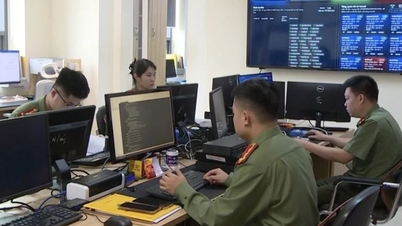
The Public Administrative Service Center of Hoai Nhon ward (Gia Lai province) applies science and technology in serving the people. (Photo: MY HA)
However, in reality, this journey still faces many "bottlenecks," as many organizations still operate based on traditional experience, while AI applications are developing in a fragmented, individualistic way, lacking connectivity and an overall strategy.
Internal conversion factors are limited.
Most individuals and businesses in Vietnam are currently only using AI for single tasks, providing immediate results but not yet achieving systemic changes.
Mr. Dang Trung Hieu, Director of Thanh Nam Fire Protection Technology Joint Stock Company, shared that the company clearly recognizes the great potential and benefits of AI, but has not yet invested on a company-wide scale. Currently, AI is only being used in individual departments.
According to Mr. Hieu, many transformation and training programs that businesses are currently accessing are expensive and only focus on teaching the basic use of AI tools. They don't delve into the specifics of each industry, nor do they identify bottlenecks or cost inefficiencies in the process to propose suitable AI solutions. Businesses are willing to invest on a large scale when the transformation and training consulting firm truly understands operations, can quantify benefits, and demonstrate that AI improves efficiency compared to traditional working methods at a reasonable cost.
Similarly, observations show that some state management agencies, despite showing early interest in digital transformation and applying AI to their operations since 2020, still remain at the experimental stage in core operations after more than five years. The main reason stems from the cautious mindset of the organization's leaders regarding legal risks, liability, and investment efficiency when expanding AI on a comprehensive scale.
Associate Professor, Dr. Nguyen Xuan Hoai, Director of the Artificial Intelligence Institute, stated: AI transformation is still misunderstood in many places, viewed as a purely technological project. Many organizations focus too much on the technology aspect, forgetting that the main issue lies in the transformation of mindset. In reality, the term comprises two parts: "AI" representing technology and, more importantly, "transformation," encompassing human factors, systems, and organizational culture. If organizational leaders do not fully understand AI, they will set unrealistic expectations or fail to measure effectiveness, leading to erroneous or half-hearted investment decisions. This is a dangerous barrier because leadership decisions guide the entire transformation process. A lack of understanding will make employees feel insecure, leading to resistance or a lack of cooperation, preventing the technology from being effective.
The key issue in the AI transformation process lies in data—the element considered the "lifeblood" of the entire system. However, for a long time, managing and sharing data between departments and units has faced many obstacles. A typical example is the risk of fraud in medical examinations and treatments: a patient might be prescribed two different medications for the same condition at two different hospitals without receiving timely warnings, because the data is not connected and synchronized in real time.
Transforming mindsets and operating methods.
Experts believe that for AI transformation to be truly effective, organizations need a transformation program that is sufficiently "deep," "broad," and "long-lasting" to impact the organization's work culture and operational methods.
Mr. To Hong Luong, Deputy Director of the Center for Electronic Social Insurance and Health Insurance Payment Control under the Vietnam Social Insurance ( Ministry of Finance ), believes that AI transformation is not just a matter for the IT department, but requires the highest level of determination from leaders to professional staff, and a shift in mindset towards AI being merely a support, reference, or pilot program. Deep understanding, long-term vision, and decisive leadership, along with a clear transformation program, strong investment, and the application of AI in core business processes, will determine the success of the AI transformation process within the system.
Associate Professor, Dr. Nguyen Xuan Hoai argues that, in the context of changing processes and working methods, transformation programs need to focus on transforming individuals' perceptions, skills, and decision-making methods, shifting from traditional experience-based to data-driven and AI-based approaches. Simultaneously, it is necessary to establish principles for effective collaboration between people and between people and AI. This is the foundation for building a data-driven organizational culture—placing data at the center and prioritizing AI (AI-first).
To support the transformation management for staff, implementation must be decisive; build tracking and management tables with specific data, and leverage and integrate products and technologies created during the transformation process into daily work. Working directly and regularly with data will help develop a data-driven mindset within the team.
According to Mr. Phan Phu Thuan, information security expertat FPT Smart Cloud, FPT Group, only through practical experience and regular feedback can employees develop problem-solving and creative capabilities in a constantly changing AI environment. For businesses needing to implement AI transformation according to a suitable roadmap, it's advisable to start with moderately sized projects but implement them thoroughly and effectively, measuring real-world results, learning from the implementation process, and then gradually expanding. True transformation only occurs when an organization is ready to change from its mindset and culture to the core of its business operations. The ultimate goal is to become an organization where AI is not something added later, but an inseparable part of the operating model from the outset – an AI-Native organization.
QUANG HUY
Source: https://nhandan.vn/chuyen-doi-ai-di-vao-thuc-chat-post940537.html










































































































Comment (0)