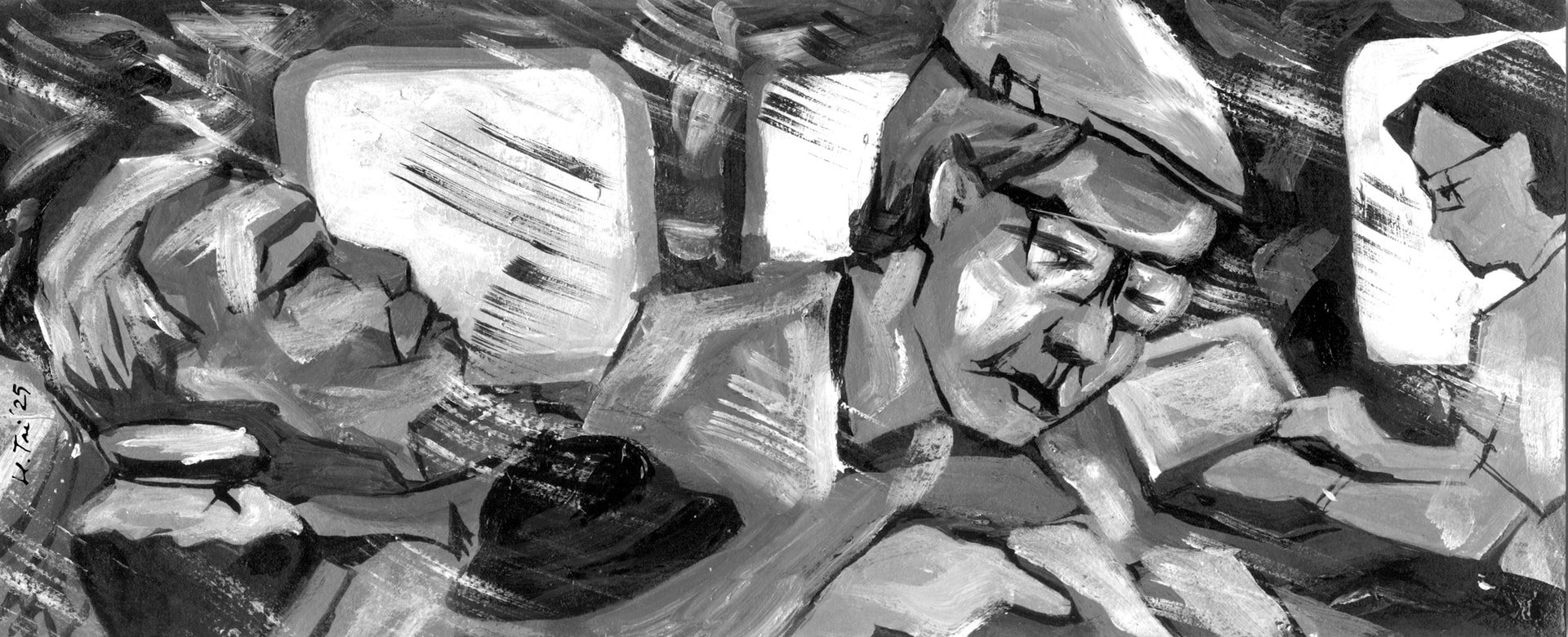
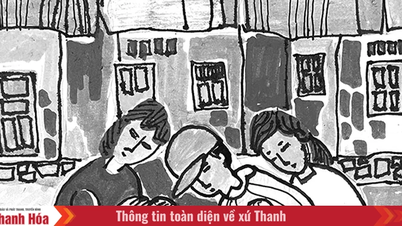
Illustration: HIEN TRI
The train whistle sounded, the engine rumbled, and the train began to move. The young man sat up and pulled out his laptop to work. The old man paid no attention to his surroundings; his eyes were sleepy, and he remained lying down, clutching the bag tightly as if afraid it would break if it was bumped. Occasionally, he would look up into the distance as if contemplating something, then look back at the bag in his hands.
He was looking for a place to stuff something into so he could lie down comfortably.
Mr. Cong put down his book and looked at the old man who had struck up a conversation. He was surprised for a moment, but then replied.
- It's impossible to fit it anywhere; I'm afraid it might break, and that would be a disaster!
The young man said jokingly in a cheerful tone.
- Antiques, antique vases, sir!
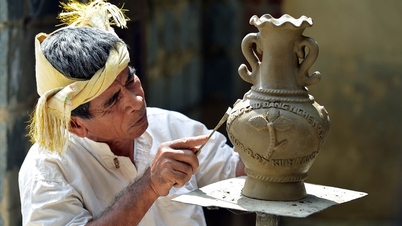
- It's just a ceramic jar, but...
The old man hesitated. He sat up, still clutching the earthenware jar, leaning against the side of the ship. The young man climbed down from the bed and sat beside the old man, trying to strike up a conversation.
- It's really hard to sleep on the train, which station are you getting off at?
The old man spoke vaguely instead of giving an answer.
- The ship was empty, I thought...
What were you thinking?
Seeing the young man enthusiastically joining the conversation, the old man couldn't remain silent any longer.
- I thought it would be very crowded, I thought two or three people would be crammed into one bed.
- That's impossible in a market economy ; what you're saying sounds like something from the old days!
What do you know about the old days?
- No, I only heard my parents say how hard life was during the subsidy period, that's all!
- Oh, I see!
Mr. Cong put down his book and sat up.
- Stories from the past are always beautiful and interesting, even if they were filled with hardship and difficulty. That's why many people live with nostalgia and die with it.
- You speak so well, like a poet.
As if introducing himself, Mr. Cong immediately recited these lines: “The shouts of the army from the river echo across the Great Viet sky / The valiant and courageous ruler inspires the people, building walls with surging waves / The wise and talented Duke, the battlefield stained with the blood of the enemy for a thousand years / The heroic naval forces lure the tide to rise and the current to fall / On the Bach Dang River, with spears and swords, the generals and soldiers are determined to achieve a great victory against the Yuan army / A heroic epic that will forever be remembered in Vietnamese history, with sacred and heroic spirit.”
The young man clapped his hands in praise:
- That's wonderful, I'm so proud! Are you a poet?
Mr. Cong did not answer, but continued reading: “Ten graves clustered together - ten girls / Shyly combing their hair, their delicate locks shimmering in the ethereal colors / A path of love, private secrets hidden from the battlefield / Just yesterday, their singing and laughter drowned out the sound of falling bombs / Suddenly, a moment of silence for their youthful souls, returning to the land of white clouds this afternoon / Dong Loc, the pure and heroic moons forever shining upon life.”
The old man looked at Cong with admiration.
- He wrote about the ten young female volunteers who sacrificed their lives at Dong Loc with great emotion; they truly were like pure, heroic moons!
After receiving the compliments, Mr. Cong officially introduced himself:
- Sir and nephew, my name is Cong, I used to be a war correspondent, not a writer or poet at all. Meeting you all who love poetry today, I am very moved. It's rare in this life...
Cong left the last few sentences unfinished, but everyone understood what he meant. After a few minutes of silence, the young man spoke again solemnly.
Which station did the poet get off at?
The man widened his eyes and raised his voice, then immediately softened it.
- I told you I'm not a poet... well, get off at a small station, even if I told you, you wouldn't know!
It seemed Mr. Cong sensed a connection with his new friends, so he opened up and started talking. His voice was soft and slightly hoarse, occasionally lost in the rhythmic clatter of the train, but everyone understood. He would get off at a small station in Quang Nam, then take a bus up to the midland region to meet his former comrades, war correspondents who had fought there, at the foot of the mountain in Mu U commune, to light incense for those who had fallen. He was fortunate to be alive to return to the old battlefield each year, to read poems to each other, and to recount his experiences working tirelessly amidst bombs and rain. A shrapnel fragment, lodged somewhere in his head, had made him seem like an "eccentric old man" in the eyes of others. After finishing his story, he sighed again.
- I heard that village is going to get a new name soon, what a shame for Mu U!
- The name Mù U is wonderful, isn't it, sir? But I don't think it's lost; it's still in your heart and the hearts of your comrades.
The old man looked at the young man with displeasure.
- It's no longer a loss, so what's the point of saying "but" anymore!
Mr. Cong looked at the old man sympathetically. The old man didn't answer immediately, hugging the cloth bundle even tighter.
- This earthenware jar contains a handful of soil, supposedly the bones and flesh of my comrade, who died at the gates of Saigon while accompanying the army delivering news of the liberation of South Vietnam. He was fortunate enough to be buried in a family's garden. The garden changed hands many times, and the new owner discovered a small, buried tombstone with his name and hometown... Now, bringing my comrade back, but Mu U is no more!
Mr. Cong listened to the story with tears welling up in his eyes.
- You're wrong, brother. Hometown is where you were born and raised; no matter what it's called, it's still your hometown!
The young man continued:
- It's just a name, that's all...
The old man didn't seem to accept the children's reasoning.
- You don't have a hometown, do you? People are like trees; they sprout and flourish in a particular soil, and they are grateful to that soil.
The old man's voice mingled with the rhythmic clatter of the train, then faded into the long, mournful whistle. The young man, as he climbed into his bed, uttered his final words.
- Our roots are in our hearts. A person who lives in their homeland but betrays it is not as good as someone who lives far from home but still cherishes their homeland.
Children who act like they're lecturing others, it's annoying, but what they say isn't wrong. No one said another word because everyone thought they were right and believed the other person was right too. Mr. Cong sighed, his voice like the wind, a tightness in his chest and a feeling of discomfort.
The train slowed down, seemingly about to stop at a station, the wind blowing against it, carrying sounds toward the rear of the train. In the wind, he clearly heard: "An old fool who thinks he's clever, spouting all sorts of ideas." He glanced up at the young man working on his computer. Then he looked at Mr. Cong, who was reading a book. So, he had been talking to himself, hadn't he?
The train stopped to pick up and drop off passengers. The young man took the opportunity to stroll out the window. A streak of light, a dome of light, a vast expanse of light, a boundless field of light appeared outside the window. Everyone came out of their rooms to admire the field of light, marveling and exclaiming. It turned out that the endless field of dragon fruit trees was hung with lights that looked like twinkling stars, a magical and romantic light, beautiful beyond description, only felt through the love of homeland, land, and people.
The train started moving again, and the field of light disappeared and reappeared—how beautiful!
My hometown is so beautiful, everyone!
The young man returned to his bed. The old man still clutched the earthenware jar containing a handful of soil and the remains of his fallen comrade. Mr. Cong mumbled, but everyone could hear him clearly: “The heartbeat of each person is the sorrow of the nation / A nation of intelligent, kind, and tolerant people / The blood of righteousness nourishes the soul of the nation, its heroic spirit / Nguyen Du wrote the Tale of Kieu as a lullaby beside the cradle / Nguyen Trai wrote the Great Proclamation of Pacifying the Ngo, passed down through generations / These verses transform into patterns, carving the image of the four-thousand-year-old homeland.”
The train, traveling against the wind, sped through the night, carrying with it a multitude of emotions... chug... chug... chug...
Source: https://baoquangnam.vn/chuyen-tau-nguoc-gio-3157196.html


![[Photo] National Assembly Chairman Tran Thanh Man working with the Standing Committee of the National Assembly's Delegation Affairs Committee.](https://vphoto.vietnam.vn/thumb/1200x675/vietnam/resource/IMAGE/2026/05/20/1779294340023_ndo_br_1-1691-jpg.webp)
![[Photo] General Secretary and President To Lam works with the Party Committee of the Ministry of Health on the work of Vietnamese traditional medicine.](https://vphoto.vietnam.vn/thumb/1200x675/vietnam/resource/IMAGE/2026/05/20/1779294323718_a1-bnd-2978-3319-jpg.webp)





































































Comment (0)