

- Returning to Vietnam just in time for the 80th anniversary of National Day, what are your impressions of the atmosphere here?
My first impression upon stepping off the plane was the same as always: emotional and a feeling of returning home. Immediately, I saw red flags with yellow stars fluttering everywhere, the streets clean and brightly decorated. This reminded me of the atmosphere in France before major events: people working together to clean and prepare meticulously to welcome guests. After checking into the hotel, I went straight to the Hanoi Post Office with two young women. There, I fully experienced the festive atmosphere: rehearsals, singing, children playing happily with their parents. A truly vibrant and joyful atmosphere.
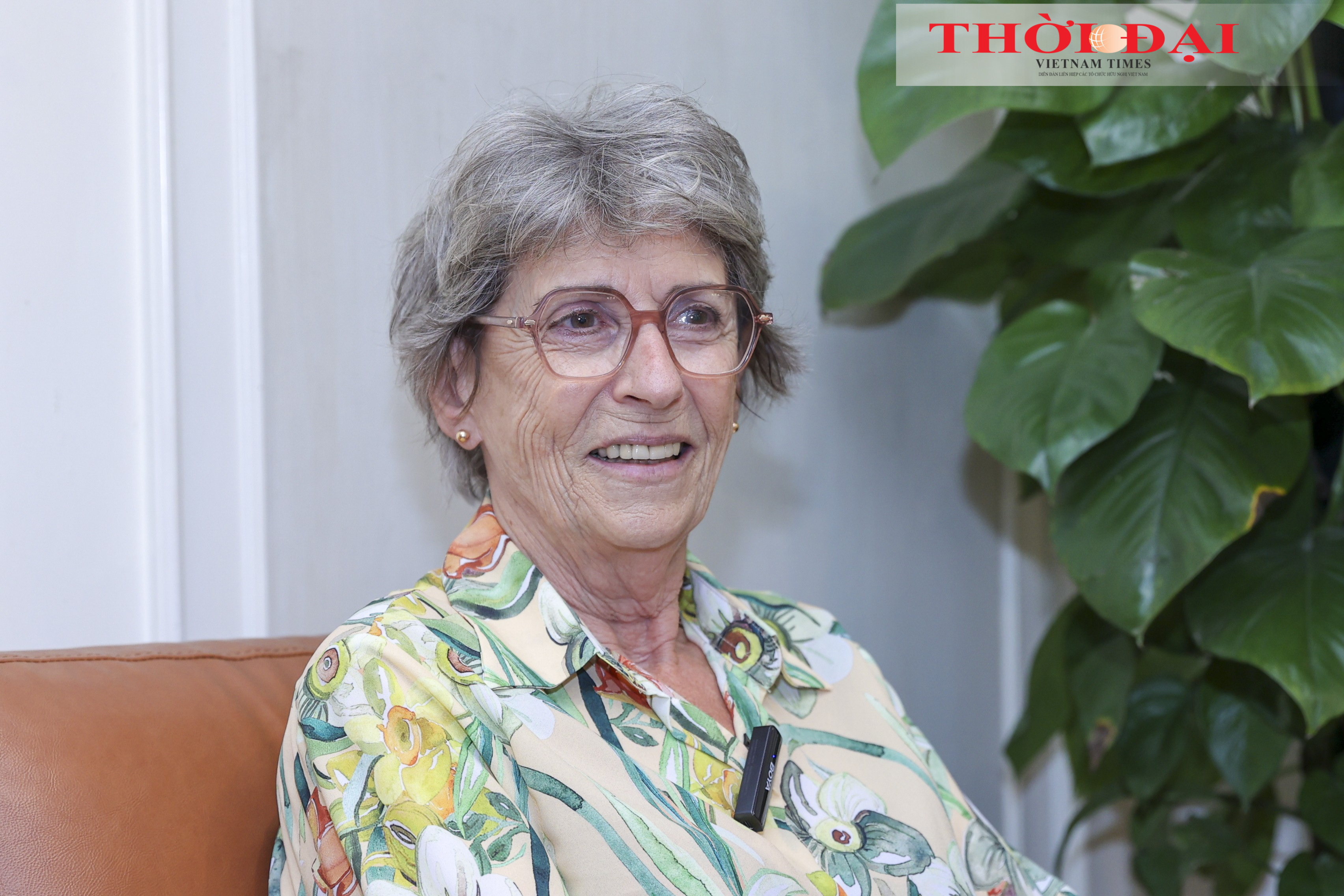 |
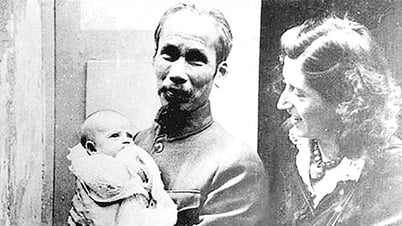
| Elisabeth Helfer Aubrac, Ho Chi Minh's adopted daughter. (Photo: Dinh Hoa) |
- In your childhood memories, what image of President Ho Chi Minh is most vivid? And how do you perceive the friendship between him and your father, Raymond Aubrac?
- President Ho Chi Minh once lived at my parents' house; they were active in the resistance movement. From a young age, my siblings and I were instilled with the spirit of freedom, equality, and fraternity. To us, he was not only our godfather but also like a member of our family.
As a young girl, I had absolutely no idea what the Indochina War was, and of course, no one could have predicted the war in Vietnam that would follow. But gradually, I realized that President Ho Chi Minh was an extraordinary figure, not only through photographs but also because he was a part of my family.
Even though we never met in person again, I maintained the habit of writing New Year's greetings, and he, in one way or another, always returned my wishes on my birthday. Therefore, President Ho Chi Minh was not a stranger, but always present like a dear family member. Gradually, I came to understand more about his leadership stature, but his personality had many similarities to my father and his friends – all of whom came from the resistance movement – so realizing this didn't shock me at all. Everything was normal and part of the natural flow of our family.
My father, Raymond Aubrac, was a humble man who upheld justice and independence, never exploiting his reputation for personal gain. He enjoyed the absolute trust of President Ho Chi Minh, and that trust contributed to strengthening the French people's confidence in him. The foundation of that relationship was trust and simplicity of character – a commonality between two exceptional individuals. My father also received the trust of French leaders, such as Prime Minister Mendès France during the period 1946-1954. Thanks to this, this special friendship contributed to significant progress in Vietnam-France relations during a challenging historical period.
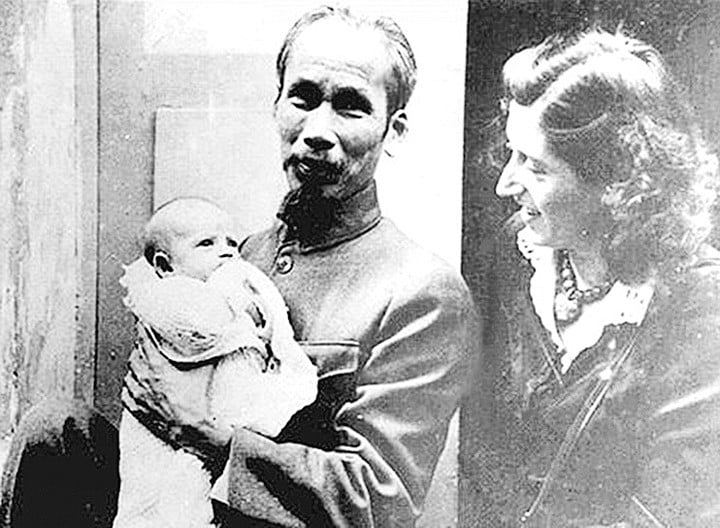 |
| President Ho Chi Minh holding his adopted daughter Babette. (Photo: KT) |
- What are your impressions of the changes in Vietnam during your previous visits?
- My first visit to Vietnam was in 1987. At that time, Hanoi still had many bomb craters, the airport was dilapidated, and there was no electricity; the people lived in very difficult conditions, lacking everything. But what moved me was that everyone was working, from repairing bicycles to patching broken tools, sometimes a can of food, a radio... no one was idle.
After that, I returned more than 10 times, and my husband visited Vietnam almost four times a year. I witnessed an astonishing pace of development: the Vietnamese people held their heads high, rebuilding together. The scars of war gradually faded, except for the devastating effects of Agent Orange. In their place was an extraordinary resilience.
- In your opinion, how has the friendship between Vietnam and France been nurtured over the past decades? What can help strengthen the bond between the people of the two countries?
- From a personal perspective, I believe there were times when relations weren't as harmonious as desired. General Vo Nguyen Giap once told me: "I never went to France because France didn't invite me." That's evidence of past hesitation.
However, France has made significant contributions, especially after the Doi Moi (Renovation) period, by helping Vietnam integrate into the international community, joining international organizations, and providing support in the field of science and technology. I believe that the relationship between the two countries can develop even more strongly, especially within the framework of the European Union. The field of education and training is one example, because the French language proficiency in Vietnam is still limited. Further efforts are needed to foster closer ties between the younger generations of Vietnam and France.
A prime example is the Franco-Vietnamese Center for Management Training (CFVG). For over 30 years, the Center has trained many generations of master's degree holders in economics, finance, and management. Vietnamese students study in English, then continue their studies in a joint program at the Sorbonne University (France). Although not using French, this model still creates a strong bridge between the youth of the two countries. I believe that such open forms of cooperation should be replicated, both in medicine and many other fields, so that the younger generation has more opportunities to connect and develop together.
- On the occasion of the 80th anniversary of Vietnam's National Day, what message would you like to send to the Vietnamese people?
For a nation, 80 years is very, very young – it's just the beginning of a powerful leap forward. For a woman, 80 years old isn't necessarily the start of a major breakthrough. But at my age, the hope is to see, or rather to know, that if this country continues on its current path of openness and innovation, while also paying more attention to the environment, then, witnessing the elegance, courage, and kindness of the Vietnamese people, an 80-year-old woman might think: "This country has a wonderful future."
Thank you very much, Madam!
Source: https://thoidai.com.vn/con-gai-nuoi-cua-bac-ho-chia-se-ve-suc-bat-phi-thuong-cua-viet-nam-216013.html





















![[Video] The craft of making Dong Ho folk paintings has been inscribed by UNESCO on the List of Crafts in Need of Urgent Safeguarding.](https://vphoto.vietnam.vn/thumb/402x226/vietnam/resource/IMAGE/2025/12/10/1765350246533_tranh-dong-ho-734-jpg.webp)







































Comment (0)