The banner of Dinh Gia Que
Đinh Gia Quế (1825 - 1885), also known as Đổng Quế, was the first supreme leader of the armed resistance movement against the French in Bãi Sậy at the end of the 19th century. He was born on December 10, 1825 (November 1, 1825 in the lunar calendar) in Nghiêm Xá village, Thường Tín district (now part of Hanoi ). In his youth, Đinh Gia Quế pursued Confucian studies and passed the imperial examinations. Afterward, he moved to Thọ Bình village (now in Hưng Yên province) to teach, and later rose through the ranks to become the village chief and district inspector of Đông Yên.
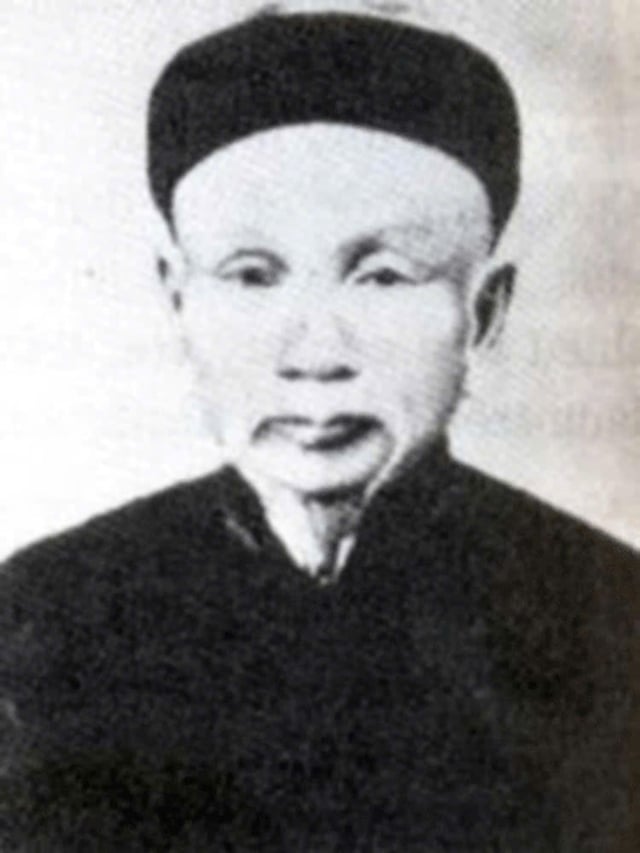
Nguyen Thien Thuat
Photo: Archival material
When the French colonialists invaded Northern Vietnam, Dinh Gia Que resigned from his official position and returned to his hometown, recruiting a rebel army and raising the banner of rebellion in the Bai Say region. He proclaimed himself Dong Quan Vu (hence often called Dong Que) and erected a banner embroidered with eight characters: "Southern Path, Can Vuong - Pacify the West, Punish the Sins ."
In its initial phase (from April 1883 to August 1885), the uprising led by Dinh Gia Que used the Binh Dan Temple ( Hung Yen province ) as its headquarters. There, he built the main base in Tho Binh hamlet with structures such as a brick wall, warehouses, a shooting range, and a martial arts training ground. Although not overly fortified, the base included tunnels and secret bunkers, becoming a refuge for the leader and the standing army, mobilizing the strength of the entire population to fight.
Dong Que's power grew stronger and stronger. "With a dispersed operational method among the people and using guerrilla tactics, the rebel army launched many attacks against enemy sweeps into their bases, ambushing the Bình Phú, Lực Điền, Thụy Lân (Yên Mĩ), Thụy Lôi (Tiên Lữ), Bần Yên Nhận (Mĩ Hào) outposts, and the Ân Thi district headquarters; ambushing enemy patrols on the Hanoi-Hai Duong and Hung Yen-Thai Binh roads..., inflicting heavy losses on the French army" ( Vietnamese Military Encyclopedia ).
After Dinh Gia Que died of illness in the spring of 1885, the command of the Bai Say rebel army was transferred to Nguyen Thien Thuat.
Nguyen Thien Thuat fought bravely.
Nguyễn Thiện Thuật (1844 - 1926), also known as Mạnh Hiếu or Tán Thuật, was an outstanding patriot and the brilliant leader of the Bãi Sậy uprising. He was born into a poor scholarly family in Xuân Dục village (now Đường Hào commune, Hưng Yên province), and was a 30th-generation descendant of the renowned Nguyễn Trãi.
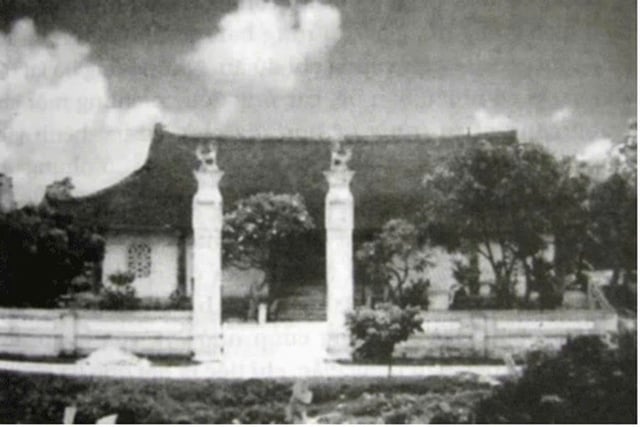
The Binh Dan Temple (Trieu Viet Vuong commune, Hung Yen province) is the place where the flag-raising ceremony and the launching of the Bai Say uprising took place.
Photo: Archival material
Nguyen Thien Thuat passed the Baccalaureate examination in 1874, the Bachelor's degree examination in 1876, and was appointed to various important official positions. In early 1883, Nguyen Thien Thuat went to Dong Trieu (Quang Ninh) to recruit resistance fighters. He allied with Dinh Gia Que to establish a resistance base at Bai Say.
In July 1885, after King Hàm Nghi issued the Cần Vương (Support the King) decree, Nguyễn Thiện Thuật succeeded Đinh Gia Quế in leadership. He quickly became a key figure in uniting progressive officials and the people in Northern Vietnam, and was appointed by King Hàm Nghi as the Grand Minister of Military Affairs of Northern Vietnam.
The French military had to acknowledge the powerlessness of the puppet government against the control of the Bai Say rebels in the area. The rebels achieved many resounding victories, most notably the ambush that inflicted heavy losses on the French army during the October 1885 sweep, the attack on the Ghenh and Ban Yen Nhan forts to avenge the death of Nguyen Thien Duong (Nguyen Thien Thuat's younger brother) in 1888, and the defeat of a French ambush in November 1888.
Although the Can Vuong movement gradually weakened after King Ham Nghi was captured (1888), Nguyen Thien Thuat remained steadfast in his fight. He refused Hoang Cao Khai's offer of surrender with four firm words: "I refuse to accept the order."
A report in French, dated October 3, 1889, from the French Resident in Hai Duong concerning the leader Nguyen Thien Thuat (Tan Thuat) and other leaders of the anti-French uprisings in Hai Duong and Hung Yen, contains the following passage:
"Tan Thuat not only played the leading role in the Bai Say uprising (Hung Yen) but can also be considered the overall leader of major rebel groups in the Northern Delta region, directing and guiding the activities of these groups with a political dimension and unity in action."
"It was observed that yesterday he contacted Doc Sung (or Lung), today with Doc Tich, tomorrow with Doi Van… it is said that he did not have a fixed residence not only for personal safety but also because his role required it" (source: National Archives Center I).
In 1888, he handed over command to his younger brother, Nguyen Thien Ke, and his lieutenant, Nguyen Duc Mau, and then went to China to seek aid, but without success. He died of illness on May 25, 1926, in Guangxi, China. It wasn't until 2005 that his remains were moved back to his hometown of Hung Yen. ( to be continued )
Source: https://thanhnien.vn/cuoc-khoi-nghia-bai-say-185251223211942901.htm




![[Image] Hanoi's urban life under the challenge of a "scorching hot" environment](https://vphoto.vietnam.vn/thumb/1200x675/vietnam/resource/IMAGE/2026/05/25/1779706979265_nang-nong-t5-2026-minh-duy-7-4636-jpg.webp)
![[Image] Close-up view of the interchange connecting the two expressways and Long Thanh Airport.](https://vphoto.vietnam.vn/thumb/1200x675/vietnam/resource/IMAGE/2026/05/25/1779703378210_ndo_br_z7863716673926-224453a31600126cce10622af6290afd-4549-jpg.webp)





















































































Comment (0)