

Tran Van Hien, Principal of Vinh Truong B Primary School in Vinh Hau commune, shared: “With the approval of the Department of Education and Training, this is the first class organized at the school in the commune, with nearly 30 Cham people attending. Understanding the differences between the Cham language and Vietnamese, from phonetic structure to grammar and writing systems… Most of the participants are elderly people, and the predominantly Cham-speaking environment in the community limits their opportunities to use and practice Vietnamese, leading to a limited Vietnamese vocabulary and difficulties in writing and expressing themselves… The school's management regularly interacts with and encourages the people; at the same time, teachers are instructed to patiently help them overcome the language barrier to learn well.”
The Cham people are all overjoyed to be able to read and write Vietnamese. “After more than four weeks of learning Vietnamese, I understand about 80% of it, and I am very happy. Not only am I happy, but the whole village and the teaching staff are also happy. I am happy and grateful for the Party and State's attention to the Cham people in teaching them to read and write. I hope the students will study diligently and absorb what they have learned in the best way possible,” said Mr. Mach Ta Res, a resident of La Ma hamlet.
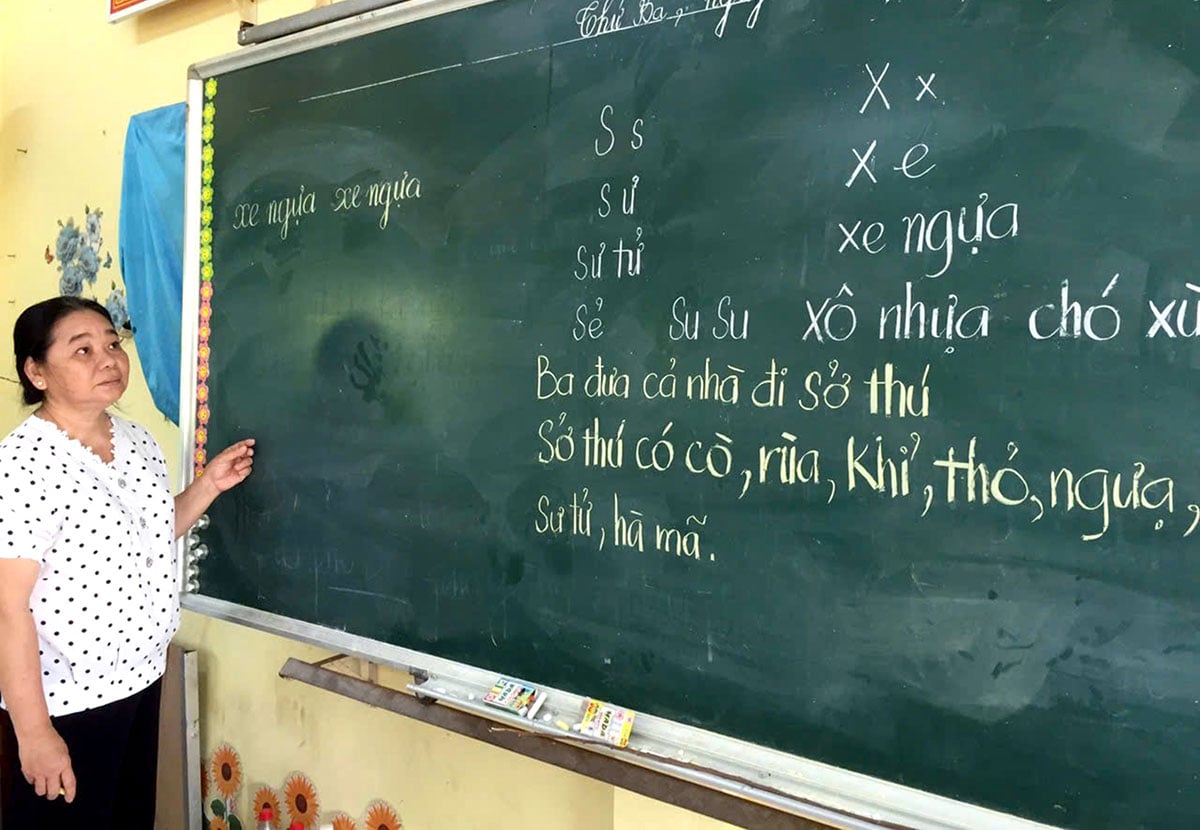
Ms. Phan Thi Ngoc Dung, who teaches Vietnamese to the Cham people in Vinh Hau commune.
Since starting on June 16th, the classes have been held regularly from Monday to Friday, from 2 PM to 4 PM. Despite her busy work schedule, Ms. Rori Giá, residing in La Ma hamlet, makes time to attend every class. She says this has been her dream for many years, so even with a lot of family responsibilities, she tries her best to attend every session. Ms. Rori Giá shared: “Currently, I’ve been studying for four weeks. Although I’m not as literate as some, being able to read a few sentences and words from the blackboard makes me very happy.”
According to Ms. Phan Thi Ngoc Dung, the instructor, when attending the class, the adults and children have to get used to a language completely different from their mother tongue, which affects their learning process. Their limited Vietnamese language skills mean they learn slowly. When the teacher lectures, they don't understand the meaning of words and quickly forget them. Therefore, the teacher always creates a relaxed atmosphere, avoids pressure, and provides timely encouragement and motivation to help them communicate confidently. "In class, I often ask the students for their opinions on whether the teaching pace is fast or if the teacher speaks Vietnamese quickly enough to adjust accordingly, so that both the teacher and students can keep up with the program," Ms. Dung said.
Mr. Tran Van Hien informed: “The school management always creates the best conditions in terms of facilities for people to come and learn; at the same time, it coordinates with the local government to propagate and encourage illiterate Cham people to arrange their time to attend classes fully.” According to the plan, the Vietnamese language teaching program for the Cham people in Vinh Hau commune will last 3 months, ending at the end of September 2025.
| For the Cham people, knowing Vietnamese is not only a condition for better integration into social life, facilitating communication, work, and daily life with the Kinh community and other ethnic groups, but also an opportunity for them to access public services, scientific and technical knowledge, market information, economic development support policies, vocational training, and employment... contributing to raising the intellectual level, alleviating poverty, and promoting socio-economic development in the locality. |
Source: https://baoangiang.com.vn/day-tieng-viet-cho-dong-bao-cham-a424654.html

![[Photo] Life on both banks of the river returns to its bustling pace on the day the Long Bien Bridge opens to traffic.](https://vphoto.vietnam.vn/thumb/1200x675/vietnam/resource/IMAGE/2026/05/28/1779949763708_cau-long-bien-minh-duy-7-3610-jpg.webp)
![[Photo] The heat at the fireworks display site on the opening night of the Da Nang International Fireworks Festival 2026](https://vphoto.vietnam.vn/thumb/1200x675/vietnam/resource/IMAGE/2026/05/27/1779889741485_ndo_br_z7872039145157-fecaba5112f39e8352544099d7ef4738-5140-jpg.webp)
































































Comment (0)