

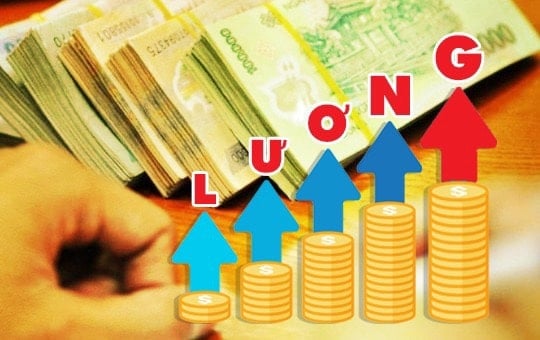
Proposed increase in regional minimum wage from 250,000 to 350,000 VND per month.
The draft regulations stipulate that the subjects of application are: Employees working under labor contracts as prescribed by the Labor Code; employers as prescribed by the Labor Code (including: enterprises as prescribed by the Enterprise Law; agencies, organizations, cooperatives, households, and individuals who hire and employ workers for them according to agreements); and other agencies, organizations, and individuals involved in the implementation of the minimum wage stipulated in this Decree.
The draft proposal suggests adjusting the monthly minimum wage and the hourly minimum wage applicable to employees working under labor contracts by 7.2% compared to the current levels (coinciding with the plan recommended by the National Wage Council to the Government ). Specifically:
The regulations stipulate the monthly minimum wage levels according to 4 regions : Region I is 5,310,000 VND/month, Region II is 4,730,000 VND/month, Region III is 4,140,000 VND/month, and Region IV is 3,700,000 VND/month.
The Ministry of Interior stated that the aforementioned minimum wage increase ranges from 250,000 to 350,000 VND (corresponding to an average increase of 7.2%) compared to the current minimum wage. This adjustment is approximately 0.6% higher than the minimum living standard for workers until the end of 2026, aiming to improve the lives of workers. This adjustment aims to share and harmonize the interests of both workers and businesses, focusing on improving the lives of workers while ensuring the maintenance and development of business operations.
The regulations stipulate minimum hourly wages across four regions: Region I at 25,500 VND/hour, Region II at 22,700 VND/hour, Region III at 20,000 VND/hour, and Region IV at 17,800 VND/hour.
According to the Ministry of Interior, the hourly minimum wage continues to be determined based on the equivalent conversion method from the monthly minimum wage and standard working hours as stipulated in the Labor Code. This is the method recommended by ILO experts for Vietnam to choose and has been used when calculating the hourly minimum wage from 2022 to the present.
Minimum wage adjustment effective January 1, 2026
Regarding the timing of the minimum wage adjustment, the draft proposes implementing it from January 1, 2026, to ensure sufficient time for businesses to prepare plans and resources for implementation.
Most countries also choose to adjust the minimum wage at the same time as the start of the fiscal year to facilitate business planning for enterprises.
In Vietnam, from 2000 to the present, the Government has adjusted the minimum wage 20 times, with 15 out of 18 adjustments made on January 1st. Other adjustments on January 1st each year were linked to unusual fluctuations (the current minimum wage will be applied from July 1st, 2024; this adjustment is made in the context of the economy and society after overcoming the most difficult period of the COVID-19 pandemic and beginning to move towards a good recovery with many positive aspects).
Regulations specifying the list of areas to which the minimum wage applies, based on the new commune-level administrative units.
The current minimum wage level in Decree No. 74/2024/ND-CP, established by region and linked to district-level administrative boundaries, is no longer suitable for the actual situation in localities after the reorganization of the two-tiered government system from July 1, 2025. Therefore, the draft proposes a new list of regions I, II, III, and IV based on the existing list stipulated in Decree No. 128/2025/ND-CP, with a review and update based on the request of the provincial People's Committees.
The draft Decree stipulates that the application of the regional area is determined according to the location of the employer's operations as follows:
- Employers operating in a particular region must apply the minimum wage rate stipulated for that region.
- If an employer has units or branches operating in areas with different minimum wage levels, each unit or branch shall apply the minimum wage stipulated for the area in which it operates.
- Employers operating in industrial zones and export processing zones located in areas with different minimum wage levels shall apply the minimum wage level of the area with the highest minimum wage.
- Employers operating in areas where the name has changed or the area has been divided shall temporarily apply the minimum wage rate stipulated for the area before the name change or division until the Government issues new regulations.
- Employers operating in areas newly established from one or more areas with different minimum wage levels shall apply the minimum wage level of the area with the highest minimum wage.
Regarding the application of the minimum wage, the draft Decree stipulates:
The monthly minimum wage is the lowest wage level used as a basis for negotiating and paying wages to employees who are paid monthly. It ensures that the wage for an employee working the full normal working hours in the month and completing the agreed-upon labor quota or work cannot be lower than the monthly minimum wage.
The minimum hourly wage is the lowest wage used as a basis for negotiating and paying wages to workers who are paid on an hourly basis. It ensures that the wage for the job or position of a worker for one hour of work and completion of the agreed-upon labor quota or work cannot be lower than the minimum hourly wage.
For employees paid weekly, daily, by-product, or on a piece-rate basis, the monthly or hourly wage of these payment methods must not be lower than the minimum monthly or hourly wage. The monthly or hourly wage, based on normal working hours, is determined by the employer in accordance with labor laws as follows:
- Monthly salary is calculated by multiplying the weekly salary by 52 weeks and dividing by 12 months; or by multiplying the daily salary by the number of normal working days in the month; or by the piece-rate salary or fixed salary for work performed during normal working hours in the month.
- Hourly wage is calculated by dividing the weekly or daily wage by the normal number of working hours per week or day; or by dividing the piece-rate or contract wage by the normal number of working hours for producing products or fulfilling contracted tasks.
The draft Decree clearly states that employers are responsible for reviewing agreements in labor contracts, collective labor agreements, and the employer's regulations and rules to adjust and supplement them accordingly; they are not allowed to abolish or reduce wage entitlements for employees working overtime, working at night, in-kind benefits, and other entitlements as prescribed by labor law. Regarding provisions already agreed upon or committed to in labor contracts, collective labor agreements, or other legally valid agreements that are more beneficial to employees (including agreements on wage rates for employees performing jobs or positions requiring vocational training that are at least 7% higher than the minimum wage) than those stipulated in this Decree, these provisions shall continue to be implemented, unless the parties agree otherwise.
HA (according to VGP)Source: https://baohaiphongplus.vn/de-xuat-tang-luong-toi-thieu-vung-7-2-tu-1-1-2026-416629.html
![[Photo] National Assembly Chairman Tran Thanh Man attends the groundbreaking ceremony for the National Highway 1A spatial axis project.](https://vphoto.vietnam.vn/thumb/1200x675/vietnam/resource/IMAGE/2026/05/19/1779161360398_ndo_br_bnd-1412-jpg.webp)
![[Photo] Capturing the moment the tide recedes at Yen Binh Son rapids - a million-year-old scenic spot in Quang Ngai.](https://vphoto.vietnam.vn/thumb/1200x675/vietnam/resource/IMAGE/2026/05/19/1779175463885_yen9-1199-jpg.webp)
![[Photo] General Secretary and President To Lam presides over a meeting on the implementation of Directive No. 34-CT/TW of the Party Central Committee.](https://vphoto.vietnam.vn/thumb/1200x675/vietnam/resource/IMAGE/2026/05/19/1779187768672_a1-bnd-2350-631-jpg.webp)



















































![[Photo] General Secretary and President To Lam receives Indian Defense Minister Rajnath Singh](https://vphoto.vietnam.vn/thumb/402x226/vietnam/resource/IMAGE/2026/05/19/1779184046302_anh-man-hinh-2026-05-19-luc-16-46-58.png)
























Comment (0)