

In the sweltering days of late April, National Highway 29 from Phu Yen province to Dak Lak remained bustling with traffic, even more so than usual. Along this strategic 293km east-west route connecting the fertile Central Highlands with the potentially rich coastal region, people from both provinces are now traveling back and forth more frequently.
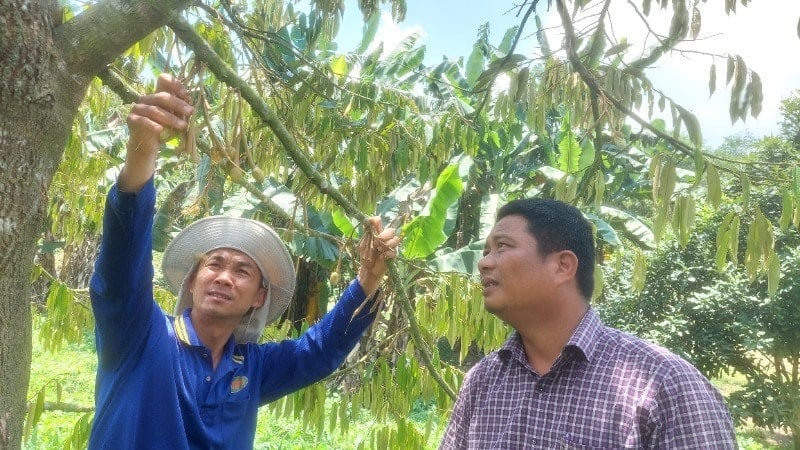 Le Minh Quan's durian orchard is currently in the flowering stage, promising a bountiful harvest.
Everyone shared a feeling of excitement, eager to explore new lands and expansive horizons before uniting under one roof. In the border region, prosperous villages with economically valuable crops like coffee and durian began to stir, eagerly awaiting the day they could bear the famous Dak Lak brand.
Opening up opportunities for growth
Located east of Hon Den mountain, in Ea Bar commune, Song Hinh district, Phu Yen province, about 1km as the crow flies from Dak Lak province, the 5-hectare durian orchard is managed by Mr. Le Minh Quan.
He is also a member of the Hon Den Cooperative, which has a total of 12 hectares of Dona durian trees that have been granted a planting area code. Last year, thanks to the trees that are 5-7 years old, Mr. Quan also harvested nearly 30 tons.
According to Mr. Quan, if the weather is favorable, the yield will increase by about 10 tons, and traders will come to buy directly from the farm at market price because the growing area has a code, plus the seeds and techniques are from Dak Lak.
"Having the brand name of Dak Lak's famous crops recognized both domestically and internationally makes the farmers very happy. They no longer worry about sales and prices, and even pests and diseases are better controlled," Quân said, unable to hide his joy.
Vice Chairman of the People's Committee of Ea Bar commune, Le Mo Y Bong, excitedly added: "This is an opportunity to open up a sustainable development direction for the commune's key durian growing area of over 500 hectares out of a total area of more than 800 hectares in Song Hinh district, promising a breakthrough in the development of this land rich in the cultural identity of the ethnic minority people."
Not far away, Mr. Le Quoc Huy, the owner of a coffee plantation of over 1 hectare, which was in its third year of harvest, also finished harvesting before the Lunar New Year, selling over 20 tons of fresh coffee to traders in Dak Lak at 25,000 VND/kg, earning a profit of over 250 million VND.
Mr. Huy expressed his hope: "In this 'coffee capital,' when it's incorporated into Dak Lak, it will have a brand name, and with the addition of a dry processing plant, it will continue to be a huge success, encouraging farmers to quickly expand their cultivated area."
Huy added that there's a plot of land, about 1 hectare in size, where just a few days ago, someone offered 1.9 billion VND, and now the price has increased to 2.1 billion VND, but the owner still refuses to sell.
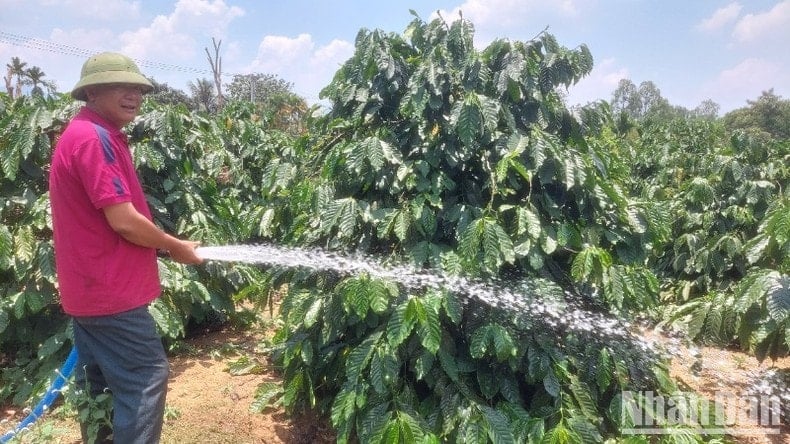
Mr. Le Quoc Huy hopes to bring the Dak Lak coffee brand to life.
With one of the largest durian cultivation areas in the mountainous Song Hinh district, covering 20 hectares, of which 5 hectares are already producing fruit, Mr. Cao Nguyen Lam shared: “Because we are an agricultural area, the farmers here prefer to trade with Dak Lak province because of their long-standing strengths and brand. Not only durian, but many other crops largely depend on traders from Dak Lak coming down to buy, sometimes with several groups coming in a single day.”
According to Mr. Lam, because Dak Lak had done it before, had more experience, a registered area code, a stronger and more stable market, it was excellent for the people there to follow suit.
"Not to mention that National Highway 29 will soon be expanded, providing seamless connectivity to the new provincial center and the coast. Don't you think that's incredibly beneficial? The people here will be able to live in the central area, with improved infrastructure, housing, and urban development. It's fantastic, so wonderful, I'm very happy," Mr. Lam shared his joy with the reporter.
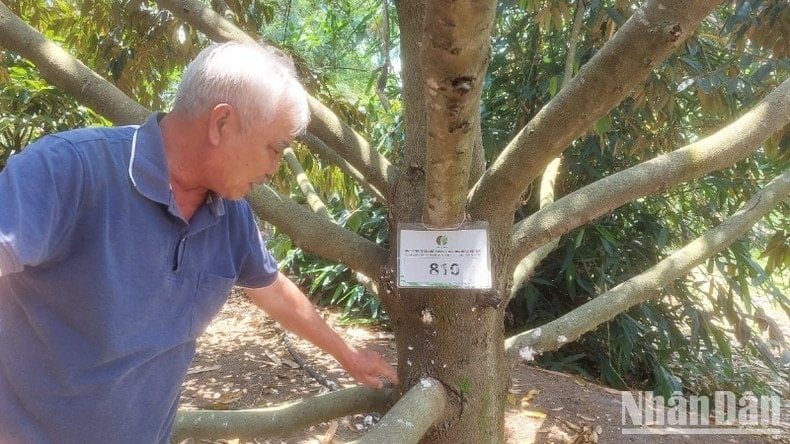
Mr. Lam hopes to earn around 5 billion VND from this durian harvest.
From the story of durian and coffee trees in this land bordering the Central Highlands, and especially with the policy of merging Phu Yen and Dak Lak provinces, anyone can see that the door to long-term, sustainable strategic development has begun to open, signaling the joint efforts, unity, and solidarity of the people of the two provinces to rise together in a new era after the merger.
The Huong Dak Phu rest stop is bustling.
Traveling north along National Highway 29 towards the Central Highlands, we came across a rest stop called Huong Dak Phu, opened by local people, located at the intersection of Phu Yen, Dak Lak, and the reservoir of the Krong H'Nang Hydropower Plant.
Despite the scorching early summer sun, this area is a popular rest stop for truck drivers, pedestrians, and other vehicles traveling between Phu Yen and Dak Lak.
Huong Dak Phu only sells very simple, affordable food and drinks that everyone can enjoy, such as chicken rice and clean sugarcane juice, but it embodies quite a few of the distinctive characteristics of both localities.
What surprised us was that the owner was from Phu Yen. He is Tran Cao Phu, who arrived in Dak Phu, Cu Prao commune, M'Drak district, Dak Lak province in the late 1990s, 26 years ago, when the area was still under survey for the Krong H'Nang hydroelectric project, with no paved roads and very few inhabitants.
Mr. Phu recalled that this area used to belong to the Ba hamlet, facing numerous difficulties. Later, it developed to have about 60 households and became the present-day Dak Phu village.
I've lived in both provinces, so I'm very happy and proud to be back here, as long as life and social welfare are better than they are today.
When asked what he thought about the merger of Phu Yen province with Dak Lak, Mr. Phu blurted out without hesitation: "Personally, I strongly agree and welcome it, because Dak Lak province has industrial crops, and its revenue is always stronger than Phu Yen's agricultural crops, so there will be a sharing of resources to develop and expand."
When the merger takes place, I also believe that if Phu Yen has weaknesses in any area, Dak Lak will focus on investing in it to balance things out, and vice versa, because both will be under one roof, and there can't be a situation where one house is smaller than the other.
Furthermore, Mr. Phu asserted that when National Highway 29 is upgraded and expanded, the people will be the first to benefit, so they are ready to cooperate with the government to complete this strategic road, a dream they have cherished for generations.
Mr. Phu revealed that when the road construction began, he harbored many dreams, but his greatest aspiration was to have a little more money to expand and upgrade this rest stop. He explained that while people from Phu Yen often travel to Dak Lak for work or other purposes, it's usually more individual travel than group trips. And once they reach this point, they're tired and hungry, so they need something to eat, drink, and stay overnight.
Most recently, a delegation from Phu Yen province, on a working trip to Dak Lak province, stopped here to rest and have refreshments before continuing their journey. This rest stop is not only a source of daily livelihood for my family, but it also multiplies our joy because we regularly meet fellow countrymen from the past and now from Dak Lak province.
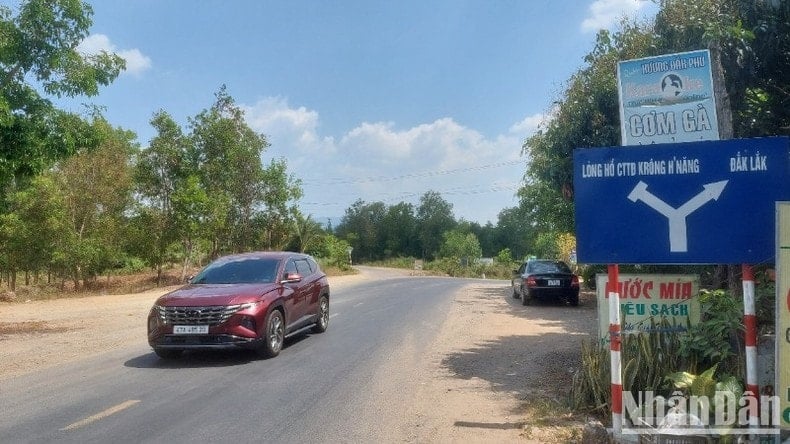
The border area between Phu Yen and Dak Lak on National Highway 29 promises to be an ideal rest stop.
From the perspective of a small-scale trader, Mr. Phu also pointed out the development of the marine economy, especially tourism. According to him, the newly established province will share the advantages of the sea, further developing resort tourism; facilitating the trade of goods and agricultural products to Vung Ro port, and distributing them far and wide.
As the sun reached its zenith, we said goodbye to our ideal stopover point and traveled over 80km back to the coastal city of Tuy Hoa, our hearts filled with nostalgia, remembering the saying, "No one loves Dak Lak as much as Phu Yen."
We look forward to seeing you again when the new province is formed and operational, promising a continuous land strip, a brilliant and prosperous east-west development axis, fully possessing both forest and sea elements, with friendly people rich in patriotic traditions, which will certainly be preserved and developed, as President Ho Chi Minh once said when mentioning the prosperous and beautiful land of Vietnam: "Our country is in a tropical region, with a good climate; golden forests, silver seas, and fertile land…".
National Highway 29, connecting Phu Yen and Dak Lak, is over 180km long, passing through Dong Hoa town and the districts of Tay Hoa, Song Hinh, Krong Nang, Ea Kar, and Buon Ho town. The section within Phu Yen province is 109km long, and within Dak Lak province is 73.5km long. This route connects the central coastal region with the Central Highlands, linking to key national transportation arteries and passing through the Southern Phu Yen Economic Zone, connecting seaports, airports, railways, and border crossings within the Cambodia-Laos-Vietnam development triangle.
According to Mr. Pham Van Tien, Deputy Director of the Department of Construction of Phu Yen province, after many years of use, many sections of National Highway 29 are gradually deteriorating, the road surface is narrow, while the volume of traffic is increasing, thus failing to meet the growing demand for passenger and goods transportation along the east-west economic corridor and posing a potential risk to traffic safety.
Source: https://baodaknong.vn/di-qua-truc-dong-tay-phu-yen-len-dak-lak-250073.html
![[Photo] Ba Lang An Lighthouse - the "eye of the sea" amidst the "rock museum" of Quang Ngai province.](https://vphoto.vietnam.vn/thumb/1200x675/vietnam/resource/IMAGE/2026/05/29/1780038698840_anh-man-hinh-2026-05-29-luc-14-10-42.png)


![[Image] Pleasant weather helps students enter the 10th grade entrance exam with confidence.](https://vphoto.vietnam.vn/thumb/1200x675/vietnam/resource/IMAGE/2026/05/29/1780034401612_ngay-1-thi-lop-10-minh-duy-8-5009-jpg.webp)
























































Comment (0)