

Save 5,000 VND per week.
The national financial inclusion strategy aims to ensure that all citizens and businesses, especially vulnerable groups, have safe and convenient access to appropriate financial products and services at reasonable costs. For the poor and low-income earners, micro-savings is a crucial pillar.
Sharing practical experiences in financial saving at the seminar "Saving - An Inner Strength in the Digital Age" organized by the Banking Times on the morning of October 30th in Hanoi , Ms. Pham Thi Thuy Linh, General Director of the Tinh Thuong Microfinance Organization (TYM) under the Vietnam Women's Union, said: Weekly and monthly, poor women with low incomes participate in TYM's activities at the village cultural centers where they reside. There, they contribute very small savings to build up assets for the future.

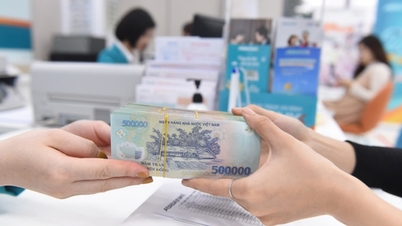
To raise capital, TYM started with very simple methods, such as designing the simplest, most accessible, and flexible financial products. Accordingly, women could deposit savings weekly or monthly, with amounts as low as 5,000 VND per week. Thanks to this, the organization reached 220,000 customers.
“For many people, 5,000 dong may seem insignificant, but it’s different for poor women with low incomes. To this day, some women still persistently save 5,000 dong each week, or even more, 10,000 dong or 20,000 dong. Such simple savings products have helped women accumulate assets from very small amounts of capital,” shared Ms. Pham Thi Thuy Linh.
Besides the mandatory savings associated with customers' loans, there are voluntary savings accounts for women, with each account value starting from just 100,000 VND. From these products, TYM has now achieved a savings balance of 2,300 billion VND.
"This number is very small compared to the outstanding loans of a branch of any commercial bank, but it is the result of the hard work and perseverance of more than 220,000 customers," Ms. Thuy Linh proudly said.
To date, the average savings balance per TYM customer is 10 million VND/person. Before 2010, that figure was only 1 million VND/person.
Savings currently account for 70-80% of TYM's total outstanding loans, equivalent to approximately VND 2,900 billion.
TYM's target customers are 100% poor, low-income women. This unique characteristic means that TYM's loans do not require collateral; repayment is made gradually on a weekly or monthly basis; loan and repayment procedures are simple; and credit discipline is maintained.
Notably, Ms. Thuy Linh cited figures that every commercial bank and financial company would envy: a repayment rate consistently exceeding 99.99%, while non-performing loans amounted to a mere 0.0004%. Even during the most challenging times of the Covid-19 pandemic or natural disasters like storms and floods, customers continued to deposit savings and repay loans on time.
Saving is not just about accumulating wealth.
Through her interactions with hundreds of thousands of women, especially those in rural and mountainous areas, Ms. Thuy Linh observed that these are the people who initiate and maintain saving habits within their families. They plan their spending, balancing immediate and future needs, including expenses for their children's education, and setting aside funds for emergencies or unforeseen circumstances.
"Many customers shared that they previously wished they had a savings account with just 2 million VND to prepare for unforeseen circumstances in old age. As women in the family, they truly adhere to the discipline of saving," she said.

At the seminar, Deputy Governor of the State Bank of Vietnam, Pham Thanh Ha, noted that throughout the country's development periods, the spirit of saving has become a guiding principle in management thinking and policies. Along with the country's development, savings have become an important support for socio-economic growth.
"In the current context, saving is not simply about accumulating finances, but also about effectively utilizing resources to invest in the future. Practicing saving helps people develop safe accumulation habits and invest effectively, while also helping businesses take advantage of all available resources," the Deputy Governor assessed.
According to Associate Professor Dr. Chu Khanh Lan, Deputy Director of the Department of Forecasting, Statistics and Monetary and Financial Stability (State Bank of Vietnam), the Government 's National Comprehensive Financial Strategy has identified savings as one of the five key banking and financial service products. The goal is to have 25-30% of adults with savings accounts by 2025.
From an individual and household perspective, saving helps people balance their daily living expenses and allows them to access the formal financial system, avoiding predatory lending. To acquire investment-related skills, individuals first need saving skills, thereby enhancing their resilience to life's risks.
Source: https://vietnamnet.vn/dieu-ky-dieu-cua-viec-nhan-gui-tiet-kiem-tu-5-000-dong-2457944.html

![[Photo] Two flights successfully landed and took off at Long Thanh Airport.](/_next/image?url=https%3A%2F%2Fvphoto.vietnam.vn%2Fthumb%2F1200x675%2Fvietnam%2Fresource%2FIMAGE%2F2025%2F12%2F15%2F1765808718882_ndo_br_img-8897-resize-5807-jpg.webp&w=3840&q=75)































































































Comment (0)