

Vietnamese people aren't reading less; they're reading more, but they have more ways of reading. More ways of reading means a wider space for publishing. Publishers must seek out these different ways of reading to create suitable products.
Innovation will be the central theme of publishing. Innovation in book production, book distribution, new business models, and new collaboration models. Publishers must think broadly, boldly experiment to find what works best for each publisher. This is one of the many directives from Minister of Information and Communications Nguyen Manh Hung. At the conference on the implementation of publishing and distribution of publications in 2024, held in Hanoi on March 22, 2024, VietNamNet would like to present the full text of Minister Nguyen Manh Hung's speech.
Minister of Information and Communications Nguyen Manh Hung: Innovation will create the future of publishing, and creativity here is limitless. Photo: Chi Hieu
Recent difficulties show that the publishing industry needs innovation and a rethinking of books. The publishing industry is undergoing a rebirth and will take on a new form to produce better books. A sector facing difficulties is one that is being replaced by external organizations without finding a new direction. With a new industrial revolution, businesses will emerge that use new technologies to create substitute products in many industries and fields. The Fourth Industrial Revolution creates digital transformation, creating a new space: cyberspace. In the publishing industry, a series of new businesses have naturally appeared, mainly digital technology companies, that have never been involved in publishing before but offer substitute products primarily in cyberspace. So how will we respond? The natural reaction is to reclaim what has been taken, but reclaiming it requires technology. However, technology in the publishing sector is not as strong as that of technology companies. Using new technology to improve work in the old space doesn't require exceptional technology; it can be done independently. The new space, however, demands exceptional technology. Therefore, collaborating with technology companies will enhance the competitiveness of the publishing industry. Publishing will have to operate simultaneously in both spaces. The old space, with the help of new technology, will expand, improve quality, and increase productivity. The new space will help publishing expand its market, create new products, and foster long-term growth. But these two spaces don't operate independently; they complement each other. Whichever space is better online should be online, and vice versa. Publishing is political , cultural, and economic, so if these three elements are combined seamlessly, publishing will succeed. Politically, it receives support from the State. Culturally, it receives support from the people. The economy is market-driven, so it's crucial to skillfully leverage and combine these three elements. Vietnamese people aren't reading less; they're reading more. However, they have more ways to read, including reading without actually reading by asking virtual assistants. More ways to read means a wider publishing landscape. Consequently, the space for creativity is also much larger. Publishing must explore these diverse reading styles to create suitable products. Where the readers are, we must be there. Therefore, innovation will be the main story of publishing. Innovation in book production, book distribution, new business models, and new collaboration models. So we must think broadly, boldly experiment and make mistakes to find what works best for each publisher. Innovation will create the future of publishing, and the creativity here is limitless. The Ministry of Information and Communications will handle the publishing sandboxes. A book will remain a book, but in countless forms. These countless forms are ways for books to reach millions of people. A printed book might only reach thousands, tens of thousands, or hundreds of thousands of people, but a concise format across multiple platforms can reach millions and more. Therefore, the value of books also increases. Books can now travel much further than before. Building a digital platform for book publishers, providing automated and intelligent tools for bookmakers from creation, editing, production, introduction, and multi-platform distribution, creating multiple versions of books in various formats, and then collecting reader feedback and interacting with readers. Readers also participate in the book production process, analyzing data to serve each customer individually based on target audience, analyzing data to identify market trends... An open digital platform will attract many resources for book production, potentially unlimited. So, open your "box." Collaboration, especially with digital technology companies, is the main solution for the publishing industry.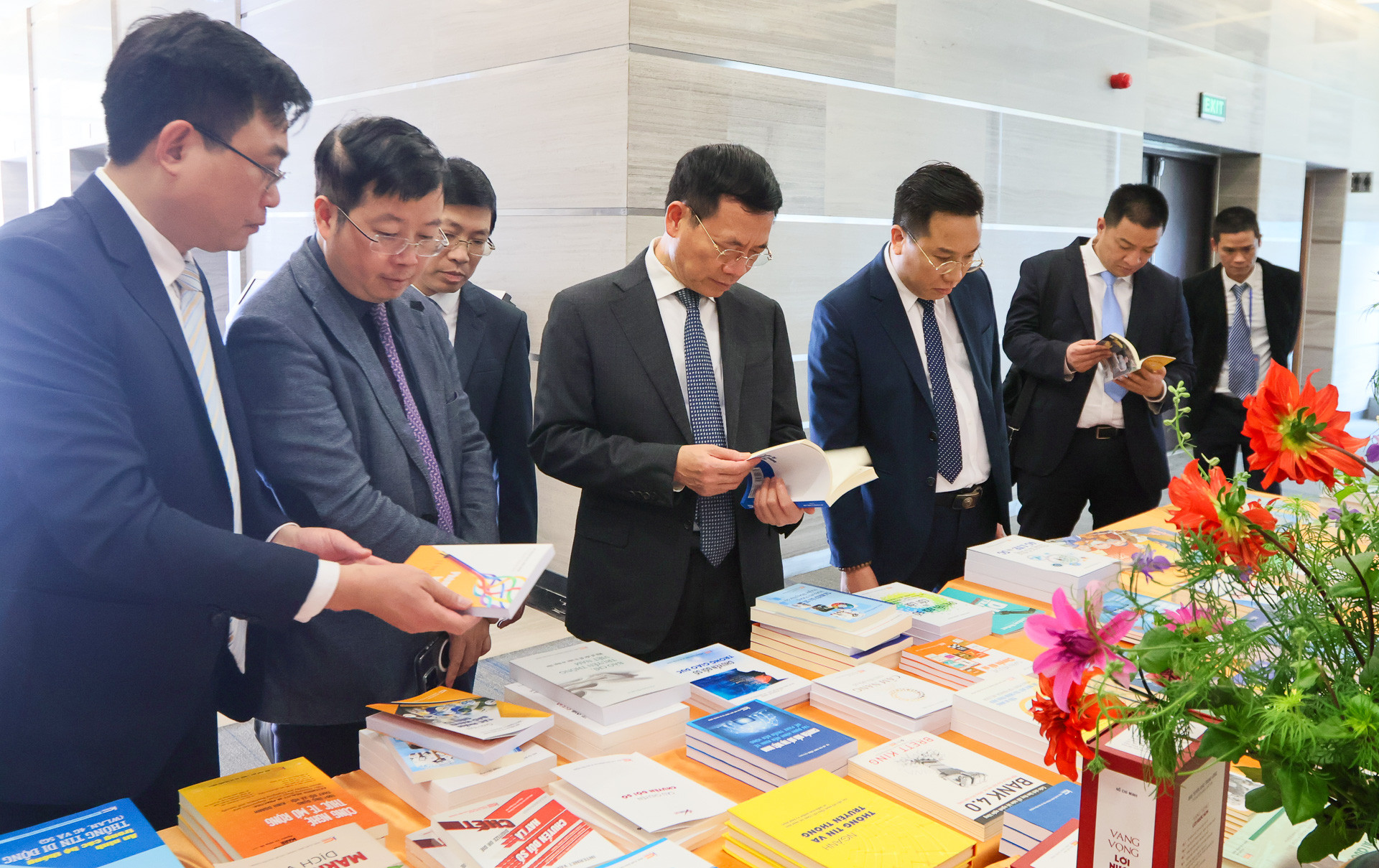
Printed books possess a vitality and uniqueness that e-books cannot replace. In the photo: Minister Nguyen Manh Hung and other leaders of the Ministry of Information and Communications at the printed book exhibition of the Ministry of Information and Communications Publishing House. Photo: Chi Hieu.
Books need a means of transmission. If new transmission methods exist in the digital environment, they should be used. Books are the creation of knowledge. Currently, there are new ways to create knowledge, new tools that allow more people to create and spread knowledge. Publishing houses can become a platform providing tools for many people to write, publish, and distribute books. To develop books and publishing, there must be readers, many readers, which means there must be a market. So let's start promoting reading. We have changed Vietnam Book Day to Vietnam Book and Reading Culture Day. Many countries have reading time in schools. Reputable people, politicians, businesspeople, artists, and celebrities should read books and participate in promoting them. Recently, several media outlets have revived the "One Book a Day" segment on television and in newspapers. The number of books a Vietnamese person reads annually is currently not high compared to other countries in the region and the world . Books are knowledge. Knowledge must reach more citizens for the country to develop rapidly and sustainably. Therefore, the publishing industry has the task of increasing the number of books a Vietnamese person reads each year. Publishing is also a business, and business requires a brand. A brand is built on differentiation. We have many publishing houses, and each must have its own brand to distinguish itself from others. If all publishing houses were the same, then only one publishing house would be needed. By identifying their unique strengths, publishing houses can also find a different business model. Business requires introduction and promotion. Bookstores that are currently struggling will face significant difficulties in promotion. Therefore, Vietnamese telecommunications companies can help Vietnamese publishing and Vietnamese books by sending a free text message about books to people every week. This action may seem small, but for books, it's enormous; sending 4 messages per month to 100 million Vietnamese people would cost 60 billion VND. Regarding some difficulties in publishing: Firstly, there is a lack of subject matter. This is because we focus on bestsellers. Bestsellers are in the Western market, meaning they sell millions of copies. But in Vietnam, that's not necessarily the case; bestsellers aren't always suitable, and it's rare to sell a million copies. Therefore, we need a different approach. We must understand the tastes of Vietnamese readers, meaning we must understand the market, conduct market research, and read many manuscripts to find something suitable, even if the manuscript price is very low. Secondly, the traditional book market is shrinking. If publishers now consider having two areas to operate in, they will see that the market is not shrinking. We still operate in the traditional market, but with greater diversity, satisfying more specific needs. For example, we print books that have been identified as high-value, with higher quality and higher prices. The space is old, but the methods are new. The new space is the digital space, so we must consider it a new survival space, even though revenue is not yet high. These two spaces are not independent but complement each other. For example, the online space is used to test the market before printing. The online space is cheaper, while the physical space is more expensive. Recently, a film company created a digital platform for writing and reading stories for free; stories with many readers will be adapted into films. Therefore, the digital environment is very good for testing the market. Thirdly, e-books are growing slowly. If we consider e-books as an independent market, it will be very difficult to succeed; we will see a small market and low revenue. The US, a country with a very developed e-book market, only has a 20% market share. The solution here is to consider the two markets, the traditional market and the online market, as one and complementary. Electronic revenue might be low, but it could boost print book revenue, or vice versa. We should think "and" rather than "or." The word "and" is the hardest to learn, but only "and" can open up new avenues for collaboration. Fourth, the publishing industry has limited human resources. This limitation stems from our inability to generate high revenue and pay high salaries, not from a lack of manpower. Therefore, the root of human resource needs lies in business, in the fact that while books are marketable, publishers haven't yet adopted a market-oriented mindset. Publishing is economics , it's business. Publishers must think like businesses, starting from the market, continuously innovating technology, managing effectively, and focusing on both mass and high-value segments. Regarding some key tasks for the coming period: First, perfecting the institutional framework, especially the digital framework, of the publishing industry. The focus is on amending the Publishing Law. Institutionally, this includes issues of copyright, the operating models of publishing houses, models for forming large publishing houses, cooperation models, and linkage models. In 2024, the Publishing Department must organize numerous workshops, inviting domestic and international experts to discuss new publishing models. Secondly, it involves building digital infrastructure for the publishing industry. The focus is on digital publishing platforms and AI platforms to serve publishing houses. These should be shared platforms, at least at a basic level. Thirdly, it requires training digital human resources for the publishing industry. Digital human resources will be the fundamental production force of publishing. Training should include both practical training and in-depth training through retraining of publishing staff. Training in business and management is just as important as, if not more important than, training in digital technology. The Publishing, Printing, and Distribution Department must lead this training. Fourth, improve statistical data collection. Without data, it's impossible to formulate correct policies or manage effectively. Establish online connections between the Department and publishing units to improve statistical reporting. Conduct social surveys to gain a deeper understanding of this field. Fifth, each year we must have a few books that reach hundreds of thousands or millions of readers, creating a shared awareness throughout society about a particular value. The Publishing Department must also play the role of conductor to ensure a balance in the Vietnamese knowledge system.
  The mission of publishing remains the creation of knowledge, the storage, accumulation, and dissemination of knowledge, but the methods need to be innovative. Books are an open and evolving concept; if they don't change, they may be replaced. It's time for publishing to undergo a radical transformation to survive and thrive, opening a new chapter for the publishing industry. That chapter is digital publishing. It's a combination of traditional and digital publishing. Think differently and do things differently. Major, long-standing difficulties and challenges are often only solved by thinking differently. In many cases, thinking small won't work, but thinking big can, because thinking big leads to changes in methods and approaches. Therefore, it's very possible that the first innovation for the publishing industry is thinking bigger...
Vietnamnet.vn
Source![[Photo] Closing Ceremony of the 10th Session of the 15th National Assembly](/_next/image?url=https%3A%2F%2Fvphoto.vietnam.vn%2Fthumb%2F1200x675%2Fvietnam%2Fresource%2FIMAGE%2F2025%2F12%2F11%2F1765448959967_image-1437-jpg.webp&w=3840&q=75)

![[Photo] Prime Minister Pham Minh Chinh holds a phone call with the CEO of Russia's Rosatom Corporation.](/_next/image?url=https%3A%2F%2Fvphoto.vietnam.vn%2Fthumb%2F1200x675%2Fvietnam%2Fresource%2FIMAGE%2F2025%2F12%2F11%2F1765464552365_dsc-5295-jpg.webp&w=3840&q=75)




















































![[OFFICIAL] MISA GROUP ANNOUNCES ITS PIONEERING BRAND POSITIONING IN BUILDING AGENTIC AI FOR BUSINESSES, HOUSEHOLDS, AND THE GOVERNMENT](https://vphoto.vietnam.vn/thumb/402x226/vietnam/resource/IMAGE/2025/12/11/1765444754256_agentic-ai_postfb-scaled.png)








































Comment (0)