

By April 13, 1975, our forces had advanced close to and were preparing to attack the "steel shield" of Phan Rang, the enemy's "last stand" defensive line in Saigon.
At noon that same day, the General Staff sent a telegram to the Xuan Loc - Long Khanh Campaign Command, instructing: No additional forces should be deployed in the Xuan Loc direction at this time. With the existing forces, the tactics should be adjusted to suit the objectives set forth.
Lieutenant General Tran Van Tra, Deputy Commander of the Campaign Command, arrived at the Command Headquarters with the Commander of the 4th Army Corps to study the developments of the battle and decided to reorganize the forces and change the tactics of the Xuan Loc Campaign.
Based on the fundamental assessment that, for the entire enemy defense line of Saigon, Xuan Loc was only valuable when connected to Bien Hoa, the Campaign Command and the 4th Corps decided to establish a new battle plan, isolating and cutting Xuan Loc off from Bien Hoa by capturing the Dau Day intersection, cutting Highway 1, blocking enemy counterattacks from Bien Hoa and Trang Bom, and capturing Tan Phong, cutting Highway 2 to Ba Ria.
The decision to change the fighting strategy opened up a new direction for development on the Xuan Loc front, reflecting the keenness, practicality, and decisiveness of the Command in managing the campaign.
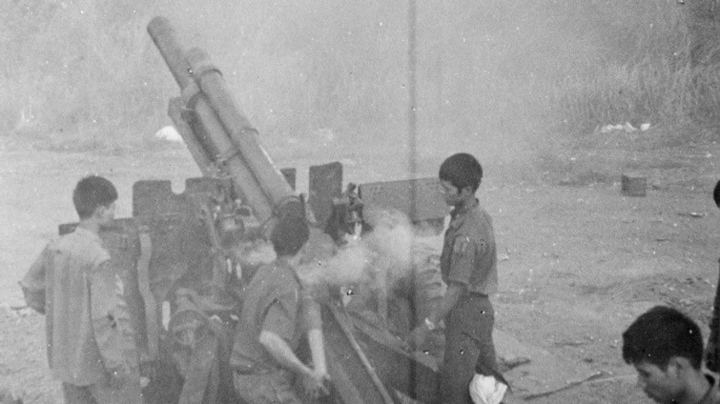
Liberation Army artillery fires at Bien Hoa airport. (Photo: VNA)
On April 13, 1975, the Command of the Saigon-Gia Dinh Liberation Campaign unanimously proposed to the Politburo that the campaign to liberate Saigon be named the Ho Chi Minh Campaign.
The Saigon-Gia Dinh City Party Committee focused on directing preparations for the uprising, mobilizing the masses, and distributing leaflets to build up forces. All levels were reinforced with cadres, party members, and mass bases. The city's special forces maintained firm control over key forces, such as 60 special operations units and over 300 armed civilians, ready to launch a mass uprising.
In addition, forces stationed in the outskirts were ordered to be ready to advance into the city center, and logistical support for the campaign was also deployed. The best support units for their respective fronts included: 210, 814, 235, 220, 230, and 240. These logistical fronts closely coordinated with the logistical bases in the outskirts and city center to receive support from the central government, building a comprehensive and widespread supply network.
In Military Region 8, on April 13, 1975, two regiments, the 24th and 88th, and two battalions from Long An province opened fire and attacked the enemy in Tan Tru.
In Military Region 9, from April 13 to 20, 1975, the region's forces launched small-scale attacks, destroying two companies of the 31st Regiment and three M113 vehicles on National Highway 4 and its surrounding areas. Simultaneously, they actively prepared to capture and cut off this road, encircle and shell Tra Noc airport, and were ready to capture the two towns of Vinh Long and Tra Vinh .
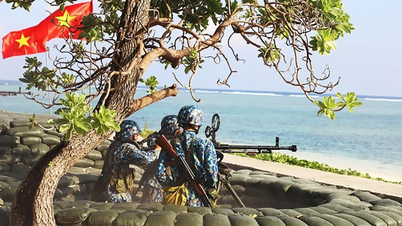
Also on April 13, 1975, General Vo Nguyen Giap sent a directive to Comrade Hai Manh and the Party Committee of Zone 5, emphasizing the opportune moment to seize the offshore islands: If the enemy has withdrawn all or most of its forces, immediately seize the islands.
Libra
Source: https://vtcnews.vn/ban-tin-chien-thang-13-4-1975-doi-cach-danh-tran-xuan-loc-ar937325.html
![[Photo] Prime Minister Pham Minh Chinh receives Lao Minister of Education and Sports Thongsalith Mangnormek](/_next/image?url=https%3A%2F%2Fvphoto.vietnam.vn%2Fthumb%2F1200x675%2Fvietnam%2Fresource%2FIMAGE%2F2025%2F12%2F16%2F1765876834721_dsc-7519-jpg.webp&w=3840&q=75)
![[Image] Leaked images ahead of the 2025 Community Action Awards gala.](/_next/image?url=https%3A%2F%2Fvphoto.vietnam.vn%2Fthumb%2F1200x675%2Fvietnam%2Fresource%2FIMAGE%2F2025%2F12%2F16%2F1765882828720_ndo_br_thiet-ke-chua-co-ten-45-png.webp&w=3840&q=75)
![[Live] 2025 Community Action Awards Gala](/_next/image?url=https%3A%2F%2Fvphoto.vietnam.vn%2Fthumb%2F1200x675%2Fvietnam%2Fresource%2FIMAGE%2F2025%2F12%2F16%2F1765899631650_ndo_tr_z7334013144784-9f9fe10a6d63584c85aff40f2957c250-jpg.webp&w=3840&q=75)

![[Photo] Prime Minister Pham Minh Chinh receives the Governor of Tochigi Province (Japan)](/_next/image?url=https%3A%2F%2Fvphoto.vietnam.vn%2Fthumb%2F1200x675%2Fvietnam%2Fresource%2FIMAGE%2F2025%2F12%2F16%2F1765892133176_dsc-8082-6425-jpg.webp&w=3840&q=75)














![[Image] The tenacious fighting spirit of Vietnamese women's football](/_next/image?url=https%3A%2F%2Fvphoto.vietnam.vn%2Fthumb%2F1200x675%2Fvietnam%2Fresource%2FIMAGE%2F2025%2F12%2F17%2F1765990260956_ndo_br_4224760955870434771-copy-jpg.webp&w=3840&q=75)































![[Live] Closing Ceremony and Award Presentation for the "Impressive Vietnam Tourism" Video/Clip Creation Contest 2025](https://vphoto.vietnam.vn/thumb/402x226/vietnam/resource/IMAGE/2025/12/17/1765974650260_z7273498850699-00d2fd6b0972cb39494cfa2559bf85ac-1765959338756946072104-627-0-1338-1138-crop-1765959347256801551121.jpeg)

















Comment (0)