

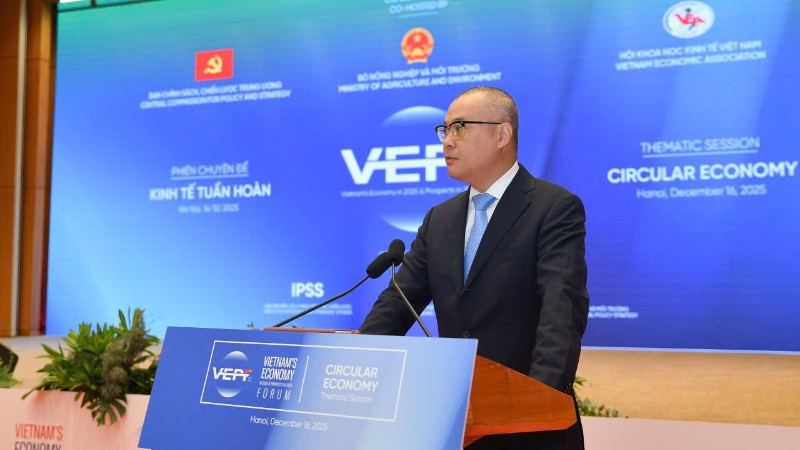
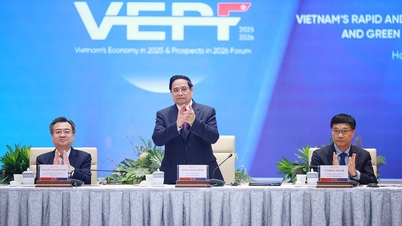
Session 1 on finance and banking, themed "Mobilizing and effectively utilizing financial resources for economic growth targets in the 2026-2030 period," saw delegates focusing on: forecasting capital needs and the ability to mobilize resources to support high growth in the 2026-2030 period; key orientations for banking credit policies and capital market development; and proposing policies to further enhance the role of financial and monetary entities in effectively mobilizing and utilizing domestic and foreign financial resources.
Speaking at the conference, Deputy Minister of Finance Do Thanh Trung emphasized that the goal of "double-digit" economic growth for the 2026-2030 period reflects the very high political determination of the Party and the State, requiring fundamental changes in thinking and action as well as the way resources are mobilized, allocated, and used.
To achieve this goal, many delegates argued that fiscal policy needs to continue playing a constructive role in long-term growth, managed proactively, sustainably, and with a focus on key areas, prioritizing development investment and social security in the structure of state budget expenditures.
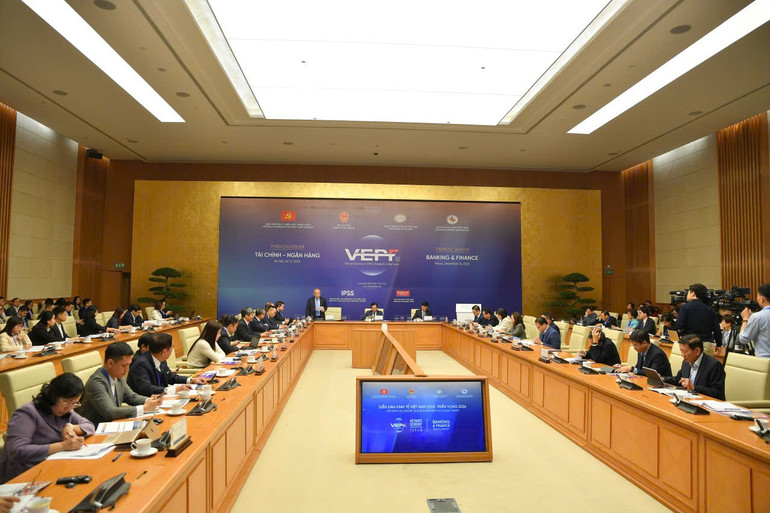
Simultaneously, the capital market continues to be strengthened and developed to become the main channel for mobilizing medium and long-term resources for the economy, gradually reducing pressure on the banking credit system and enhancing the transparency and safety of the market.
Besides financial and monetary solutions, discussions emphasized that improving the operational efficiency of state-owned enterprises and creating a favorable environment for the private sector are crucial factors in promoting growth. At the same time, the investment and business environment needs to be further improved so that the private sector truly becomes the most important driving force of growth and innovation.
Strengthening close coordination between fiscal and monetary policies should also be considered a key factor in ensuring macroeconomic stability, controlling inflation, and supporting high growth amidst increasing risks. In particular, institutional reform and the creation of a transparent and stable legal environment are identified as fundamental and decisive solutions to retain financial resources and attract businesses, especially long-term strategic investors, to Vietnam.
In the second thematic session on circular economy and green transition, delegates focused on discussing the practical application of the circular economy model in various economic sectors. They identified and assessed the advantages of the green transition and the application of the circular economy, while also pointing out policy, resource, governance, and implementation barriers through the sharing of practical experiences from corporations, businesses, and localities.
Francesca Nardini, Deputy Head of the United Nations Development Programme (UNDP) in Vietnam, believes that data from Europe and the OECD show that Vietnam has the necessary foundation to implement this model.
According to forecasts, by 2030 and 2050, the circular economy could help reduce urban waste by 30 to 34%; reduce greenhouse gas emissions by 40 to 70%; create more jobs, increase the resilience of the economy; and reduce dependence on imported raw materials.
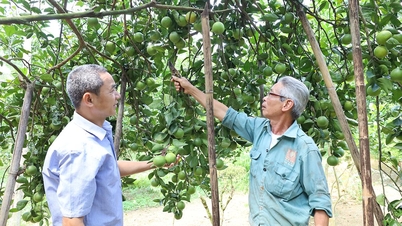
Specifically, among the priority sectors, agriculture and food play a particularly important role, contributing approximately 11.6% of GDP and 26% of total employment. Vietnam currently produces around 100 to 105 million tons of agricultural products annually, but consumes a lot of energy and resources, thus needing to promote the application of circular solutions.
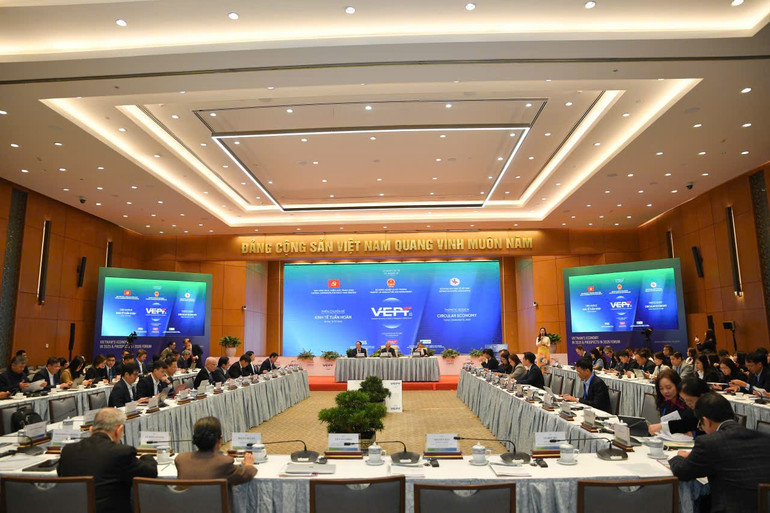
The energy sector is also a key pillar, contributing approximately 4% to GDP and providing jobs for nearly 4 million workers. Improving energy efficiency and implementing circular solutions in this sector will help reduce pollution and increase the competitiveness of the economy.
Furthermore, industries such as plastics, textiles, electronics, and beverages currently account for up to 60% of landfill waste, largely operating on a linear model. Improvements through better product design, extended material lifecycles, and increased recycling rates could generate higher economic value.
Some business representatives suggested focusing on the application of high technology and green technology to bring products to consumers; researching and applying closed-loop agricultural production processes would help save costs and reduce product prices.
From a financial perspective, many opinions suggest the need to further simplify lending procedures, promote digital transformation in access to capital, and incorporate green and sustainable criteria into credit granting. Businesses that meet green criteria should be prioritized for capital, especially in green agriculture.
Source: https://nhandan.vn/doi-moi-tu-duy-huy-dong-and-su-dung-hieu-qua-nguon-luc-tai-chinh-vi-muc-tieu-tang-truong-hai-con-so-post930663.html
![[Photo] Prime Minister Pham Minh Chinh receives Lao Minister of Education and Sports Thongsalith Mangnormek](/_next/image?url=https%3A%2F%2Fvphoto.vietnam.vn%2Fthumb%2F1200x675%2Fvietnam%2Fresource%2FIMAGE%2F2025%2F12%2F16%2F1765876834721_dsc-7519-jpg.webp&w=3840&q=75)
![[Photo] Prime Minister Pham Minh Chinh receives the Governor of Tochigi Province (Japan)](/_next/image?url=https%3A%2F%2Fvphoto.vietnam.vn%2Fthumb%2F1200x675%2Fvietnam%2Fresource%2FIMAGE%2F2025%2F12%2F16%2F1765892133176_dsc-8082-6425-jpg.webp&w=3840&q=75)
![[Live] 2025 Community Action Awards Gala](/_next/image?url=https%3A%2F%2Fvphoto.vietnam.vn%2Fthumb%2F1200x675%2Fvietnam%2Fresource%2FIMAGE%2F2025%2F12%2F16%2F1765899631650_ndo_tr_z7334013144784-9f9fe10a6d63584c85aff40f2957c250-jpg.webp&w=3840&q=75)
![[Image] Leaked images ahead of the 2025 Community Action Awards gala.](/_next/image?url=https%3A%2F%2Fvphoto.vietnam.vn%2Fthumb%2F1200x675%2Fvietnam%2Fresource%2FIMAGE%2F2025%2F12%2F16%2F1765882828720_ndo_br_thiet-ke-chua-co-ten-45-png.webp&w=3840&q=75)



![[Video] Independence and self-reliance linked with international integration through 40 years of reform](https://vphoto.vietnam.vn/thumb/402x226/vietnam/resource/IMAGE/2025/12/16/1765899635777_1-1-8054-png.webp)








![[Video] Bach Mai Hospital puts into operation a group of the world's most modern equipment.](https://vphoto.vietnam.vn/thumb/402x226/vietnam/resource/IMAGE/2025/12/17/1765931442107_dung00-58-18-13still010-jpg.webp)


















































Comment (0)