

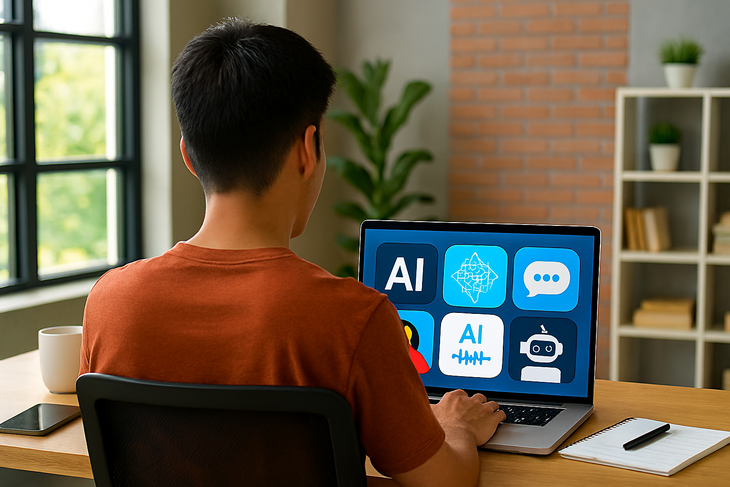
The trend of multitasking among young people is gradually spreading.
Artificial intelligence (AI) is not only changing the way people work, but also ushering in a new era of multitasking. Instead of sticking to a single job, more and more young people, especially Gen Z, are leveraging the power of AI tools to take on multiple projects simultaneously, optimizing their time and increasing their income many times over.
This trend is spreading rapidly globally, creating a completely different labor market landscape than before.
A new trend among young people: AI becomes a "colleague".
Speaking to Tuoi Tre Online , Hoang Yen (25 years old, Ho Chi Minh City) shared that every morning she opens three work tabs simultaneously: writing content for a domestic startup, designing banners for foreign clients, and operating an automated prompt sales account. Thanks to AI support, Hoang Yen completes a large workload in just one morning.
Yen is not the only case. Over the past two years, more and more young people from Generation Z have begun to "stack" their work, using artificial intelligence to increase productivity, automate processes, and expand their personal income. Instead of just one job, they can take on three to four projects simultaneously, building an entire "chain" of income streams around themselves.
A recent report from Upwork shows a sharp increase in AI-related jobs, with Gen Z being the group adopting these tools the most. The average income of those who use AI daily is also significantly higher than those who don't, reflecting the emergence of a new labor model among young people.
Ways to make money using AI are booming.

AI is helping Gen Z surpass traditional work models.
Currently, the most popular way to make money with AI is through higher-productivity freelance work. Young people are taking on jobs such as content writing, design, video editing, or marketing, where AI assists in creating drafts, generating ideas, and handling repetitive tasks, helping them shorten time and increase income.
Additionally, a booming trend is selling prompts, templates, or automated agents on platforms like Gumroad, Etsy, or personal websites, generating revenue ranging from tens to hundreds of dollars per product.
Another group is building micro-SaaS – AI-powered automated services that provide solutions for answering customer inquiries, aggregating data, or writing advertising content, generating revenue through a monthly subscription model.
Notably, some people are even using AI to maintain two or more full-time remote jobs. AI handles much of the administrative work, such as writing reports and responding to emails, helping them conceal the fact that they are juggling multiple roles.
In the US, recent surveys show that about 5% of remote workers fall into this group, generating high incomes but also raising ethical concerns.
The underlying technology and the risks

Gen Z and the race to get rich using AI.
At the core of this trend lies the ability to leverage AI tools to their fullest potential. ChatGPT, Gemini, and Claude assist in content creation, while Midjourney and DALL·E help with rapid image design. Automation platforms like Zapier and Make connect disparate tasks into a seamless workflow.
In particular, the emergence of no-code agent creation platforms makes it easier for young people to turn small ideas into commercially viable products and services.
While offering economic benefits, the trend of multitasking with AI also brings with it numerous legal risks. When someone works for a company while also taking on freelance projects, the boundaries between rights, obligations, and confidentiality are easily violated.
AI-generated products also pose potential risks of copyright infringement, unauthorized data use, or misinformation, leading to disputes.
Furthermore, income from multiple sources, especially overseas platforms, causes many young people to encounter difficulties in tax declaration, posing a challenge for authorities.
The future of a new labor model
Leveraging AI helps young people create diverse and flexible income streams, but for this model to develop sustainably, it requires a legal framework, transparency, and appropriate skills.
If the focus is solely on productivity, the market could descend into price competition, reduced quality, and worker burnout.
As AI platforms and automated agents continue to develop, the "one person - many jobs" model is likely to become the mainstream. The issue is not just how much money can be made from AI, but how to build a healthy and sustainable labor model.
Source: https://tuoitre.vn/gen-z-lam-2-3-viec-cung-luc-tang-thu-nhap-gap-3-lan-nho-ai-20251015114845851.htm
































![[Video] The craft of making Dong Ho folk paintings has been inscribed by UNESCO on the List of Crafts in Need of Urgent Safeguarding.](https://vphoto.vietnam.vn/thumb/402x226/vietnam/resource/IMAGE/2025/12/10/1765350246533_tranh-dong-ho-734-jpg.webp)



























































Comment (0)