

ST25 rice is priced at $1,200 per ton.
In the Asian market, rice prices this week have returned to their previous order. Specifically, for standard 5% broken rice, Vietnam is the highest price at $397/ton, followed by Thailand at $395/ton, Pakistan at $387/ton, and India at $376/ton.
In the Mekong Delta provinces, many traders reported that the price of 5% broken rice from Vietnam exceeded $400 per ton since the beginning of April, but has recently decreased slightly due to exchange rate fluctuations. In reality, rice prices are trending upwards, especially for high-quality fragrant rice varieties. According to businesses, the supply is limited because the largest rice harvest of the year has ended. Conversely, traditional customers, particularly the Philippines and African countries, are experiencing high demand.
Mr. Nguyen Vinh Trong, Director of Viet Hung Co., Ltd. (Tien Giang), reported: The price of ST25 rice raw material is currently at 25,000 VND/kg, an increase of 6,000 VND/kg compared to last month. Therefore, the export price of rice has reached 1,200 USD/ton (FOB price at Ho Chi Minh City port). This is due to the low production of ST25 rice during the recent winter-spring crop, while domestic demand for this product is very high. In addition, the prices of other fragrant rice varieties have also increased sharply compared to before, such as OM 5451 at 530 USD/ton and DT8 at 540 USD/ton…
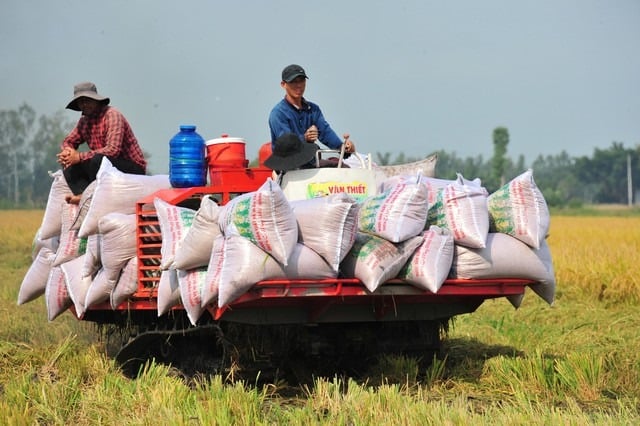
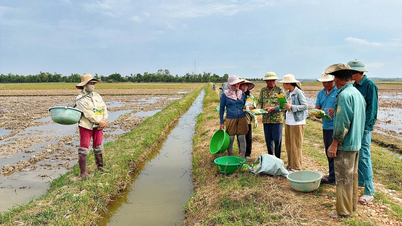
Farmers in the Mekong Delta are starting to hoard rice, waiting for better prices.
PHOTO: CONG HAN
In particular, demand for rice from Vietnam's major trading partners remains very high. According to the Ministry of Industry and Trade : For many years, the Philippines has mainly imported rice from Vietnam, accounting for about 80-85% of the market share, followed by Thailand at about 10%, with the remainder imported from India, Pakistan, Bangladesh, and other countries. The Philippine government has also made efforts to diversify its rice supply and types of imported rice. Notably, it signed a rice trade cooperation agreement with Cambodia, although this agreement is unlikely to yield significant results.
"In 2025, the Philippines' rice import demand remains high, projected at around 4.9 million tons, or even over 5 million tons. Vietnamese rice will continue to be the main source of imports for the Philippines. Whether we like it or not, the Philippines will continue to depend on Vietnam's rice supply in the future," according to a report from the Vietnamese Trade Office in the Philippines.
Similarly, in its April market analysis report, the US Department of Agriculture (USDA) stated that African countries will become the world's largest rice importers in 2025. Among these are many leading importers who are traditional customers of Vietnam. Specifically, Ivory Coast is the second largest rice importer in Africa with 1.8 million tons. According to Vietnamese Customs, in 2024, Ivory Coast imported 483,000 tons of rice, valued at $286 million, making it Vietnam's fifth largest rice buyer. In the first quarter of this year, Ivory Coast, with a market share of 16.3%, rose to become Vietnam's second largest rice buyer, after the Philippines (42.1%).
Besides Ivory Coast, in 2024, Ghana was Vietnam's fourth largest rice buyer with a volume of 613,000 tons, an increase of 4.3%, and a value of $424 million, an increase of 17% compared to the same period the previous year. In the first quarter of 2025, Ghana, with a market share of 10.2%, temporarily ranked third after Ivory Coast. It can be seen that these partners are all increasing their purchases of Vietnamese rice.
Targeting the high-end, sustainable market
Ms. Phan Mai Huong, co-founder of the international rice market website SS Rice News, stated: Global rice consumption remains high, from the mass market to the premium segment. Vietnamese rice is currently in the mid-to-high segment and is aiming for a higher segment with added value and brand recognition. Demand in this segment is very high, especially in Japan, the US, and the EU. For example, the unprecedented rice price surge in Japan has lasted from the end of last year until now and shows no signs of abating. The government has had to utilize its reserves for emergencies.
However, at a recent seminar in Can Tho, only one Vietnamese enterprise exported rice to this market, with a modest quantity of 5,000 tons in 2024. The target for 2025 is to double that to 10,000 tons. Meanwhile, in the US, Thailand exports approximately 850,000 tons of rice annually, of which 750,000 tons are fragrant rice, while Vietnam's exports only reach 20,000-30,000 tons. A similar situation is observed in the EU, which imports around 2 million tons of rice annually. These figures demonstrate the enormous potential in the premium segment.
"If Vietnam wants to build a brand and increase the value of its rice, it needs to target these high-end markets. To enter these markets, it requires continued improvements in production to ensure quality and safety," Ms. Huong noted.
The new Chairman of the Vietnam Food Association (VFA), Do Ha Nam, analyzed: The important factor causing such a rapid increase in rice prices is that our supply is not in surplus. Traditional customers always have high and stable demand for Vietnamese rice. The price drop is due to some businesses competing to sell, leading to price reductions. This allows customers to use this to pressure other businesses, ultimately creating a sharp price drop. Therefore, after the Prime Minister issued a directive, rice prices immediately increased again.
"For high-end markets, our production in the US is currently only 30,000 tons, and the Japanese market is even smaller. To export to these markets, it is crucial that we shift our production towards sustainability and strictly control chemical residue levels," Mr. Nam emphasized.
Prices of Thai specialty rice have dropped sharply. The Thai Rice Exporters Association (TREA) reported a simultaneous drop in prices for various Thai specialty fragrant rice varieties. The sharpest decline was $43 for Jasmine rice, bringing its price down to $737 per ton. Hom Mali rice for the 2024-2025 crop year fell by $19 to $988 per ton, while Hom Mali rice for the 2023-2024 crop year dropped by $22 to $1,180 per ton. |
According to Thanh Nien newspaper.
Source: https://thanhnien.vn/gia-gao-viet-lai-dung-dau-the-gioi-185250415224720455.htm
Source: https://baolongan.vn/gia-gao-viet-lai-dung-dau-the-gioi-a193566.html



![[Image] Nearly 125,000 Hanoi students completed the Literature exam for the 10th grade entrance exam.](https://vphoto.vietnam.vn/thumb/1200x675/vietnam/resource/IMAGE/2026/05/30/1780117233041_ndo_br_thiet-ke-chua-co-ten-2-png.webp)




















































































Comment (0)