

Faced with weak enrollment and insufficient revenue to cover expenses, a number of universities and colleges have been planning mergers. This is also a goal aimed at further reforming the organizational and management system, improving the quality and efficiency of public institutions. However, according to education experts, mergers must ensure scientific rigor, effectiveness, and a focus on reducing quantity while increasing quality.
A flurry of mergers
In late May 2024, the People's Committee of Tay Ninh province held a meeting with a delegation from Ho Chi Minh City University of Education to survey and propose the establishment of a branch campus of Ho Chi Minh City University of Education in the province.
During the meeting, representatives from Ho Chi Minh City University of Education proposed establishing a branch campus by merging with Tay Ninh Provincial College of Education, performing functions such as student recruitment, undergraduate and postgraduate training, short-term training, scientific research, and technology transfer, all of which fall under the purview of Ho Chi Minh City University of Education.
Representatives from the Tay Ninh Provincial People's Committee stated that the establishment of the branch campus aims to innovate education and training in fields that meet the province's workforce needs, ensuring alignment with Tay Ninh province's development planning. Previously, Ho Chi Minh City University of Education also established a branch campus in Long An province through the merger of Long An College of Education. The university officially began enrolling students at this branch campus in 2024.
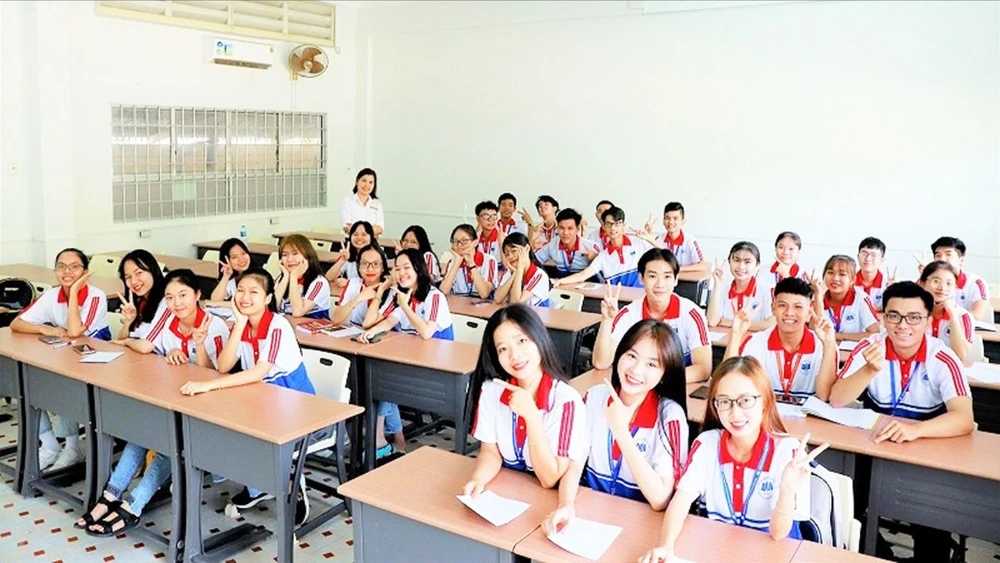
Similarly, the leaders of the Quang Nam Provincial People's Committee have also held numerous working sessions with the leaders of Da Nang University and proposed that Quang Nam University become a member of Da Nang University. This would elevate the status and create a new position for Quang Nam University, as well as address the university's enrollment issues, as its enrollment rate has been quite low compared to its targets in recent years.
Many universities in Ho Chi Minh City have also merged colleges and universities into branches or member institutions. Specifically, in 2021, the Ho Chi Minh City University of Agriculture and Forestry and the People's Committee of Ninh Thuan province agreed to merge Ninh Thuan College of Education into the Ninh Thuan branch of the Ho Chi Minh City University of Agriculture and Forestry. In 2019, the Ministry of Education and Training decided to establish a branch of the Ho Chi Minh City University of Economics (now the Ho Chi Minh City University of Economics) in Vinh Long province based on the merger of Vinh Long College of Economics and Finance. The College of Finance and Customs merged with the Ho Chi Minh City University of Finance and Marketing in 2017. In 2019, the governing body of An Giang University transferred from the People's Committee of An Giang province to the Vietnam National University (VNU) Ho Chi Minh City, and the university became the 8th member institution of VNU Ho Chi Minh City.
Meanwhile, the vocational education and training (VET) sector is also bustling with mergers of institutions. Specifically, by 2025, the number of public VET institutions will decrease by approximately 20% compared to 2020. This is a target set in the VET network planning for the period 2021-2030, with a vision to 2045, approved by the Government in Decision No. 73/QD-TTg dated March 10, 2023. Accordingly, public secondary schools will decrease by about 40%; private VET institutions and VET institutions with foreign investment will increase by about 45%; and the merger of continuing education and vocational training centers into a single VET institution at the district level will be completed...
Quality must be ensured.
According to Associate Professor Vo Van Thang, Rector of An Giang University, after merging and becoming a member university of the Vietnam National University Ho Chi Minh City, the university has overcome many difficulties. From 2019 to the present, the university has consistently achieved good enrollment results and has received many projects and cooperation programs in training and scientific research, as well as being given favorable conditions to improve the qualifications of its lecturers and attract talented staff to work at the university.
Sharing about the challenges encountered during the merger of the College of Finance and Customs in 2017, Mr. Hua Minh Tuan, former Vice Rector of the Ho Chi Minh City University of Finance and Marketing, said: Besides the policies and legal procedures of the management agency, a series of issues had to be resolved such as personnel, standardization roadmap, salaries, and facilities… The biggest obstacle was the lack of any guiding document, so without determination and consensus from many sides, implementation would be very difficult. The advantage for the school was that both schools belonged to the Ministry of Finance, so the obstacles were resolved quickly. Since the merger, the school's facilities have been expanded, the teaching staff has been upgraded, and the quality of training has continuously improved.
According to Dr. Tran Dinh Ly, Vice Rector of Ho Chi Minh City University of Agriculture and Forestry, there was a time when the establishment of too many colleges and universities led to a surplus crisis, making enrollment difficult and resulting in insufficient budget to cover the burden. This is a transitional period to reorganize and affirm the true value of colleges and universities. Mergers will yield good results if they are in the right direction and with the right goals; conversely, if they do not meet the standards or lack the capacity, they will lead to self-elimination.
The Ministry of Education and Training's plan for the planning of the network of higher education and teacher training institutions for the period 2021-2030, with a vision to 2050, has set the goal of consolidating and reorganizing universities that do not meet the standards of higher education institutions through restructuring options and focusing investment to meet the standards within a 3-5 year timeframe; merging them to become a training unit or a branch of a reputable higher education institution...
* Dr. Pham Vu Quoc Binh , Deputy Director General of the Department of Vocational Education and Training, Ministry of Labour, Invalids and Social Affairs: Reorganize or dissolve weak vocational schools.
The country has over 1,800 vocational training institutions (including 1,205 public ones), currently forming a network of high-quality schools and key national and regional vocational training programs, with an average enrollment of 2 million people per year. However, despite this development, the vocational school system still has many shortcomings, lacking a rational distribution across regions, and mainly concentrated in urban areas. The structure of vocational education enrollment remains inadequate, primarily focusing on basic and short-term courses (over 80%); the quality and effectiveness of training in many schools are still low and not aligned with the human resource needs of each industry and locality; and the relationship between schools and businesses is still weak... These shortcomings necessitate the urgent restructuring or dissolution of weak vocational schools; and the reform and improvement of vocational education quality.完善 policies to encourage and facilitate the establishment and participation of domestic and foreign businesses, organizations, and individuals in vocational education and training activities.
* Ms. HUYNH LE NHU TRANG , Deputy Director of the Department of Labor, War Invalids and Social Affairs of Ho Chi Minh City: Reduce the number of vocational training institutions.
Although Ho Chi Minh City accounts for 9.61% of vocational training institutions nationwide, their distribution is uneven. Furthermore, the fact that many vocational training institutions are under the management of various ministries, departments, and city agencies creates significant challenges in leadership and guidance, from professional expertise to management. In addition, the number of vocational training institutions meeting land area standards is limited: the city currently uses 49 land and property locations for training, with a total area of nearly 900,000 m², of which only 11 institutions meet the land area standards, while 17 do not.
Based on this reality, in order to improve the quality of human resource training for the city and the country, Ho Chi Minh City has been planning, merging, and reducing the number of vocational education and training institutions. After the mergers, the city will continue to promote investment in modern facilities and equipment, and training programs that ensure the quality of training meets international and ASEAN standards.
* Mr. Nguyen Quang Thanh, Head of the Organization - Administration - Planning Department, Binh Phuoc College (Binh Phuoc province): One school has three specialized management agencies! The school was established in 2019 based on the merger of three schools: Binh Phuoc College of Education, Binh Phuoc College of Health, and Binh Phuoc Vocational College. The merger had the advantage of streamlining the organizational structure. However, the school is currently facing difficulties in its training programs because it has three specialized management agencies: the health sector is managed by the Ministry of Health, the education sector by the Ministry of Education and Training, and the vocational departments by the Ministry of Labor, Invalids and Social Affairs. This has inadvertently led to some shortcomings, such as the teaching allowance for lecturers, which varies: lecturers in health-related fields receive 25%, vocational training fields receive 30%, and education fields receive 40%. The uneven distribution of allowances within the same school has not only caused confusion among lecturers but also created difficulties for the school's management. The school previously sent a document to the General Department of Vocational Education and Training regarding this issue, but according to current regulations, the teaching allowance for lecturers in different disciplines cannot be changed.
THANH HUNG - QUANG HUY
Source: https://www.sggp.org.vn/giai-bai-toan-sap-nhap-co-so-giao-duc-post749338.html


![[Image] Central Party Office summarizes work in 2025](/_next/image?url=https%3A%2F%2Fvphoto.vietnam.vn%2Fthumb%2F1200x675%2Fvietnam%2Fresource%2FIMAGE%2F2025%2F12%2F18%2F1766065572073_vptw-hoi-nghi-tong-ket-89-1204-jpg.webp&w=3840&q=75)












































































Comment (0)