

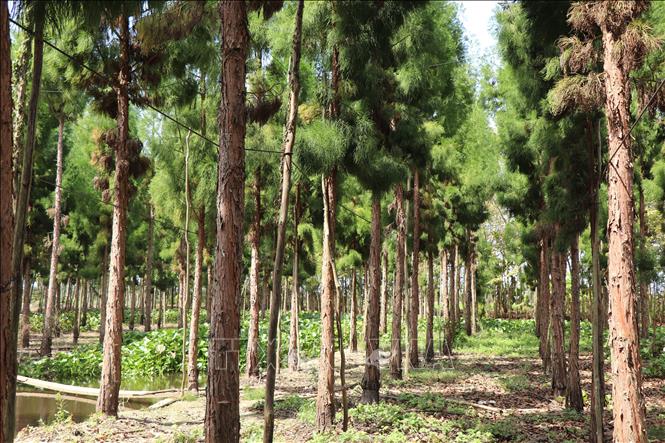
According to Mr. Ngo Chi Dien, initial surveys in the garden revealed that the tree that Mr. Thong calls "cypress" shares many similarities with the cypress species (Glyptostrobus pensilis (Staunt). K. Koch) listed in Part II of the Vietnamese Red Book of Forest Plants. A total of 17 trees were found in Mr. Huynh Cong Thong's garden (including one tree planted 19 years ago with a trunk diameter of 161 cm and a height of approximately 12 m, and 16 trees planted 17 years ago with trunk diameters ranging from 60-75 cm and heights from 8-10 m).
However, to ensure scientific and legal accuracy, the Rural Development and Forestry Sub-Department will coordinate with specialized agencies such as the Institute of Biology and species identification units to determine the scientific identity and origin of the tree. This is a mandatory step to avoid confusion and ensure objectivity in accordance with the law.
Authorities acknowledge Mr. Huynh Cong Thong's research and dedication in preserving and propagating several rare plant species over the years. The public's interest in biodiversity conservation is highly commendable and aligns with the general policy of the agricultural sector in preserving genetic resources," Mr. Dien stated.
From a state management perspective, Mr. Ngo Chi Dien argued that it needs to be clarified that the cypress tree planted at Mr. Huynh Cong Thong's house is an endangered, rare, and precious forest plant species belonging to Group IA according to Decree 06/2019/ND-CP and Decree 84/2021/ND-CP. This group prohibits exploitation and all commercial activities without permission from the competent authority, except in cases serving scientific research, conservation, or non-commercial transfer, and must be approved by the competent authority.
"Even though the cypress tree in Mr. Thong's garden was propagated by grafting onto the rootstock of another species (a type of fig tree), the grafted part is still identified as an individual of a rare and endangered species. Therefore, buying, selling, or giving it away for commercial purposes is not permitted under current law," Mr. Dien explained.
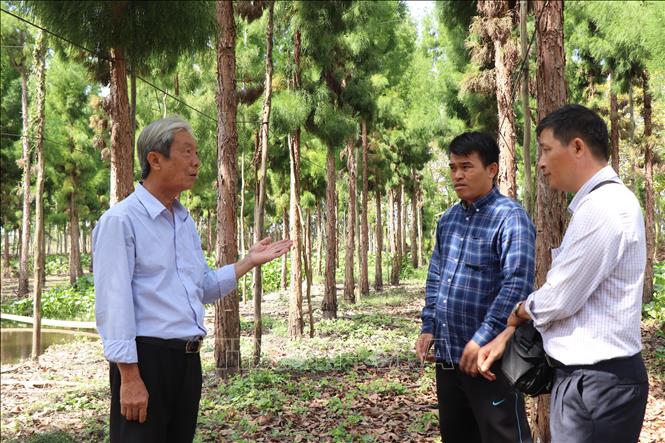
In the coming period, the Can Tho City Rural Development and Forestry Department will coordinate with specialized agencies and local authorities to work with Mr. Huynh Cong Thong to inspect and specifically determine the origin of the mother tree, the propagation process, and guide him through the necessary procedures if he wishes to register a conservation facility or transfer the tree for research purposes, in order to ensure a balance between state management requirements and community interests.
Because the cypress tree is a critically endangered and rare species belonging to Group IA under Vietnam's law on the protection of rare species, and inventory and classification of this species are not common in home gardens, there are currently no centralized and complete reports on its number. Therefore, the Can Tho City Rural Development and Forestry Department is coordinating with local authorities to review and inventory the cypress trees on Tan Loc islet and other areas in the city to obtain accurate data on the number of cypress trees, in order to develop appropriate solutions, guidance, and handling procedures in accordance with the law.
Although there are no official statistics, according to the leaders of the Rural Development and Forestry Department of Can Tho City, the planting and propagation of the cypress tree by local people can bring several significant benefits to the species' conservation, such as: increasing the number of individuals (in the wild) through legal propagation methods (with clear conditions), potentially creating additional "gene reserve" populations outside of natural forests - helping to reduce pressure on the threatened natural population. In addition, gradually restoring the species' genetic resources - preventing the risk of extinction, contributing to increased public awareness of biodiversity conservation, and also providing an opportunity for the nation to build a gene bank, restore the species, restore the population, and conduct biological research.
From a management perspective, Mr. Ngo Chi Dien stated: The State encourages people to research, propagate, and conserve rare tree species, but it is necessary to understand the legal status of each type of tree to comply with the law. At the same time, registration with state agencies is required to receive guidance on procedures and for the authorities to monitor and manage the process.
The leaders of the Can Tho City Rural Development and Forestry Department recommend that individuals wishing to research, breed, or conserve endangered, rare, and precious species must comply with the law and meet the following conditions: possess documentation proving the legal origin of the mother plant; register the cultivation facility or gene conservation facility as stipulated in Decree No. 84/2021/ND-CP; only be permitted to breed, store, or transfer for conservation and research purposes, not for commercial purposes; and all transportation, donation, and display activities must be licensed by the competent authority.
Previously, the Vietnam News Agency reported on teacher Huynh Cong Thong from Tan Loc islet, Can Tho city, who, driven by his passion for unique and rare plants, has successfully researched and developed a method for propagating the cypress (also known as water pine), a rare plant species listed in Group 1A (rare plant group) in the Vietnamese Red Book. To date, he has propagated more than 2,500 trees, contributing to the conservation of valuable genetic resources.
Source: https://baotintuc.vn/kinh-te/giam-dinh-loai-va-nguon-goc-cay-thuy-tung-duoc-ghep-o-can-tho-20251215110444021.htm
![[Image] Leaked images ahead of the 2025 Community Action Awards gala.](/_next/image?url=https%3A%2F%2Fvphoto.vietnam.vn%2Fthumb%2F1200x675%2Fvietnam%2Fresource%2FIMAGE%2F2025%2F12%2F16%2F1765882828720_ndo_br_thiet-ke-chua-co-ten-45-png.webp&w=3840&q=75)

![[Photo] Prime Minister Pham Minh Chinh receives Lao Minister of Education and Sports Thongsalith Mangnormek](/_next/image?url=https%3A%2F%2Fvphoto.vietnam.vn%2Fthumb%2F1200x675%2Fvietnam%2Fresource%2FIMAGE%2F2025%2F12%2F16%2F1765876834721_dsc-7519-jpg.webp&w=3840&q=75)
![[Live] 2025 Community Action Awards Gala](/_next/image?url=https%3A%2F%2Fvphoto.vietnam.vn%2Fthumb%2F1200x675%2Fvietnam%2Fresource%2FIMAGE%2F2025%2F12%2F16%2F1765899631650_ndo_tr_z7334013144784-9f9fe10a6d63584c85aff40f2957c250-jpg.webp&w=3840&q=75)
![[Image] The tenacious fighting spirit of Vietnamese women's football](/_next/image?url=https%3A%2F%2Fvphoto.vietnam.vn%2Fthumb%2F1200x675%2Fvietnam%2Fresource%2FIMAGE%2F2025%2F12%2F17%2F1765990260956_ndo_br_4224760955870434771-copy-jpg.webp&w=3840&q=75)
![[Photo] Prime Minister Pham Minh Chinh receives the Governor of Tochigi Province (Japan)](/_next/image?url=https%3A%2F%2Fvphoto.vietnam.vn%2Fthumb%2F1200x675%2Fvietnam%2Fresource%2FIMAGE%2F2025%2F12%2F16%2F1765892133176_dsc-8082-6425-jpg.webp&w=3840&q=75)
















































![[Live] Closing Ceremony and Award Presentation for the "Impressive Vietnam Tourism" Video/Clip Creation Contest 2025](https://vphoto.vietnam.vn/thumb/402x226/vietnam/resource/IMAGE/2025/12/17/1765974650260_z7273498850699-00d2fd6b0972cb39494cfa2559bf85ac-1765959338756946072104-627-0-1338-1138-crop-1765959347256801551121.jpeg)


















Comment (0)