


Upon learning that a male student had bumped his head on a table while playing, the principal instructed Ms. Hue to go to the student's home and apologize immediately that night, "to prevent the parents from posting it online."
Ms. Hue, 50 years old, a homeroom teacher of a 5th grade class in Ha Nam , recounted that her class had three close male students who often played pranks on each other. That day, two of them were carrying their friend on their shoulders, but while climbing on, the boy slipped and hit his head on a desk. The incident happened before class started in the afternoon, and Ms. Hue was unaware of it.
"During class, she bumped her head and said she felt a little tired. Neither her classmates nor she mentioned anything about playing around or falling, so I thought she was sick and called her parents to pick her up," the teacher recounted.
At 9 PM, the parents called to share about the incident, saying it wasn't serious but they planned to take their child to the doctor. Ms. Hue reported it to the principal, intending to visit the home after her morning classes the next day. However, the principal instructed her to leave immediately, "don't let parents post online that teachers are slow to visit." She was also criticized for "not being attentive enough" and needed to learn from the experience.
"I felt wronged and didn't deserve such criticism," Ms. Hue expressed. But understanding the pressure from the principal, she quickly changed her clothes, ran to buy four packs of milk, and went to the student's house, 5 km away, at 10 pm.
Ms. Thanh, 28, a private preschool teacher in Hanoi , also "turns pale with fear" whenever she sees a scratch or bruise on a child's body.
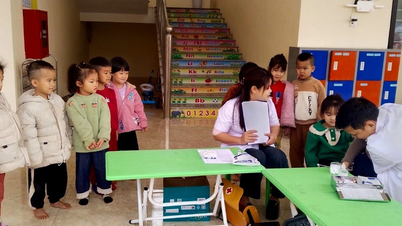
In charge of 30 three-year-olds along with another teacher, Ms. Thanh said it's impossible to prevent all potentially harmful behaviors from the children. Many children play and bump into each other, causing scrapes and bruises, or trip and fall while running and jumping.
"But parents often become suspicious at the slightest scratch on their child. Even after explaining, I'm afraid they won't believe me and will post it online, and I could lose my job," Ms. Thanh sighed.
Education administrators recognize that this mindset stems from the increasing use of social media by parents to resolve school-related issues. Even without making mistakes, teachers are still haunted by and apprehensive about dealing with parents, affecting their morale.

Content from teacher-parent group chats can be captured and posted online. (Illustrative image: Provided by a parent)
Since the beginning of the school year, social media has been flooded with posts from parents complaining about financial matters, school lunch programs, and the behavior of teachers. At the Happy School Conference on October 20th, Mr. Vu Minh Duc, Director of the Department of Teachers and Educational Management, stated that teachers face significant pressure.
"Just one instance of misconduct can cause an uproar on social media tomorrow. Teachers are under immense pressure," Mr. Duc said.
According to the Ministry of Information and Communications, Vietnam has over 77 million internet users, accounting for nearly 80% of the population. The internet enables rapid information dissemination; many incidents posted online by parents attract tens of thousands of interactions within just a few hours.
Having previously posted on Facebook about the income and expenditure of her son's class parent fund, Ms. Nhai, 29, from Hanoi, said this method was immediately effective. Just 6 hours after posting, the homeroom teacher and representatives from the parent committee came to meet with her.
"The head of the parent committee promised to make the fees public, and the teacher explained everything thoroughly. I thought it was reasonable, so I removed the post," Ms. Nhai recounted, arguing that parents, being "powerless and voiceless, need collective pressure."
A school principal in Quang Tri said this mindset is now prevalent, forcing schools and teachers to be cautious in every word and action.
"Regardless of whether it's right or wrong, going online means you'll have to report it, explain it, get reprimanded by superiors, and face negative publicity," he said, adding that when discovering such incidents, it's best to be open-minded and tactful to resolve them promptly.
He believes the cause lies in the lack of openness and trust between parents, schools, and teachers for direct communication. However, he is also frustrated that some incidents are blown out of proportion by parents or that parents intentionally post false information without thoroughly investigating the matter. He knows of colleagues who spent an entire week dealing with a meal that wasn't provided by the school but was posted online, or of lower-level teachers whose conversations were manipulated in Zalo groups, screenshots of which were sent everywhere.
Associate Professor Dr. Nguyen Thi To Quyen, Acting Head of the Department of Sociology and Development, Academy of Journalism and Communication, agrees. She believes that accurate feedback from parents online helps to quickly address violations and serves as a lesson for schools and teachers, but many of the feedback lacks objectivity.
As a result, teachers develop a sense of professional self-defense, according to Dr. Hoang Trung Hoc, Head of the Department of Educational Psychology, Academy of Educational Management. When feeling insecure in the face of external influences, teachers withdraw and are reluctant to contribute.
"When teachers lose their enthusiasm and passion for their work, the students are the ones who suffer the most," Mr. Hoc observed.
In Vietnam, there are currently no studies on the specific impact of this issue. In South Korea, however, between 2018 and 2022, more than 1,000 teachers were assaulted or attacked by students and parents. The fear of parents among teachers is so serious that the government is planning a series of changes, including restricting parental contact with teachers.
Witnessing a colleague receive harsh criticism and be reprimanded for pointing and scolding a student, Mr. Trung, a middle school math teacher in Hanoi, said his enthusiasm had diminished. Knowing he sometimes has a short temper, he resolved to simply finish teaching the lesson, instead of closely monitoring, urging, or even raising his voice to remind students about their homework.
"I feel guilty too, but oh well, I'm just an employee. Just one moment of losing self-control, and getting exposed online, would become a stain on my career," Mr. Trung said.
For Ms. Hue in Ha Nam, who was already exhausted from the heavy workload, paperwork, and training, having to apologize to the students in the middle of the night was the last straw.
"I feel that with just one slip-up, everyone will dismiss the 30 years I've dedicated," Ms. Hue said, adding that she had submitted a request to her superiors to retire three years early.

Parents flocked to Cu Chinh Lan Primary School in Gia Lai province on May 29th to protest against a music teacher for causing their children to fail the subject. (Photo: Ngoc Oanh)
Educators believe that conflicts between schools and parents are unavoidable. The key is to resolve issues in a positive and civilized manner.
Dr. Hoc acknowledges that parents may view education as a service, and have the right to demand that the provider (the school) improve its quality. However, this is a special service, and the buyers – the parents – should also behave appropriately.
"The response must be humane, educate my child, and be observed by other students," Mr. Hoc shared.
Mr. Nguyen Van Ngai, former deputy director of the Ho Chi Minh City Department of Education and Training, advises parents to investigate thoroughly, not only hearing from their children but also asking friends and other parents. Once they understand the situation, they should share it with the teacher, and if the handling is unsatisfactory, they should seek help from the school administration.
Meanwhile, teachers also need to adapt to being service providers, equipping themselves with communication skills with parents and students, and handling media crises, according to Mr. Hoc. Mr. Ngai, on the other hand, suggested that schools should establish procedures for receiving and handling complaints, with clear channels for parents to contact when needed.
"I hope that schools and parents will consider, before taking any action, whether it will have any negative impact on the students. After all, the students are the ones who are most affected," Mr. Ngai said.
Thanh Hang
*Names of teachers and parents have been changed.
Source link



![[Image] Lunar New Year 2026 is celebrated with great fanfare around the world.](https://vphoto.vietnam.vn/thumb/1200x675/vietnam/resource/IMAGE/2026/02/17/1771339826059_155b0e14cbf624b0045-2993-jpg.webp)



































































































Comment (0)