

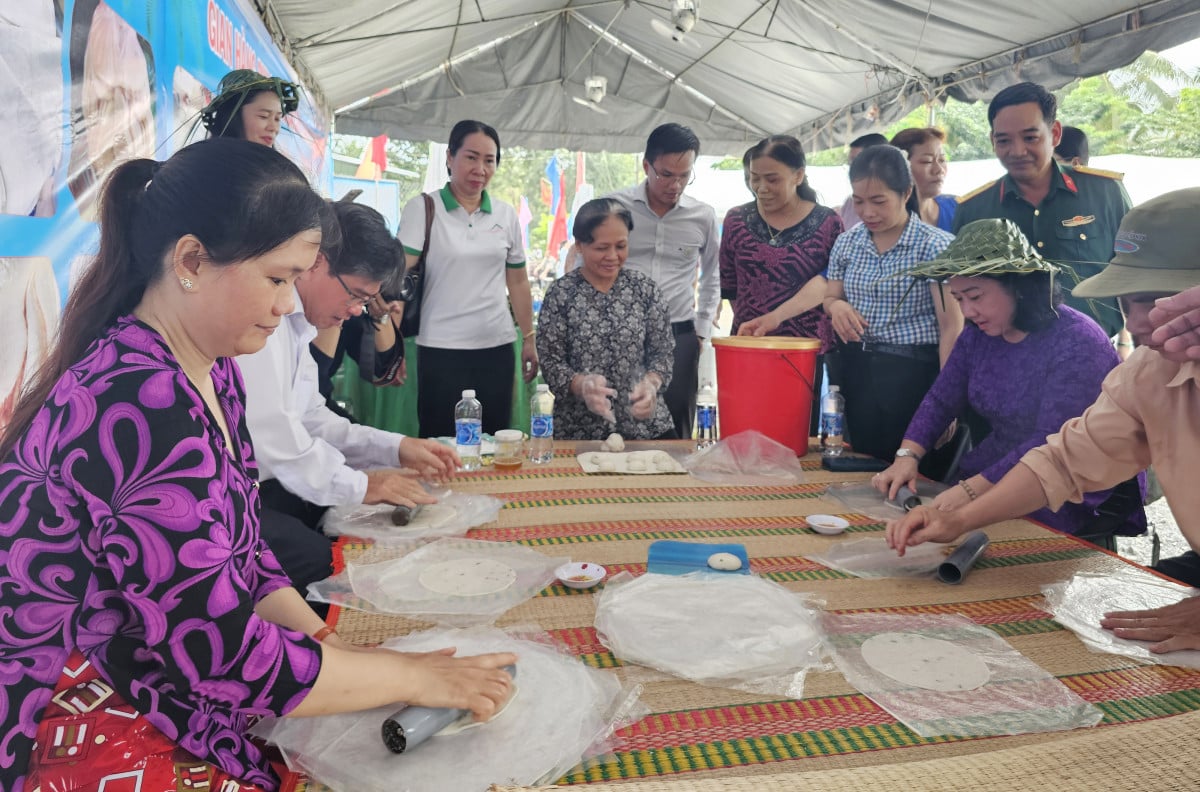
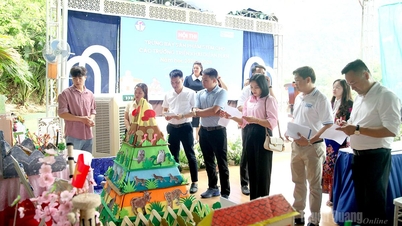
Experience the process of making Son Doc puffed rice cakes.
My Long Rice Paper Making Village
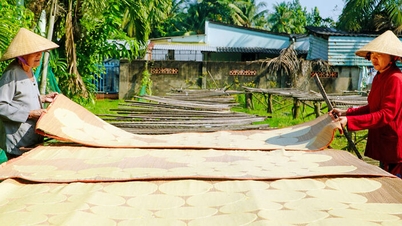
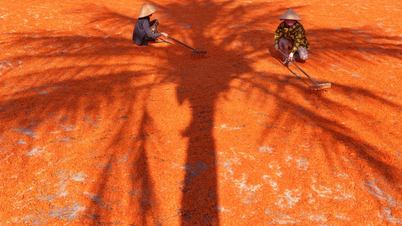
From Ben Tre City, follow Provincial Road 885 to My Thanh commune, Giong Trom district, home to the famous My Long traditional rice paper making village. Upon arriving at the village, you'll see rows of rice paper sheets stretching out on both sides of the road, drying in the sun, connecting one house to another.
With a three-generation tradition of making rice paper, Mr. Nguyen Thanh Huy, from Nghia Huan hamlet, My Thanh commune, Giong Trom district, said that the rice paper here is made from ingredients such as rice, sugar, salt, sesame seeds, and, of course, thick coconut milk. Each rice paper maker has its own secret recipe, but the most important step is still selecting the ingredients: glutinous rice and rich coconut milk.
Huy shared that this profession requires "staying up late and waking up early," paying attention to even the simplest steps. He meticulously instructed that the coconut milk, after being pressed, must be boiled until it is very thick and creamy. The rice for the cakes is also washed clean and then put into a blender with the coconut milk, after which black or white sesame seeds are mixed into the flour to make the cakes more fragrant and delicious. The rice paper oven is made by hand; a large pot of water is underneath, and a thick but smooth cloth is placed on top. When the water is boiling, the batter is poured in ladlefuls and must be rolled thinly and evenly across the cloth. As soon as the cake turns translucent, it must be removed to a bamboo tube, then transferred to a woven mat made of coconut leaves (also known as a coconut mat) to be taken out to dry in the yard. This work always requires the skillful hands of experienced craftsmen to ensure the finished product is round, even, not too thick, not too thin, and does not stick to the mold. Moreover, the rice paper making profession is dependent on the weather, so they have to wake up late at night to roll out the sheets in time to dry them in the early morning sun; if there isn't enough sun, the rice paper will become tough.
According to Mr. Huy, currently, the most concentrated rice paper making workshops are located in Nghia Huan hamlet, My Thanh commune, Giong Trom district. They are gradually improving techniques and investing in equipment to replace some steps in the manual production process (such as washing rice, grinding flour, making rice paper, etc.), aiming to reduce manual labor, increase production, improve quality and variety, and contribute to increasing people's income. In particular, besides the traditional coconut milk rice paper, the craft village has also created many types of rice paper such as milk rice paper and egg yolk rice paper, meeting the tastes of consumers both domestically and internationally.
Son Doc traditional rice cracker village
The Son Doc rice cracker village is located in Hung Nhượng commune, Giồng Trôm district. Son Doc rice crackers have long been a source of pride for the local people.
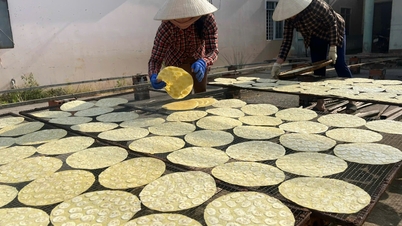
With over 20 years of experience in his family's traditional rice cracker making, Mr. Cao Minh Tan from Hung Nhuong commune (owner of Hai Sam rice cracker business) explains that the glutinous rice used for making rice crackers is sticky rice, which is steamed and then pounded until smooth with sugar, coconut milk, etc. Previously, the pounding process was usually done by men and young people; nowadays, pounding rice crackers is less strenuous thanks to the assistance of machinery.
“After pounding, the dough is rolled into round shapes and dried in the sun until completely dry. Currently, the rolling process has been switched to using machines to increase productivity and produce more beautiful finished products with consistent thickness. This helps meet market demands and increase the competitiveness of the village's products,” said Cao Minh Tan.
In addition, businesses like Mr. Tan's, which produce puffed rice cakes, also turn to e-commerce platforms and social media to market and sell their products. Mr. Tan says that after adopting e-commerce, his business has gained more customers than before. With an increased customer base, his business now operates continuously and regularly every day, employing 20 regular workers and producing over 10,000 cakes per day. During the Lunar New Year, daily production increases three to four times.
Ms. Phan Thi Kim Phung from Dong Thap said she became "addicted" to the taste of Son Doc puffed rice cakes during a trip to Ben Tre. Afterward, she often researched and ordered them online to enjoy. According to Ms. Phung, what made her "addicted" was the evenly puffed, crispy, and fragrant taste of coconut milk and sticky rice. When baked over charcoal, the cakes expand to 3-4 times their original size.
Conservation and development
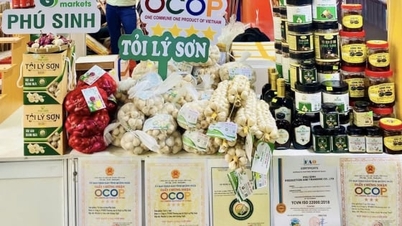
According to Nguyen Thai Binh, Secretary of the Giong Trom District Party Committee, the traditional craft of making rice paper and puffed rice cakes in the area has been included in the list of National Intangible Cultural Heritage according to Decision No. 4069/QD-BVHTTDL dated October 30, 2018, of the Ministry of Culture, Sports and Tourism. Currently, the My Long Rice Paper Cooperative has 150 ovens; the Son Doc Puffed Rice Cake Cooperative has 51 production facilities; many establishments have achieved OCOP product certification, thereby increasing the value of the products, expanding the consumer market, and penetrating distribution channels in supermarkets, markets, stores, and e-commerce platforms.
According to Nguyen Thai Binh, Secretary of the Giong Trom District Party Committee, in order for My Long rice paper and Son Doc puffed rice cakes to continue developing sustainably, appropriate solutions are needed in the future. These include determining the scale of production, ensuring the development of the craft village, attracting people to participate in production through cooperative development, and gradually researching and applying technology in the packaging process, improving packaging designs, and linking this with product promotion.
In addition to preserving intangible cultural values, the Secretary of the Giồng Trôm District Party Committee, Nguyễn Thái Bình, suggested developing a linked production chain associated with green spaces and a clean environment, creating a tourist destination linked to other tourism activities and reflecting a unique cultural identity. This would allow visitors to the craft villages to enjoy specialty cakes and experience the cake-making process. This would certainly be an interesting activity for tourists visiting the traditional craft villages of "Mỹ Lồng Rice Paper" and "Sơn Đốc Puffed Cake" in the future. Simultaneously, it is necessary to maintain and promote this festival annually at a suitable time, combining it with promotional and sales activities, and honoring artisans through recognition of craft village artisans based on specific, transparent criteria and regulations, ultimately leading to the recognition of outstanding artisans.
Text and photos: Chuong Dai
Source: https://baodongkhoi.vn/giu-lua-lang-nghe-truyen-thong-tram-nam-27062025-a148788.html





















































Comment (0)