

According to Minister Nguyen Van Thang, major cities like Hanoi and Ho Chi Minh City cannot eliminate traffic congestion as long as high-rise apartment buildings and urban areas continue to spring up in their core areas.
During the questioning session with Minister of Transport Nguyen Van Thang on the morning of June 8th, Representative Trang A Duong (a full-time member of the National Assembly's Ethnic Affairs Committee) raised the issue of serious traffic congestion in major cities, especially Hanoi and Ho Chi Minh City. This negatively impacts socio -economic development and people's lives. Therefore, he requested the Minister to explain the main causes and the solutions that the Ministry and local authorities will implement in the future.
Responding to the delegates, Minister Nguyen Van Thang affirmed that traffic congestion in Hanoi and Ho Chi Minh City is a very big problem, and it's difficult to cover everything in just three minutes of answering questions. There are many causes of traffic congestion in these cities, and solving it requires time; it cannot be done overnight. Many large cities around the world with strong economic and financial resources, such as Tokyo (Japan) and Beijing (China), have also had to deal with traffic congestion for a long time.
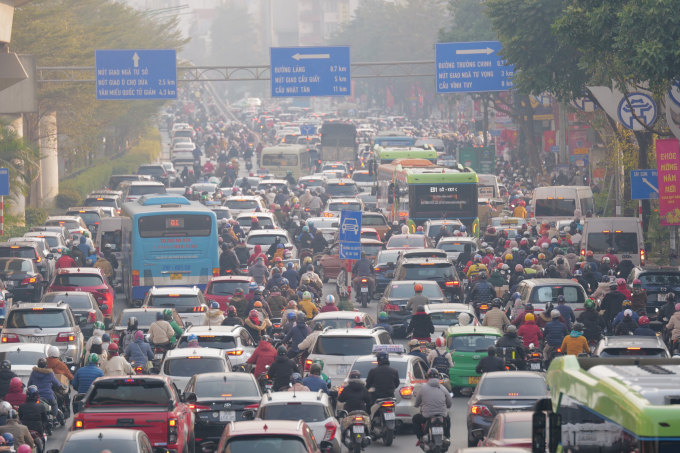
Traffic congestion in Hanoi on January 30th, as people returned to work after the Lunar New Year (Year of the Rabbit 2023). Photo: Ngoc Thanh
To solve the traffic congestion problem in Hanoi and Ho Chi Minh City, Mr. Thang suggested strict management and control of urban planning in relation to population size. "If urban planning is not well controlled, and high-rise apartment buildings and urban areas continue to spring up in the city center, the risk of congestion will persist," Mr. Thang said.
He suggested that when planning urban areas, cities should pay attention to the area allocated for transportation, noting that Hanoi and Ho Chi Minh City need 16-26% of their land for transportation infrastructure but have only achieved 8-9%. The land allocated for parking lots is also very limited.
Developing public transportation is also a necessary solution. Most major cities around the world prioritize the construction of public transportation routes. The Ministry of Transport has coordinated with Hanoi and Ho Chi Minh City to accelerate the construction of urban railway lines.
"I am very surprised by the performance of the Cat Linh - Ha Dong railway line after 19 months of operation," Mr. Thang said, noting that statistics show 31,000-33,000 passengers use the line daily, reaching up to 50,000 passengers per day during peak periods. With a frequency of 6 minutes per train, the line has contributed to reducing traffic congestion in Hanoi. For the first time, the project management board reported a profit of 100 billion VND; 80% of passengers purchase fixed-price tickets.
In the coming period, the transportation sector will accelerate the progress of urban railways and focus on developing bus routes. The Ho Chi Minh City Ring Road 3 and the Capital Region Ring Road 4 must also be implemented decisively to quickly create bypasses, expand space, and reduce the volume of vehicles passing through the inner city.
The minister stated that Beijing (China) has implemented regulations allowing vehicles to enter the city center on alternate days (even and odd days) to reduce traffic congestion. However, in Vietnam, similar solutions are still under discussion.

Minister of Transport Nguyen Van Thang answers questions before the National Assembly on the morning of June 8th. Photo: National Assembly Media
Concluding the questioning session with Minister Nguyen Van Thang, National Assembly Chairman Vuong Dinh Hue assessed that traffic congestion on major routes, key hubs, and large cities like Hanoi and Ho Chi Minh City remains complex. Therefore, he requested that relevant agencies research and implement solutions for traffic safety and congestion control from the planning stage, organizing traffic scientifically and rationally; and promoting the application of information technology in management and operation.
Traffic congestion has been a long-standing problem in Hanoi and Ho Chi Minh City, yet no effective solution has been found. At the end of May, Ho Chi Minh City planned to address 24 traffic congestion hotspots. This year, the city aims to eliminate at least one hotspot at the Kênh Xáng bridge area on Trần Văn Giàu road in Bình Chánh district. Besides this location, Ho Chi Minh City has 23 other congestion hotspots, many of which have remained unchanged for years.
According to a report summarizing 10 years (2012-2022) of implementing the policy to strengthen traffic safety and alleviate congestion, the Hanoi Department of Transport stated that in 2019 the city resolved 9 congestion points but 10 new ones emerged; in 2020, 8 were resolved but 11 new ones emerged; and in 2021, 10 were resolved but 8 new ones emerged.
Source link

![[Photo] Prime Minister Pham Minh Chinh receives the Governor of Tochigi Province (Japan)](/_next/image?url=https%3A%2F%2Fvphoto.vietnam.vn%2Fthumb%2F1200x675%2Fvietnam%2Fresource%2FIMAGE%2F2025%2F12%2F16%2F1765892133176_dsc-8082-6425-jpg.webp&w=3840&q=75)
![[Image] Leaked images ahead of the 2025 Community Action Awards gala.](/_next/image?url=https%3A%2F%2Fvphoto.vietnam.vn%2Fthumb%2F1200x675%2Fvietnam%2Fresource%2FIMAGE%2F2025%2F12%2F16%2F1765882828720_ndo_br_thiet-ke-chua-co-ten-45-png.webp&w=3840&q=75)

![[Photo] Prime Minister Pham Minh Chinh receives Lao Minister of Education and Sports Thongsalith Mangnormek](/_next/image?url=https%3A%2F%2Fvphoto.vietnam.vn%2Fthumb%2F1200x675%2Fvietnam%2Fresource%2FIMAGE%2F2025%2F12%2F16%2F1765876834721_dsc-7519-jpg.webp&w=3840&q=75)
















































![[Photo] Prime Minister Pham Minh Chinh attends the Vietnam Economic Forum 2025](https://vphoto.vietnam.vn/thumb/402x226/vietnam/resource/IMAGE/2025/12/16/1765893035503_ndo_br_dsc-8043-jpg.webp)




























Comment (0)