



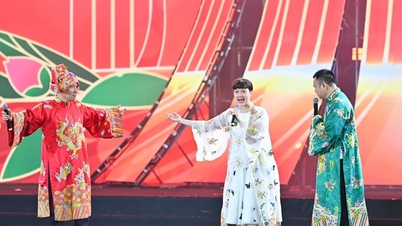
Teacher Ho Thi Do, from Son Thuy Primary School (Son Thuy commune), with her Mong ethnic minority students during a cultural performance at the school.
Late in the afternoon in Pom Khuong village, Tam Chung commune, mist lingered in front of the house as Ms. Ho Thi Mi went to check on her family's breeding cows. Four breeding cows – the family's biggest asset – had returned to the barn. Few people know that just a few years ago, her family was still classified as a poor household, their lives revolving around farming, and capital or business plans were completely foreign concepts. "Before, I was afraid of borrowing money and not being able to repay it, afraid of not succeeding. Women only knew how to follow their husbands," Ms. Mi confided.
In Pom Khuong and many other Hmong villages in the mountainous, border areas of Thanh Hoa province, stories like Ms. Mi's are not uncommon. Lack of information, fragmented production, and outdated customs such as child marriage and patriarchal attitudes have kept women confined to the kitchen. They rarely discuss business matters or make major family decisions. This silence has lasted for generations, until community outreach programs began reaching every village. Through Project 8 – “Implementing Gender Equality and Addressing Urgent Issues for Women and Children,” Ms. Mi and many other women in Pom Khuong village were able to hear, ask questions, and talk about things they previously thought were outside their concern. These changes in awareness gradually translated into concrete actions. Following these outreach sessions, she boldly took out a 50 million VND loan from the Social Policy Bank to buy breeding cows. Officials guided her on how to grow grass, vaccinate, and care for the herd. Some people told her she was reckless, but she just smiled and said that if she didn't try, she would remain poor forever.
By the end of 2023, the cattle herd was thriving. In early 2024, her family applied to be removed from the poverty list. For a Hmong woman, this was not just an economic change, but a step towards overcoming herself, her fears, old habits, and even deeply ingrained prejudices. It also signaled the formation of a new mindset in Pom Khuong.
While Ms. Mị's story is a journey of escaping poverty through a change in production mindset, daring to think and act, in Cá Nọi village, Pù Nhi commune, the story of Hmong teacher Hơ Thị Dợ is a journey of preserving literacy in the face of the heavy burden of outdated customs of child marriage and consanguineous marriage.
During her school years, while many of her peers dropped out to get married, Dợ continued to trek through the forest to school every day. “Sometimes my family urged me to go to school, because I was a grown woman. But I thought, if I quit, I’ll spend my whole life confined to the village,” Dợ recounted. This very thought helped her remain steadfast in her pursuit of education. Growing up amidst the constraints of outdated customs, Dợ understood their weight better than anyone else. From a young age, she repeatedly heard the unspoken law of the village: Hmong women must marry Hmong women, and grown-up girls must marry early. For Dợ, giving up would mean her future would be cut short at the threshold of youth.
While still in high school, Dợ joined the Party. For a Hmong woman in the highlands, this was not only a source of pride but also a reminder of her responsibility to do something to prevent the children in her village from repeating the cycle of dropping out of school and marrying early, as in the previous generation. After graduating from university, Dợ chose to return to work at Sơn Thủy Primary School, staying in the mountains to dedicate herself to her students. It was there that she met and fell in love with Phạm Văn Đức, a Kinh man. Dợ's wedding was held according to modern, civilized, and simple customs.
From Pom Khuong to Ca Noi, from petitions to escape poverty to the decision to say no to child marriage, the journey of transformation for Mong women in the highlands of Thanh Hoa is unfolding quietly but persistently. When women dare to change their mindset and way of doing things, the villages also gradually transform, and no one is left behind.
Text and photos: Tang Thuy
Source: https://baothanhhoa.vn/hanh-trinh-doi-thay-cua-phu-nu-mong-273403.htm














































Comment (0)