

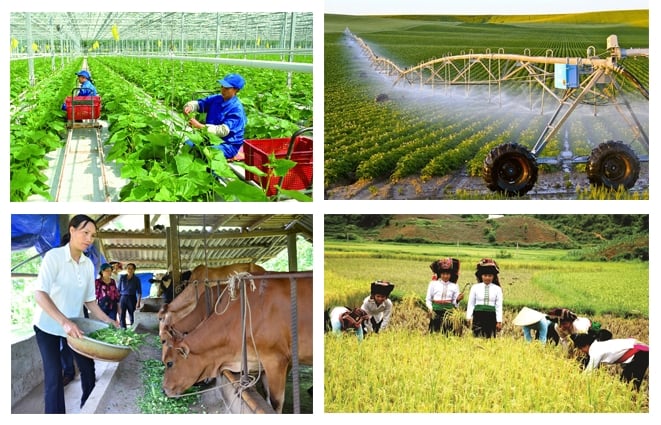
After more than 3 years of implementing Resolution No. 19-NQ/TW, dated June 16, 2022 of the 13th Party Central Committee on agriculture, farmers and rural areas to 2030, with a vision to 2045, many positive results have been achieved, which are important in ensuring food security, macroeconomic stability, economic growth; improving the lives of people in rural areas. Besides, there are still many limitations and weaknesses such as: Unsustainable growth in the agricultural sector, low productivity, quality and competitiveness of some products; many stages in agricultural production have not yet deeply applied achievements in science and technology, innovation, digital transformation, green transformation; the income of most farmers is still low and subject to many risks due to natural disasters, epidemics and market fluctuations; human resources working in the agricultural sector and in rural areas are both lacking and weak; Environmental pollution in rural areas is slowly being remedied, and in some places it is even increasing at a serious level...
In the context of a rapidly changing world, strong development of science and technology, climate change, increasingly complex market developments, and great impacts on agricultural and rural development, in order to promote the achieved results and overcome limitations and weaknesses, the Politburo requests Party committees, Party organizations, authorities, state management agencies, the Vietnam Fatherland Front, socio-political organizations, and unions at all levels to continue to thoroughly grasp and resolutely implement the tasks and solutions stated in Resolution No. 19-NQ/TW; at the same time, focus on leading and directing the good implementation of the following key tasks:
1. Continue to identify agriculture, farmers (including fishermen and salt farmers), and rural areas as having a long-term strategic position, as an important foundation to ensure macroeconomic stability and sustainable growth, in which farmers are the center, the subject, the driving force, and the resource of the innovation process; strongly shift to commodity production thinking, promote restructuring towards developing green, organic, circular, low-emission agriculture, protecting the ecological environment; apply high technology, comprehensive digital transformation; promote the potential and advantages of each region and locality. Agriculture must ensure food security in all situations, contributing to ensuring major balances of the economy, stabilizing the macro economy, and controlling inflation. Closely link agricultural, farmer, and rural development with urban development, ensuring synchronization with the effective operation of local governments at two levels.
2. By 2026, basically complete the review and full and timely institutionalization of the Party's policies and orientations into laws and guiding documents, ensuring long-term harmony of interests between the State, enterprises and farmers, creating new momentum for agricultural, farmer and rural development, supporting the restructuring of the sector, promoting new rural construction. Have breakthrough policies to attract and mobilize the strength of people and enterprises to invest in green, ecological agriculture, circular economy and support enterprises, economic organizations and people in strategic areas, remote areas, and "fence" areas of the Fatherland. Research on preferential mechanisms, incentives and promotion of the "agricultural export" process to improve market access, competitiveness, added value, prestige and position of the country.
Prioritize investment, testing, and piloting of outstanding mechanisms and policies for agricultural production models based on high science and technology, innovation, digital transformation, green development, and climate change adaptation in all stages of production, preservation, processing, logistics, and trade; consider this a key driving force for rapid and sustainable development of agriculture, rural areas, resource management, and environmental protection.
3. Build a multi-sector cooperation mechanism and industry chain. Restructure crops, livestock, and products to suit market demand and the advantages of each locality; develop an agricultural economic ecosystem according to a multi-value chain including processing industry, services, tourism, and low-carbon economy. Plan and protect specialized land areas for high-yield, high-quality rice cultivation. Plan and develop brands for strategic, key industries; specialized areas according to sustainable, low-emission standards; apply science and technology, processing industry, modern logistics services, and ensure product/service quality control.
Reorganize production towards specialization and professionalism, promote close linkages between the "6 houses". Promote research cooperation and technology transfer between enterprises, cooperatives, farmers and schools and research institutes. Effectively protect, manage and exploit intellectual property rights in the agricultural sector.
Support the development of agricultural enterprises, by 2030 there will be a number of strong agricultural enterprises leading the region and the world, leading deep participation in the global value chain, building national brands for key products. Encourage and create conditions for farming households to participate in developing cooperatives, cooperative groups, associations, industry and trade organizations to produce large-scale goods in the chain. Have solutions to improve the efficiency of household and farm economic development.
Building a unified database system on land, water, forests, minerals, hydrometeorology, biodiversity, etc. Synchronously implementing solutions to protect, develop and exploit aquatic resources sustainably, legally, in accordance with international standards and practices, associated with protecting sovereignty over seas and islands; promoting the development of aquaculture at sea, ensuring safety during storms, researching and expanding the application of aquaculture technology in far-off seas; having a mechanism to encourage the formation of ocean fishing fleets. Developing forestry economy, effectively exploiting the multi-use value of forest ecosystems.
Build a market information system to serve management and provide practical support for businesses, cooperatives and people. Proactively integrate internationally, make the most of new-generation free trade agreements and international cooperation mechanisms to promote trade, expand and diversify export markets for agricultural products. Adjust trade policies flexibly and effectively, in accordance with market fluctuations. Pay attention to and consolidate the domestic market; review, improve and upgrade agricultural product standards and regulations towards gradually approaching international standards to better serve both domestic people and exports.
4. Support training and technology transfer so that farmers gradually form a mindset of large-scale, professional, and modern commodity economic production; widely apply scientific and technological achievements in production, harvesting, preservation, and processing; have digital knowledge and skills, especially e-commerce; proactively adapt to market fluctuations, natural disasters, and epidemics; have a sense of responsibility and cooperation for mutual development. Effectively implement policies to support farmers in accessing capital, green credit, and agricultural insurance; create conditions for farmers to participate in creative startups, develop service and industrial sectors in rural areas, and integrate into new value chains. Prioritize human resource training for remote, isolated areas, ethnic minority areas, coastal areas, and islands.
5. Building a modern, rich, unique and sustainable new countryside. Perfecting the criteria for building a new countryside in accordance with the current provincial and communal levels. Focusing on building and implementing the urban and rural planning system, ensuring close connectivity, harmonious and reasonable complementarity, protecting the ecological environment ("village in the city, city in the village"), linking domestic and international value chains, in accordance with the national cultural identity, opening up more space and new resources for development.
Narrow the development gap between regions and population groups, ensure social security and gender equality; improve income, quality of life and access to services for people in rural areas. Promote the role of farmers as the center and subject in building new rural areas, deeply participating in the planning process and sustainable development. Increase resources to ensure security and order, create a safe and stable environment in rural areas.
6. Focus on investing in building and completing the agricultural, rural, irrigation, natural disaster prevention and control, and environmental protection infrastructure system in sync with other strategic infrastructures in a modern, multi-purpose direction; strive to increase state budget investment for agriculture and rural areas in the 2021-2030 period by at least twice that of the 2011-2020 period. Review and evaluate in conjunction with specific regulations on tasks and authority between the provincial and communal levels to effectively implement national target programs to ensure no overlap or omission, better serving the people and rural communities.
7. Harmoniously resolve the relationship between agricultural and rural development and ecological environment protection, resource management, and proactive response to climate change. Strengthen environmental protection to develop increasingly green, clean, beautiful, modern, and civilized rural areas; promote the collection and treatment of garbage and hazardous waste; resolutely handle pollution of rivers and riverbanks; strengthen regulation and restoration of river, lake, and mangrove ecosystems. Improve the capacity to forecast and warn of weather, incidents, and disasters to proactively adapt, prevent, and minimize damage to agricultural production and people's lives.
8. Implementation organization
- Assign the National Assembly Party Committee to coordinate with the Government Party Committee to lead and direct the review and completion of the legal system, mechanisms and policies for agricultural, farmer and rural development.
- Assign the Government Party Committee to lead and direct the development of the implementation program and organize its implementation, prioritizing the allocation of sufficient resources to carry out the tasks and solutions of Resolution No. 19-NQ/TW and this Conclusion.
- Assign provincial Party Committees, municipal Party Committees, Party Committees directly under the Central Committee, and Central Party Committees to organize research, dissemination; develop leadership programs and plans, and direct the organization to well implement Resolution No. 19-NQ/TW and this Conclusion; regularly urge, inspect, supervise and periodically report to the Politburo.
- The Central Propaganda and Mass Mobilization Commission shall preside over and coordinate with relevant agencies to organize propaganda, dissemination and implementation of this Conclusion.
- Assign the Party Committee of the Fatherland Front, Central mass organizations, and socio-political organizations to strengthen leadership and direction to promote the role of social supervision and criticism, participate in the development of laws, mechanisms, and policies; and mobilize people of all walks of life to actively implement Resolution No. 19-NQ/TW and this Conclusion.
- The Central Committee for Policy and Strategy shall preside over and coordinate with the Government Party Committee and relevant agencies to regularly monitor, urge, inspect, supervise, periodically review and summarize Resolution No. 19-NQ/TW and this Conclusion, and report to the Politburo.
Download Conclusion No. 219-KL/TW here
Source: https://dangcongsan.org.vn/xay-dung-dang/ket-luan-cua-bo-chinh-tri-ve.html


![[Photo] Prime Minister Pham Minh Chinh receives President of Cuba's Latin American News Agency](/_next/image?url=https%3A%2F%2Fvphoto.vietnam.vn%2Fthumb%2F1200x675%2Fvietnam%2Fresource%2FIMAGE%2F2025%2F12%2F01%2F1764569497815_dsc-2890-jpg.webp&w=3840&q=75)
































































Comment (0)